On April 25, 1824, Gustave Clarence Rodolphe Boulanger was born in Paris — a painter who would make the ancient nude feel startlingly modern, and whose work would scandalize the very institution that trained him.
Boulanger is best remembered as one of the founding figures of the Néo-Grec movement in French art, alongside his lifelong friend Jean-Léon Gérôme. Where earlier generations of academic painters treated the Classical world with reverence and solemnity — marble-white nudes frozen in noble poses — Boulanger and the Néo-Grecs brought something far more dangerous to their antiquity: pleasure.
The Néo-Grec Revolution
The Néo-Grecs didn’t just revisit the Classical tradition — they subverted it. As one contemporary critic observed, the movement’s artists “rarely give an orthodox image of Antiquity,” choosing instead “licentious subjects,” parodying mythological characters, and inventing “very personal allegories of Antiquity.”
This was a profound shift in how the nude body appeared in French painting. The Academy had long insisted that the nude serve grand sujet — heroic, moral, educational. Boulanger’s nudes were something else entirely: tactile, knowing, and unmistakably sensual. They didn’t teach virtue; they invited the viewer into a world of pleasure.
Phryné and the Scandal of the Particular
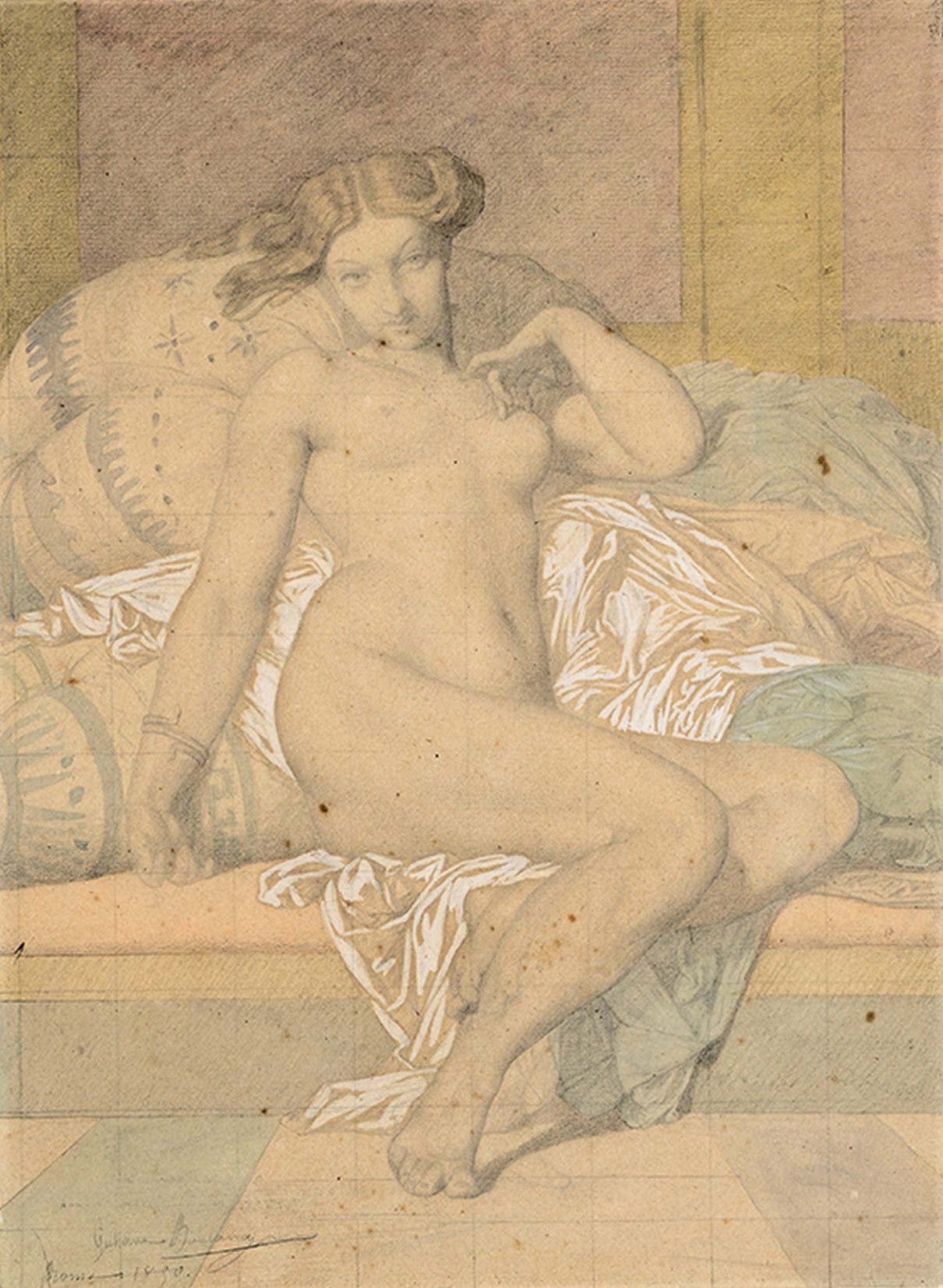
In 1850, as a first-year pensionnaire at the French Academy in Rome, Boulanger sent back his required annual painting: Phryné. The subject was the most famous courtesan of ancient Greece — the woman whose beauty inspired Praxiteles to create the Aphrodite of Cnidus, the first monumental nude sculpture of a goddess.
The Academy was appalled. One reviewer wrote that Boulanger had painted “a fat naked woman with red hair and slanted blue eyes, seated on rags of all colors.” The critic’s objection was not merely aesthetic — it was ideological. To paint Phryné as a particular, embodied woman rather than an ideal of beauty was to violate the entire premise of academic Classicism. The nude, in the Academy’s view, should transcend the body. Boulanger’s Phryné was a body — specific, flawed, undeniably alive.
This tension between the ideal and the particular is one of the central dramas of the nude in Western art. Every era negotiates it differently: the Greeks idealized, the Romantics emotionalized, the Modernists fragmented. Boulanger’s contribution was to make the nude domestic — to place it not in the realm of myth but in the realm of everyday ancient life, where desire was not a philosophical abstraction but a fact of the household.
The Body as Architecture
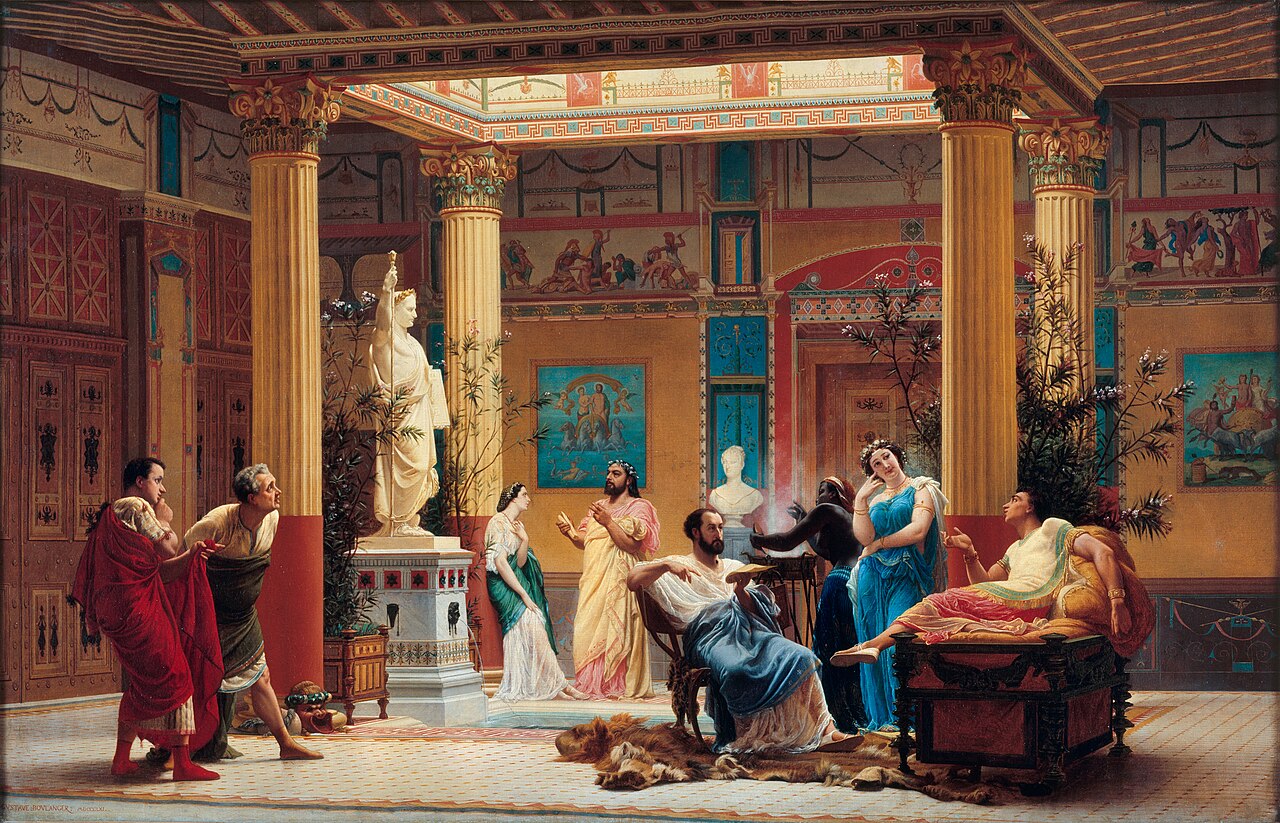
Boulanger’s masterwork, Répétition du “Joueur de flûte” et de la “Femme de Diomède” (1861), now in the Musée d’Orsay, demonstrates this principle at full scale. The painting depicts a rehearsal of two theatrical works in the Pompeiian palace of Prince Napoléon — a real event that Boulanger witnessed and documented.
What makes the painting revolutionary is its layered approach to the body. The performers wear classical costumes that reveal and conceal in equal measure. The architecture itself — the atrium, the shallow pool, the frescoed walls — frames the body as part of a total aesthetic environment. In Boulanger’s Néo-Grec vision, the nude is not an isolated object of contemplation; it is inseparable from the fabric of daily life, from the spaces people inhabit, from the pleasures they pursue.
Pompeii and the Archaeological Nude
Boulanger’s time at the excavations of Pompeii was decisive. Unlike earlier painters who imagined antiquity through literary sources alone, Boulanger could walk through actual Roman rooms, see the frescoes in situ, and study the domestic spaces where ancient bodies lived and moved.
This archaeological grounding gave his nudes a specificity that purely imaginative Classicism could never achieve. His figures don’t float in golden light; they stand on tiled floors, lean against real columns, inhabit spaces that have a documented physical reality. The nude, in Boulanger’s hands, becomes a form of knowledge — a way of understanding how ancient people actually experienced their bodies.
Why Boulanger Matters Now
Boulanger died in 1888, dismissed by one critic as “a very mediocre painter” who “taught better than he painted.” History has been unkind to the Néo-Grecs in general, overshadowed as they were by the Impressionists and the broader march of Modernism.
But Boulanger’s project — making the nude a vehicle for sensuality, specificity, and lived experience rather than abstract idealism — anticipates debates that remain urgent today. When we argue about whether a nude is “art” or “exploitation,” we are still negotiating the terrain Boulanger mapped: the relationship between the body as ideal and the body as it actually exists, between the nude as symbol and the nude as someone’s particular, irreducible flesh.
His Phryné, scandalous in 1850, now looks like a remarkably honest painting — one that treats its subject as a person rather than a proposition. That refusal to idealize, that insistence on the particular body, is what makes Boulanger worth revisiting on the 202nd anniversary of his birth.
All images in this post are public domain via Wikimedia Commons. Featured image: Gustave Boulanger, Phryné, c. 1850.