Mary Cassatt Was Born 182 Years Ago Today. She Gave the Female Nude Back to Women.
When Mary Cassatt walked into the 1890 exhibition of Japanese ukiyo-e prints at the École des Beaux-Arts in Paris, something clicked. She was 46 years old, the only American woman ever invited to exhibit with the French Impressionists, and already a master of the “mother and child” scenes that would define her legacy. But what she saw in those woodblock prints — the flat planes, the unexpected cropping, the intimate domestic scenes rendered without sentimentality — unlocked something she’d been reaching toward her entire career: a way to paint the female nude that didn’t belong to men.
Born on May 22, 1844, in Allegheny City, Pennsylvania, Cassatt spent most of her adult life in France, fighting to be taken seriously in an art world that dismissed women as dilettantes. Her 182nd birthday is a good moment to reckon with what she actually did — not just paint sweet mothers with babies, but quietly, radically, reclaim the female body for the female gaze.
The Female Nude Through a Woman’s Eyes
Before Cassatt, the female nude in Western art had a single audience: men. From Titian’s Venus of Urbino to Manet’s Olympia, the nude woman on canvas existed to be looked at — by the painter, by the collector, by the imaginary male spectator standing just outside the frame. Even the Impressionists, for all their revolutionary brushwork, mostly kept this arrangement intact. Degas painted women at their bath as if they didn’t know they were being watched. Renoir painted nudes like cream puffs.
Cassatt changed the camera angle.
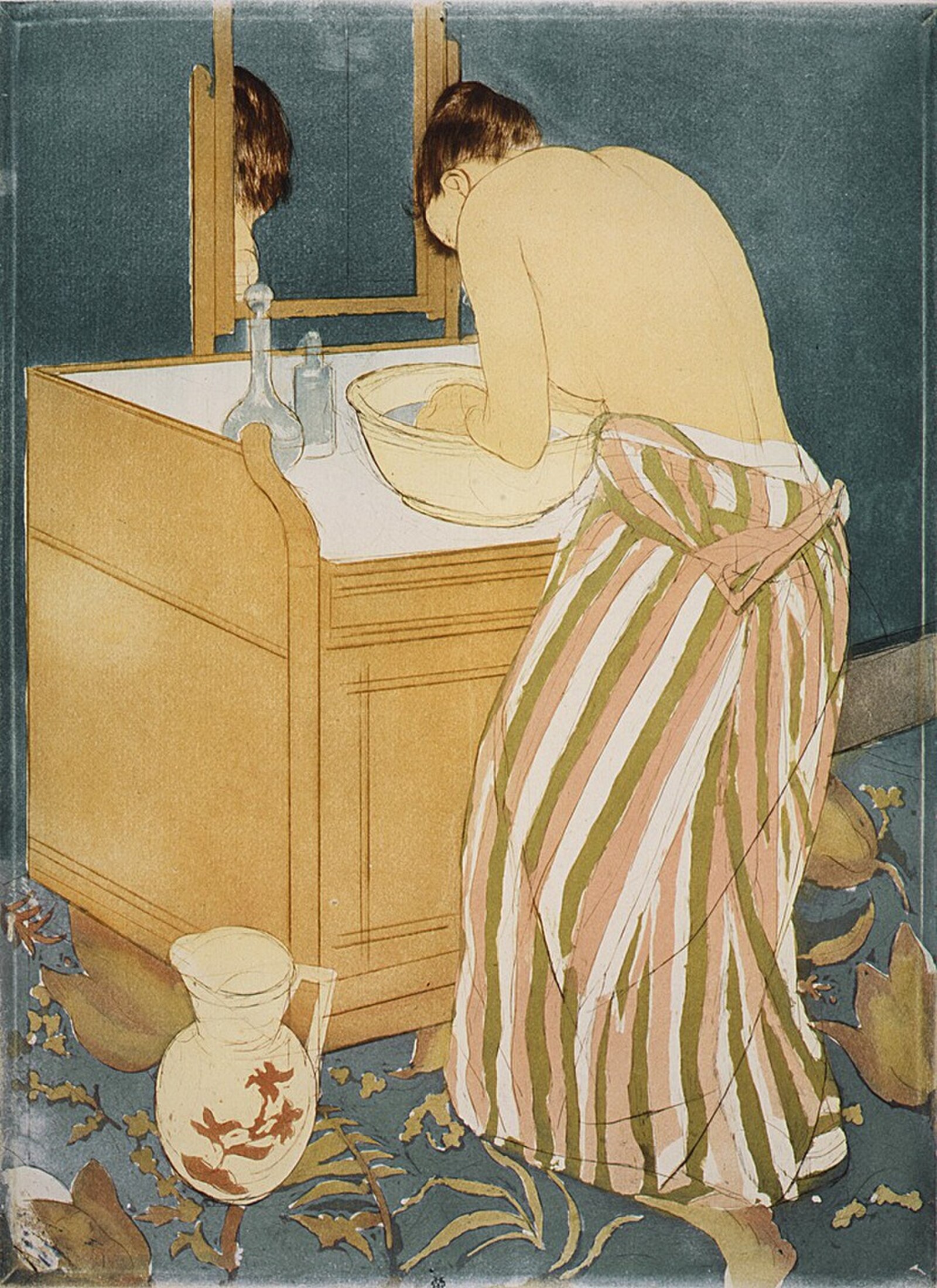
In Woman Bathing (La Toilette) — her 1891 drypoint and aquatint — a woman sits at her bath, her dress slipped down to her waist, her back to the viewer. But this isn’t a voyeuristic setup. The woman isn’t performing nudity for anyone. She’s washing. The tilt of her head, the curve of her shoulder, the towel in her hand — all of it belongs to her private ritual, not to a spectator. Cassatt borrowed the flat, decorative patterning of Japanese prints to flatten the erotic charge into something more like a meditation on daily life.
The radical thing about Cassatt’s nudes is that they don’t announce themselves as nudes. There’s no mythological title, no classical allegory to justify the bare skin. Just a woman, bathing, because bathing is what women do.
The Motherhood Nude: A Different Kind of Body
Cassatt’s most famous subject — mothers with children — is usually discussed in terms of tenderness and maternal affection. But look closer. These are also nude paintings, just not the kind the Western canon trained us to see.
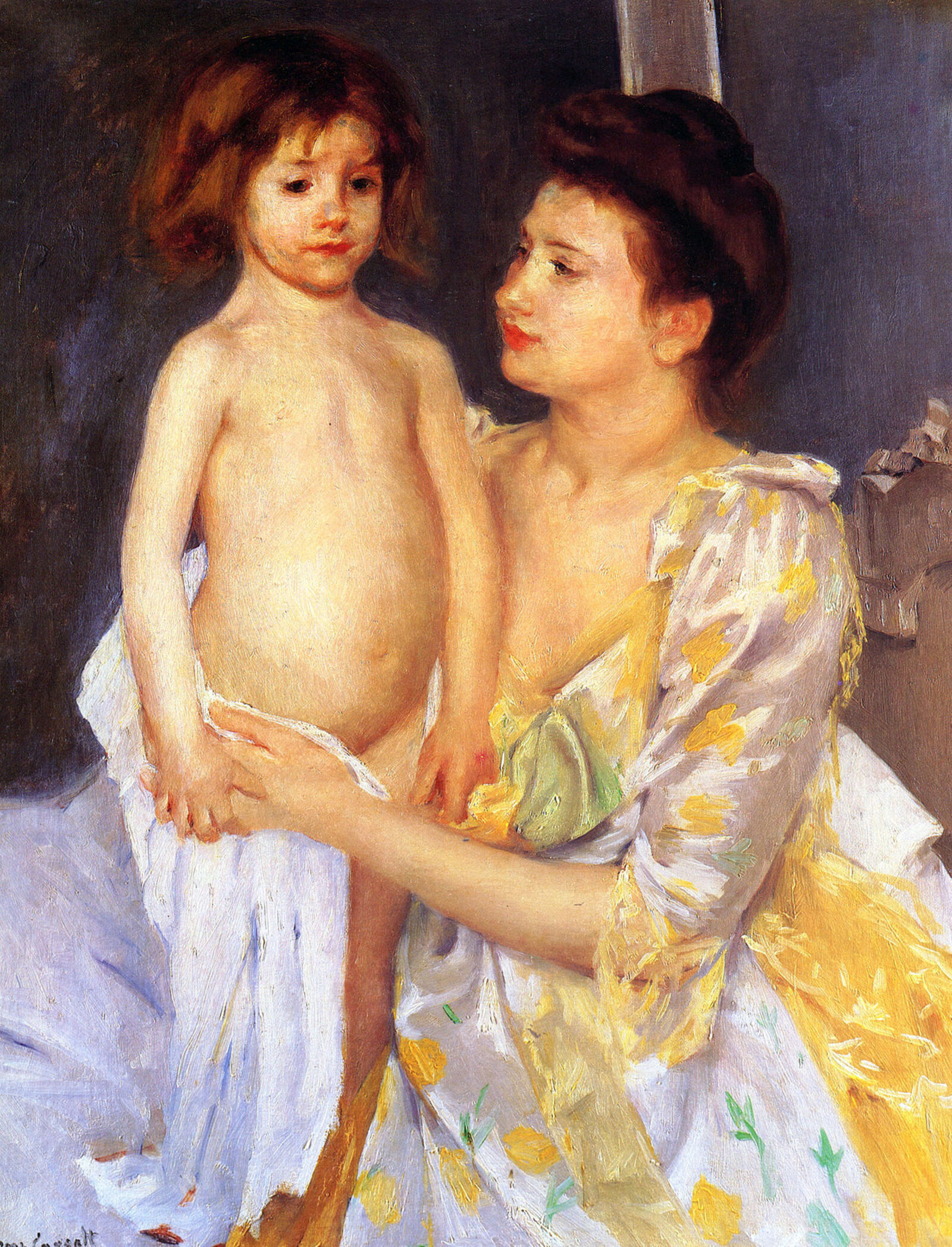
In Jules Being Dried by His Mother (1900), the child’s body is entirely bare, his mother’s hands firm and practical as she wraps him in a towel. The nudity here isn’t idealized — it’s the warm, physical reality of caring for another human being. Cassatt painted bodies that sweat, bodies that need washing, bodies that are held and dried and dressed. It was a kind of intimacy that no male painter of her era could access, because they weren’t in the room.
And this is the point Cassatt makes across her entire body of work: the nude doesn’t have to be mythological or erotic to be art. It can be domestic. It can be ordinary. It can be seen the way a mother sees her child, or a woman sees herself in the mirror.
Why Cassatt Still Matters in 2026
We’re living through another reckoning with who gets to depict the nude body and how. Social media platforms censor classical paintings while allowing exploitative content. Museums are reconsidering their collections through the lens of the male gaze versus the female gaze. The question Cassatt answered in 1891 — What does it look like when a woman paints a woman? — is still one of the most urgent questions in visual culture.
Cassatt died in 1926 at the Château de Beaufresne outside Paris, nearly blind from cataracts, having outlived most of her Impressionist peers. She was buried in the family vault at Le Mesnil-Théribus, her legacy largely reduced to “the painter of mothers and babies.” It’s a condescending reduction. The mothers and babies were a Trojan horse — a way to put the female nude in front of audiences who would have rejected it if she’d called it what it was.
She painted bodies the way women actually experience them: not as objects to be desired, but as vessels to be lived in, washed, dried, held, and loved.
Explore more of art history’s untold stories at Nude Art Los Angeles. Get involved in LA’s figure drawing and nude art community.