On May 31, 1919, Pierre-Auguste Renoir died at his home in Cagnes-sur-Mer, France. He was 78 years old. In the months before his death, he still painted every day — his arthritic hands wrapped in bandages, brushes strapped to his fingers. The man who had once declared “I think I’m beginning to understand something about painting” never stopped working. And the subject he returned to, again and again, was the female nude.
The Painter of Happiness
Renoir is often dismissed as the “painter of happiness” — a label that sounds like a compliment but functions as a dismissal. The implication is that his work is simple, pleasurable, uncomplicated. That he just painted pretty women in pretty light, and that’s all there was to it.
This is wrong. Renoir’s nudes are not simple. They’re the result of a decades-long wrestling match with the entire history of European painting — a fight to find a way of rendering flesh that felt alive rather than embalmed.
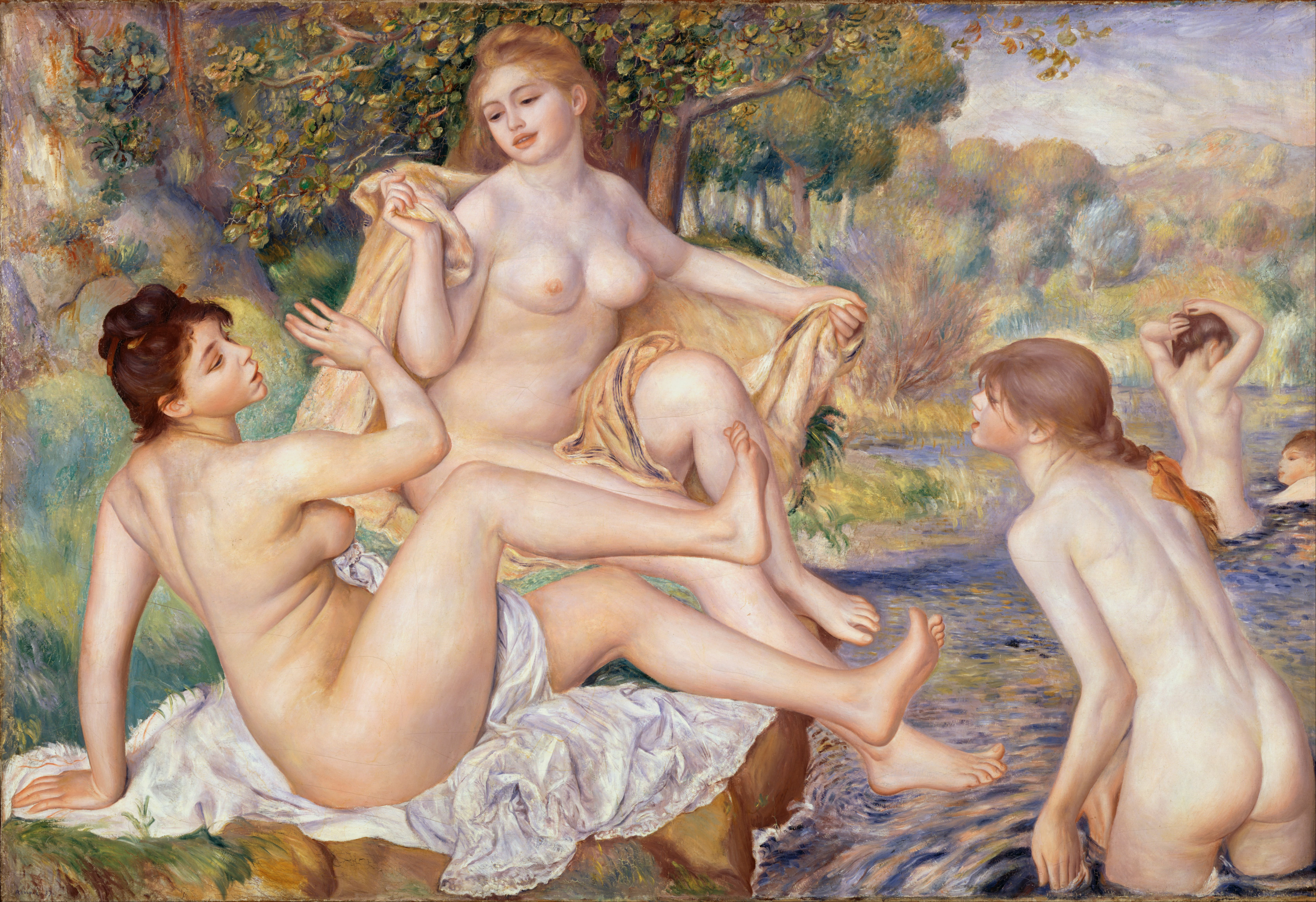
When you look at Les Grandes Baigneuses (1884–1887), now in the Philadelphia Museum of Art, you’re looking at a painting that took three years to complete. Renoir ripped it apart and started over more than once. Those bathers — those soft, rounded women lounging by the water — are the product of intense formal struggle. The composition borrows from François Boucher’s 18th-century rococo, but Renoir’s handling of light is something no 18th-century painter had ever attempted. The light in this painting doesn’t just illuminate the figures. It becomes them.
The Body as Landscape
Renoir’s great innovation was to paint the nude body the way the Impressionists painted landscapes. In the same way Monet chased light across haystacks and cathedrals, Renoir chased it across skin. The traditional academic nude — from Ingres to Bouguereau — was a polished, porcelain surface. The skin was smooth, the contours precise, the lighting theatrical. Renoir broke all of that open. His nudes are dappled. The light hits their bodies in patches, filtered through leaves, reflected off water. The skin is not a surface — it’s a relationship between light and form.
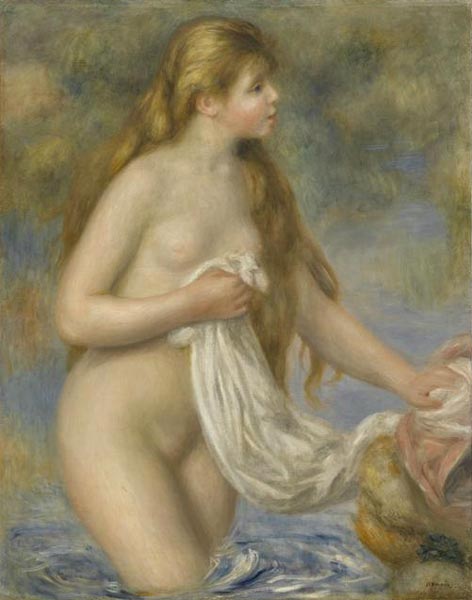
You can see this most clearly in Baigneuse aux cheveux longs (c. 1895). A woman sits at the edge of water, her long hair falling across her back. The brushwork is loose, almost sketchlike in places. Her back is not outlined — it’s suggested by the warm light gathering on her skin against the cooler tones of the water behind her. Renoir understood something fundamental about how we actually see the human body: not as a crisp contour, but as a volume of light.
The Rejection of Shame
There’s something else in Renoir’s nudes that sets them apart from his predecessors and contemporaries: the complete absence of shame. The women in Renoir’s paintings are never caught off guard, never modestly averting their gaze, never covering themselves. They simply are — unselfconsciously present in their own bodies.
This was a radical choice. The 19th-century nude was a heavily coded genre. Even Manet’s Olympia (1863), for all its confrontational modernity, gave its subject a challenging stare — a recognition that the nude body was a battleground of gazes. Renoir’s bathers don’t fight. They don’t need to. They exist in a world where the female body is not a problem to be solved or a scandal to be managed, but simply a beautiful fact of existence.
The Bather (c. 1888), now at the Dallas Museum of Art, shows this perfectly. A young woman kneels by the water, wringing out her hair. Her body is compact, solid, real. She’s not a goddess or a nymph. She’s a woman who was swimming and now she’s drying off. There’s no mythology, no allegory, no excuse. Just a body, caught in an ordinary, intimate moment.
The Accusation of Sentimentality
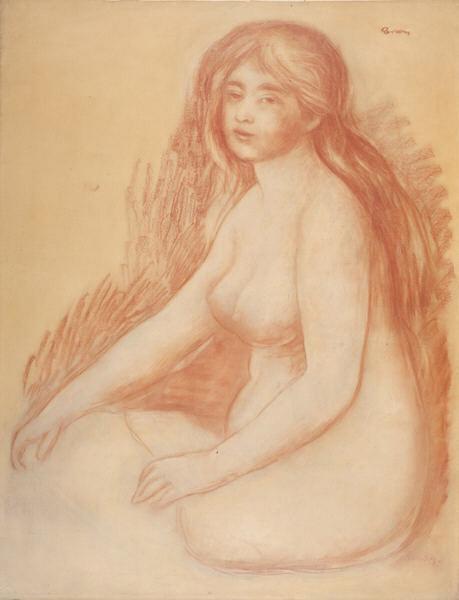
It would be dishonest to pretend Renoir is uncontroversial. His nudes have been criticized — fairly — for presenting a narrow, idealized vision of the female body. His bathers are always young, always white, always conventionally beautiful in a soft-focus, late-19th-century way. The feminist critique that Renoir’s nudes serve the male gaze is not wrong.
But it’s also not the whole story. Renoir painted women with a tenderness that his male contemporaries rarely mustered. Compare his bathers to Degas’s — where Degas often caught his subjects in awkward, unguarded, almost voyeuristic postures (the woman stepping out of the bath, seen from behind, unaware), Renoir’s women are with the viewer, not performing for them. There’s a warmth to his gaze that complicates the simple “male gaze” reading. These are not women displayed for consumption. They’re women who are comfortable in their skin, painted by a man who clearly loved looking at them.
Renoir himself said: “The nude should be painted not like a dead thing, but like a living, moving, breathing form.” He meant it. His nudes breathe.
The Late Work: Painting Through Pain
Renoir’s final years are almost unbearably moving. Crippled by rheumatoid arthritis, his fingers frozen into claws, he painted through excruciating pain. His nurses would strap brushes to his hands. The late nudes — the ones from 1910 to 1919 — are monumental in a way his earlier work never was. The bodies become larger, more sculptural, more timeless. You can feel Renoir pushing past the limits of his own body to celebrate the bodies of others.
In 1912, art dealer and friend Ambroise Vollard visited Renoir at Les Collettes, his home in the south of France. He found the old painter in a wheelchair, brushes taped to his deformed hands, painting a monumental nude. “I am just beginning to be able to paint,” Renoir told him. He was 71. He had five more years of work ahead of him.
Why Renoir Matters Now
In an art world that often prizes conceptual difficulty over visual pleasure, Renoir’s nudes feel almost subversive. They refuse to be difficult. They insist that beauty is not a trap or a deception — that the pleasure of looking at a human body, rendered with skill and love, is a legitimate aesthetic experience.
That’s not naive. That’s not simple. That’s one of the hardest things an artist can do — to make something beautiful without apology, without irony, without a protective layer of intellectual distance. Renoir’s nudes offer no such protection. They meet you directly, skin to eye, and ask only that you look.
One hundred and seven years after his death, that’s still a radical invitation.
Want more of the story? Nude Art LA curates the finest nude art from antiquity to the present — because the human body is the original masterpiece. Get involved.