Summer Solstice and the Nude: How Three Artists Captured the Body in Pure Light
Today is the summer solstice — the longest day of the year. For artists, this day has always meant something specific: it’s the day the light is most abundant, most present, most itself. And no subject has ever been more dependent on light than the nude human body.
Light makes the nude legible — it carves muscle from shadow, defines the curve of a hip, turns skin into a surface that reflects the world back at us. But different artists have used light in radically different ways to reveal the body. On this solstice, we look at three painters who made light and the nude inseparable — each in their own way.
Joaquín Sorolla: The Body Dissolved in Sun
Joaquín Sorolla (1863–1923) is sometimes called “the painter of light,” and for good reason. Born in Valencia on the Mediterranean coast of Spain, he spent his career doing what few artists had dared: he took the studio outdoors and let the sun do the modeling.
In paintings like Swimmers, Jávea and Children on the Beach, Sorolla paints nude and semi-nude figures not as sculptural forms but as events of light. The bodies are caught in the act of being seen — dappled with reflections from the water, half-lost in the glare of midday, their edges bleeding into the surrounding heat. A Sorolla nude doesn’t stand in the light; it’s made of light.
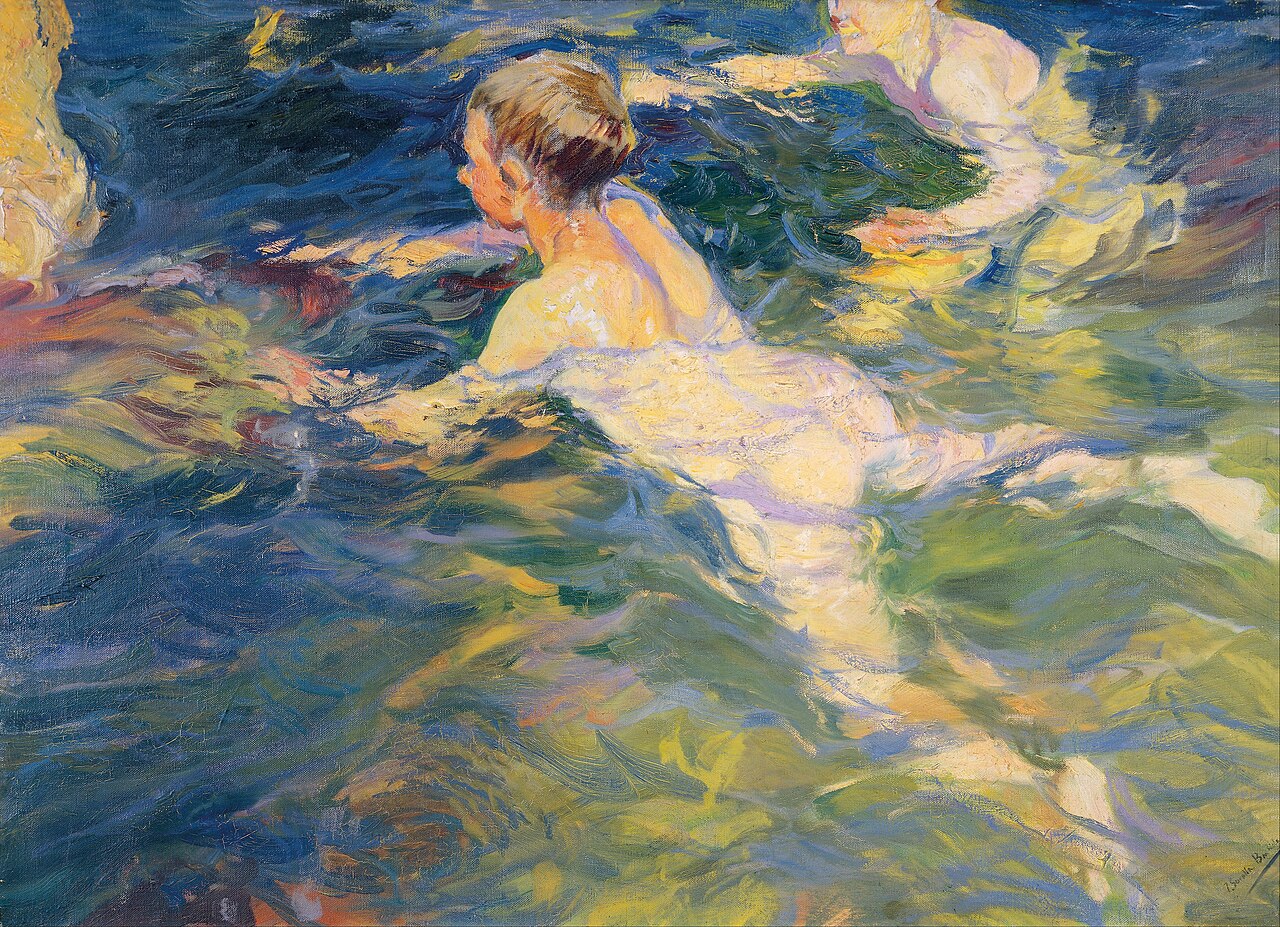
His technique was deceptively simple: thick, fast brushstrokes of pure white and yellow for the sun-struck surfaces, and violet-blue for the shadows — never black. The result is that the Valencian sun feels physically present on the canvas. When you look at his bathers, you can almost feel the heat on your own skin. The body becomes a vessel that registers the world’s brightness rather than an object to be anatomically dissected.
Sorolla understood something that seems obvious but rarely was in the history of painting: in full summer sunlight, the body is not a solid thing. It flickers, it reflects, it almost disappears. The solstice nude is a body in dialogue with its environment — not a figure on a pedestal but a figure in the world.
Paul Cézanne: The Body Built From Color
If Sorolla dissolved the body in light, Paul Cézanne (1839–1906) used light to rebuild it from the ground up. His Large Bathers series, painted in the final years of his life, is a radical departure from everything that came before.
Where Sorolla’s nudes are caught in a specific Mediterranean moment, Cézanne’s bathers exist in a kind of eternal, constructed light — a light that comes from the canvas itself rather than any sun. The bodies are built from patches of color that become form through their relationship to each other. The warm ochre of a back, the cool blue of the water, the green of a tree — none of these blend into realism; they sit side by side, and the eye does the work of assembling them into a body.
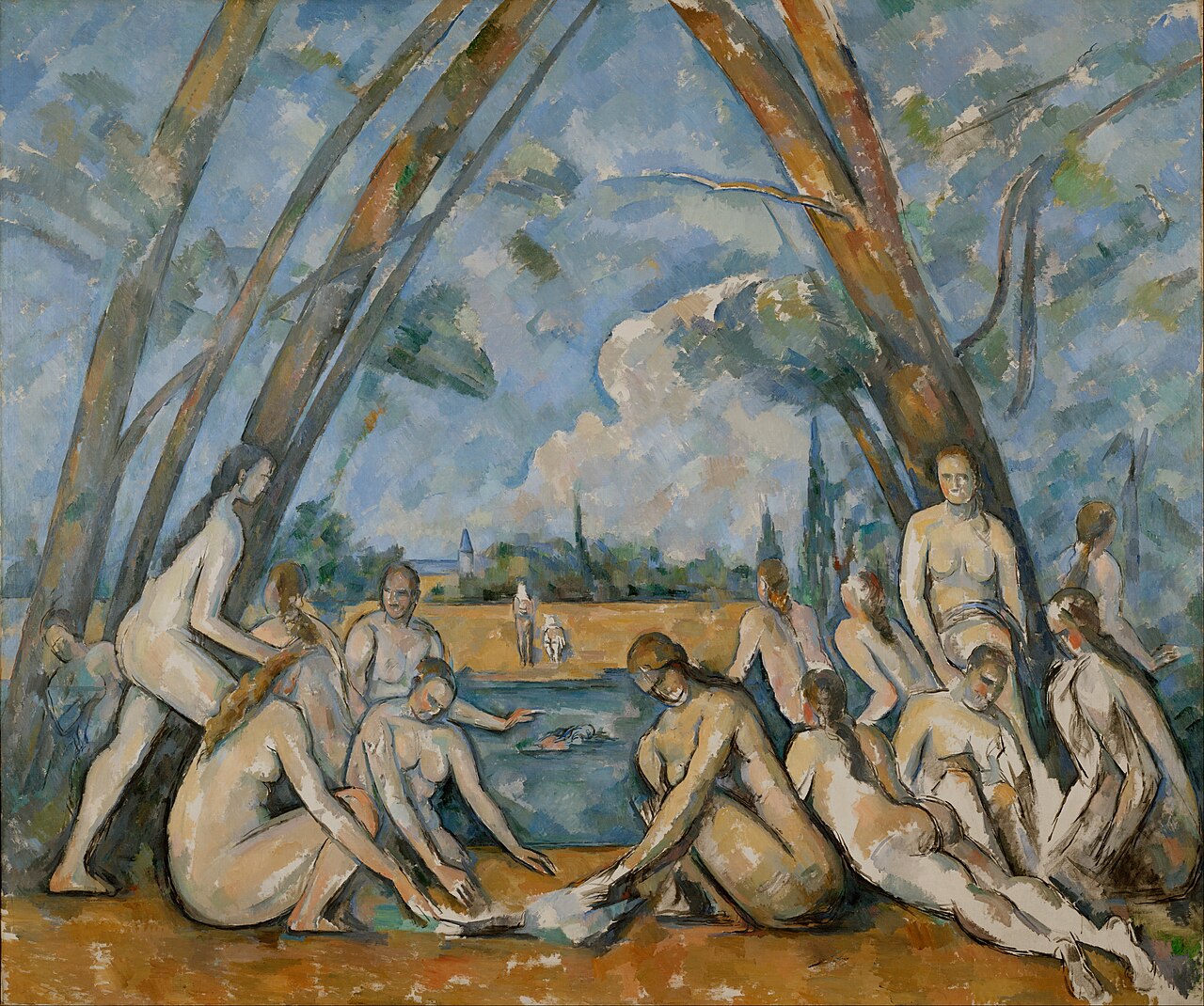
Cézanne’s great innovation was to realize that light doesn’t illuminate a pre-existing form — it creates form. His bathers have the blocky, monumental presence of architecture, but they’re built entirely from the logic of color relationships. A hip is warmer where it catches light and cooler in shadow, and that difference in temperature is what gives the figure its three-dimensionality.
The solstice quality of Cézanne’s bathers isn’t in a specific time of day — it’s in the sense that the light has been distilled into pure painterly structure. These are bodies that don’t need the sun because they generate their own light from within the painting’s color logic.
Henri Matisse: The Body Freed From Light Altogether
And then there’s Henri Matisse (1869–1954). In his 1905–1906 masterpiece Le Bonheur de Vivre (The Joy of Life), Matisse took the final step: he freed the nude body from natural light entirely.
The painting shows a pastoral paradise of nude figures dancing, playing music, lounging in a landscape of impossible colors — pink sky, green figures, orange ground. There’s no single light source. The bodies aren’t modeled by shadow and highlight. Instead, they’re rendered in flat, vibrant colors that seem to emit their own radiance.
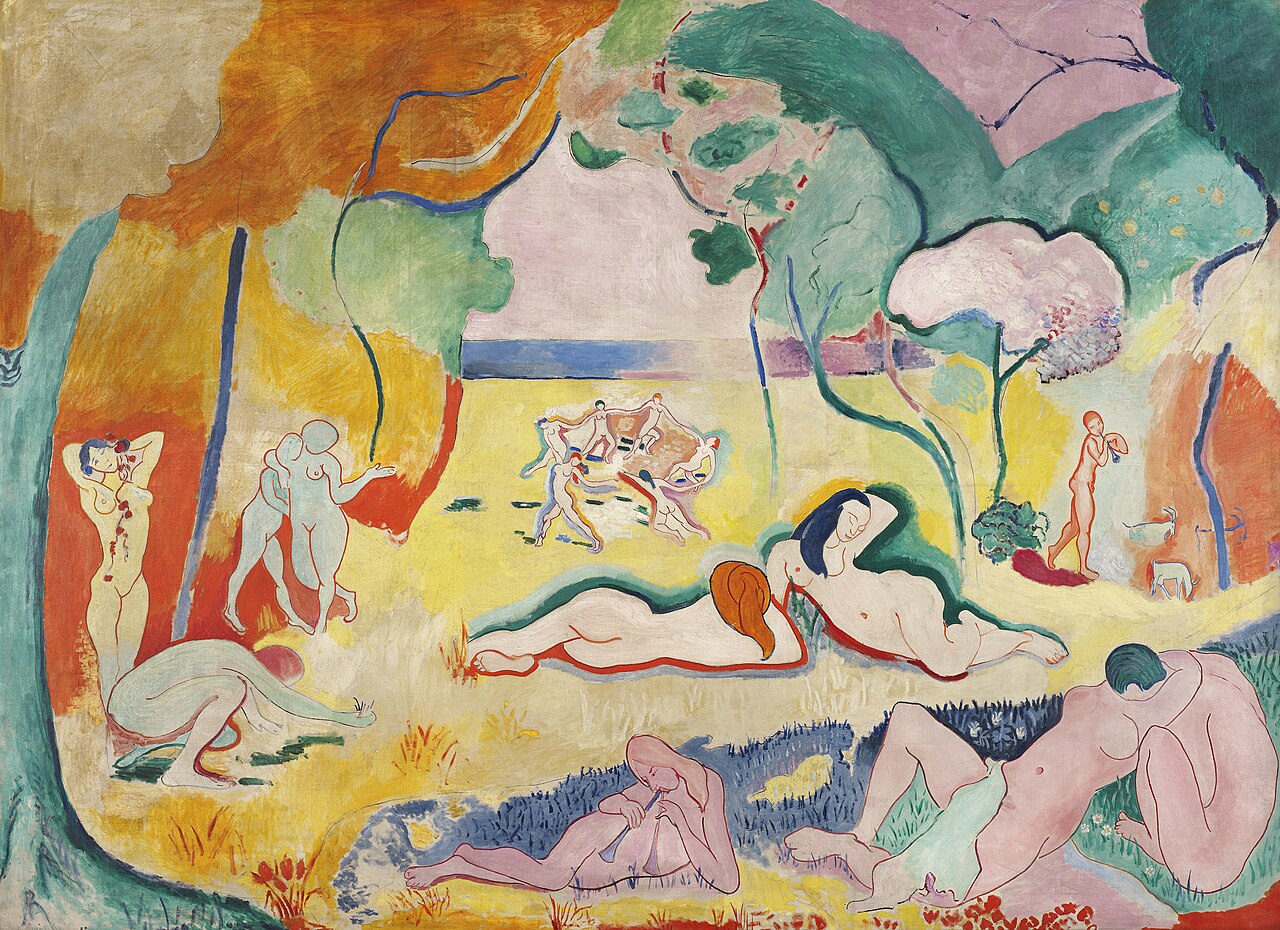
Matisse was building on Cézanne’s insight — that color creates form — but he pushed it further. If Cézanne’s nudes generate their own light, Matisse’s nudes are light. They glow from within. The reclining figure in the foreground is a curve of warm pink that doesn’t need shadow to read as three-dimensional. The dancers in the background are silhouettes of pure energy — bodies reduced to the essential gesture of joy.
This is the ultimate solstice painting. Not because it depicts a specific moment of sunlight, but because it captures the feeling of the longest day — the sense that light is so abundant it becomes the fabric of reality itself. In Le Bonheur de Vivre, the nude body has stopped being a thing that receives light and has become a thing that radiates it.
What the Solstice Teaches Us
The summer solstice is the day when the relationship between the body and light is most intense. For Sorolla, that meant capturing a specific moment of Mediterranean sun on Valencian skin. For Cézanne, it meant distilling light into the structural logic of color. For Matisse, it meant releasing the body into a world made entirely of radiance.
Three artists, three different kinds of light, three ways of understanding what it means for the nude body to be seen. What unites them is the conviction that the nude is never just a body — it’s a body in relation to the world, and the primary relationship is always with light.
On the longest day of the year, that relationship is at its most visible. Go outside. Feel the sun. Look at your own skin in the solstice light. You’re seeing what these artists spent their lives trying to capture — the body as an event of light.
— NALA explores the nude in art history, one story at a time. Join the conversation.