Walk through any major museum and you will see them: marble gods with perfect abdomens, bronze athletes caught mid-throw, Renaissance paintings of young men reclining in states of graceful undress. The male nude has been a central subject of Western art for over 2,500 years \u2014 longer than the landscape, longer than the still life, longer than almost any genre except the portrait. Yet for most of that history, the male body was rarely described as “nude” at all. It was the heroic body, the ideal body, the universal human form that artists studied, measured, and perfected. The problem \u2014 and it is a productive one \u2014 is that the male nude carries a gaze problem. Who is looking? Who is allowed to desire? And when did looking at a man become something the art world had to pretend it wasn’t doing?
\n\n\n\nThe Greek Invention: The Body as an Ideal
\n\n\n\nThe male nude in Western art begins with ancient Greece, and it begins with an audacious idea: that the human body, stripped of clothing and context, could represent something universal \u2014 courage, virtue, the perfect balance of mind and muscle. The kouros statues of the Archaic period (c. 600 BCE) show standing nude young men with rigid symmetry, their smiles frozen, their bodies an early attempt to capture the ideal form. By the Classical period, sculptors like Myron had pushed further. His Discobolus (c. 450 BCE) captures an athlete at the precise moment of torsion \u2014 the body coiled, the muscles alive, the entire figure a study of tension and release. It is not a portrait of a specific man. It is an equation for perfection rendered in marble.
\n\n\n\n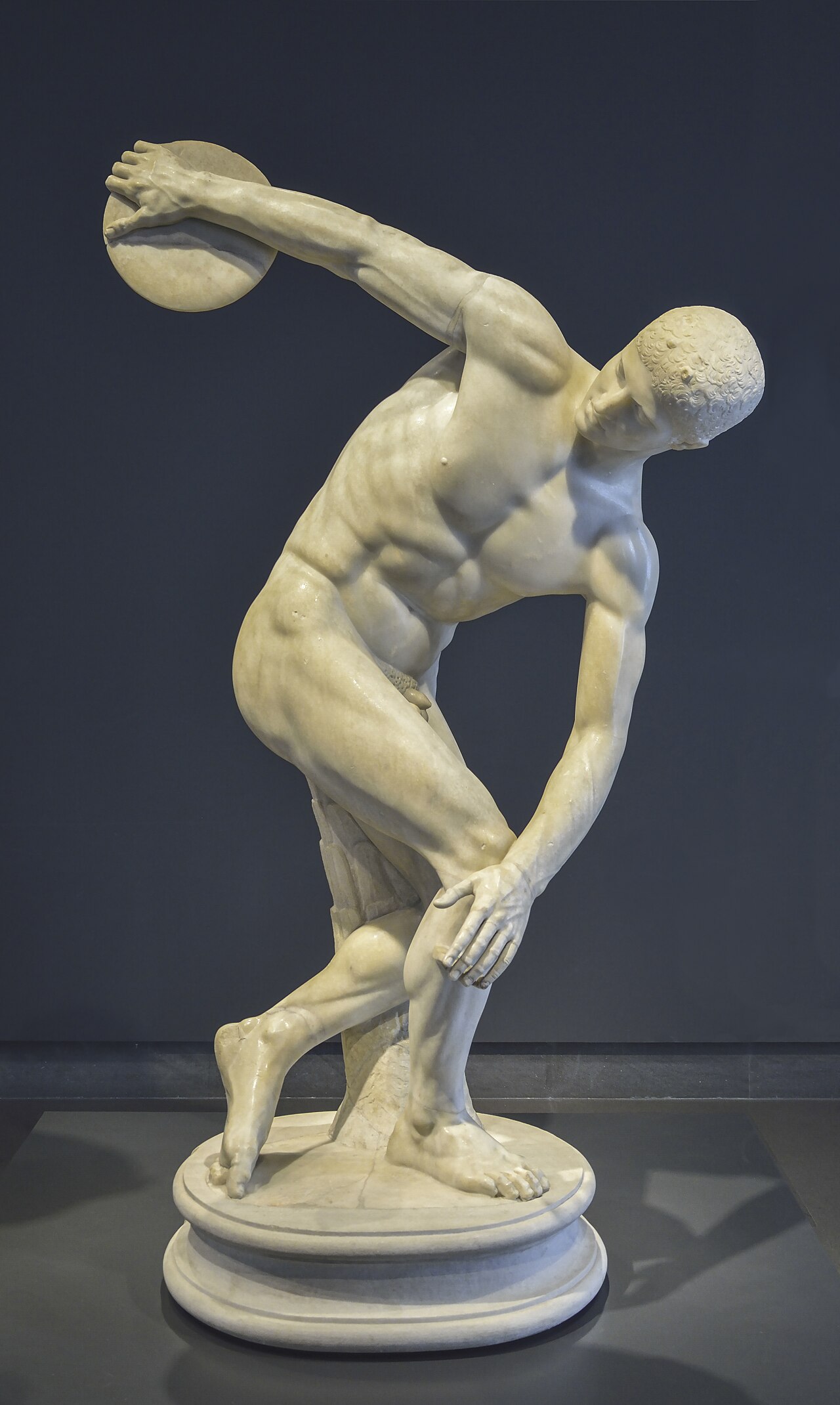
The Greeks also invented something more consequential for the male nude than any sculptural technique: they normalized the public display of the athletic body. The gymnasium (from Greek gymnos, meaning “naked”) was a space where men exercised, competed, and socialized entirely unclothed. This cultural practice meant that the nude male body was not just an artistic convention \u2014 it was a lived reality, and the art that emerged from it carried the charge of daily experience.
\n\n\n\nThe Renaissance: Anatomy and the Rediscovered Body
\n\n\n\nAfter a thousand years in which the body was largely hidden beneath Byzantine robes and Gothic drapery, the Renaissance rediscovered the male nude with an intensity that bordered on obsession. For artists of the 15th and 16th centuries, the nude male body was not merely a subject \u2014 it was the proof of their artistic mastery. Leonardo da Vinci dissected over thirty cadavers to understand the musculature beneath the skin. Michelangelo spent years studying the male form at the monastery of Santo Spirito, working from the bodies of the dead to perfect the bodies of his living sculptures.
\n\n\n\nMichelangelo’s David (1501\u20131504) stands as the single most famous male nude in Western art, and it tells us everything about how the Renaissance understood the male body. At seventeen feet tall, David is not the biblical shepherd boy of the text \u2014 he is a classical hero in the Greek tradition, his physique impossibly proportioned, his gaze fixed on a threat the viewer cannot see. The sculpture is a manifesto of human potential: the body as an instrument of divine purpose. But look closely at David’s hands \u2014 too large, the veins too prominent, the proportions slightly off. Even in perfection, Michelangelo could not resist reminding us that this is a body built from study, not nature. The ideal male nude of the Renaissance was always, at some level, a construction.
\n\n\n\n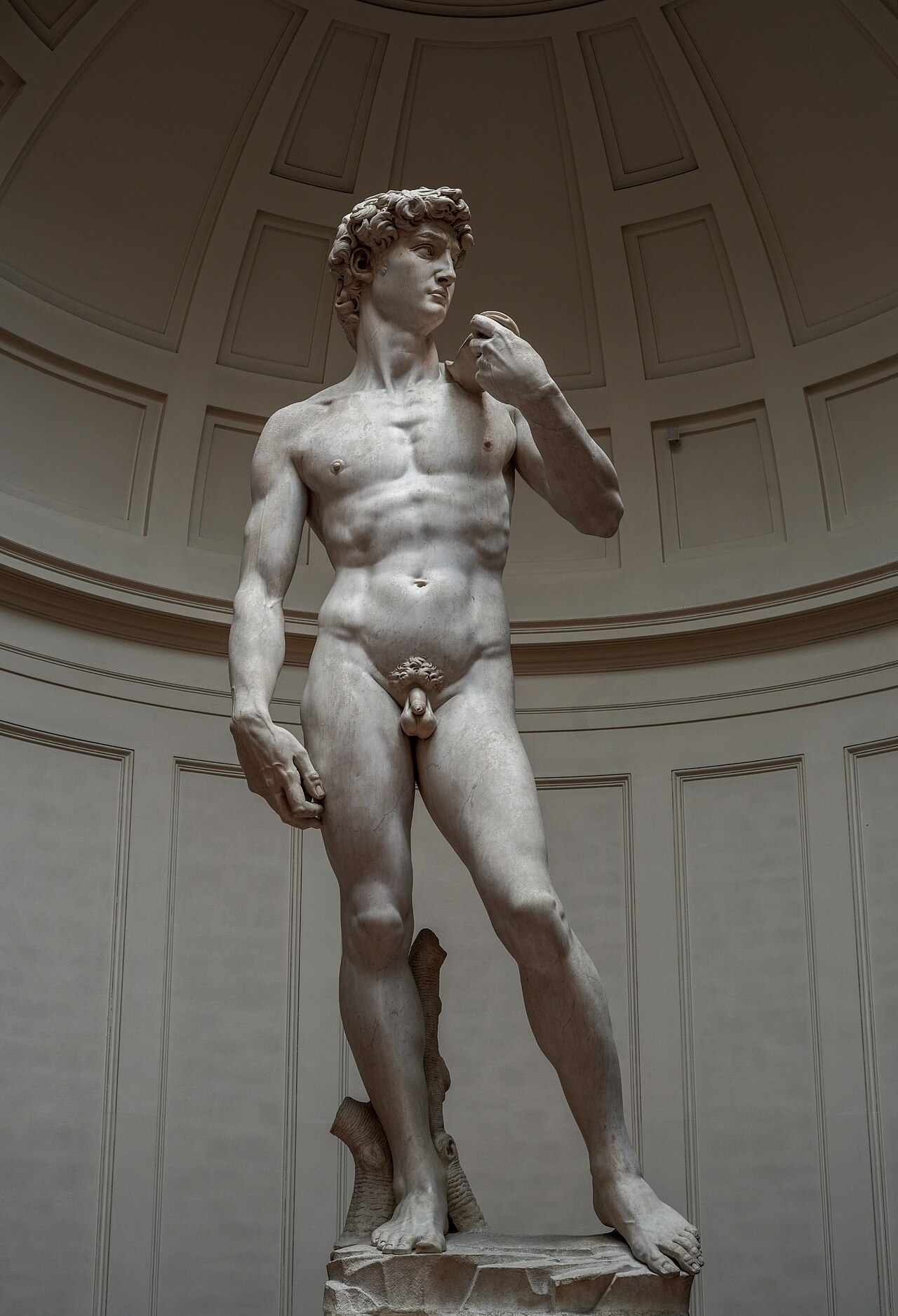
The Nineteenth Century: When the Male Nude Became a Problem
\n\n\n\nBy the 19th century, the male nude had entered strange territory. Academic painting still demanded that artists master the male figure \u2014 the acad\u00e9mie (a nude study of a male model) was the foundation of every art student’s training. The \u00c9cole des Beaux-Arts in Paris required students to produce male figure drawings for years before they were allowed to paint a draped figure. But something had shifted. The male nude, once the universal symbol of heroism and virtue, was increasingly confined to the life drawing studio and the history painting. It was becoming technical \u2014 a problem of anatomy and lighting rather than a living subject.
\n\n\n\nAt the same time, the male nude was slowly \u2014 and often scandalously \u2014 becoming something else. The photographs of Wilhelm von Gloeden in Sicily (1880s\u20131900s) posed nude Sicilian youths in classical tableaux, creating images that were art-historical on the surface and homoerotic beneath it. Thomas Eakins, the great American realist, pushed his students at the Pennsylvania Academy of the Fine Arts to work from nude male models as the foundation of their training \u2014 and was forced to resign in 1886 after removing the loincloth from a male model in a mixed-gender class. His painting The Swimming Hole (1885) shows six of his students swimming naked in a creek, their bodies arranged with a compositional precision that echoes classical friezes. It is, by any measure, a masterpiece of male nude painting. And it was controversial for exactly that reason: it was too honest about the pleasure of looking at men.
\n\n\n\n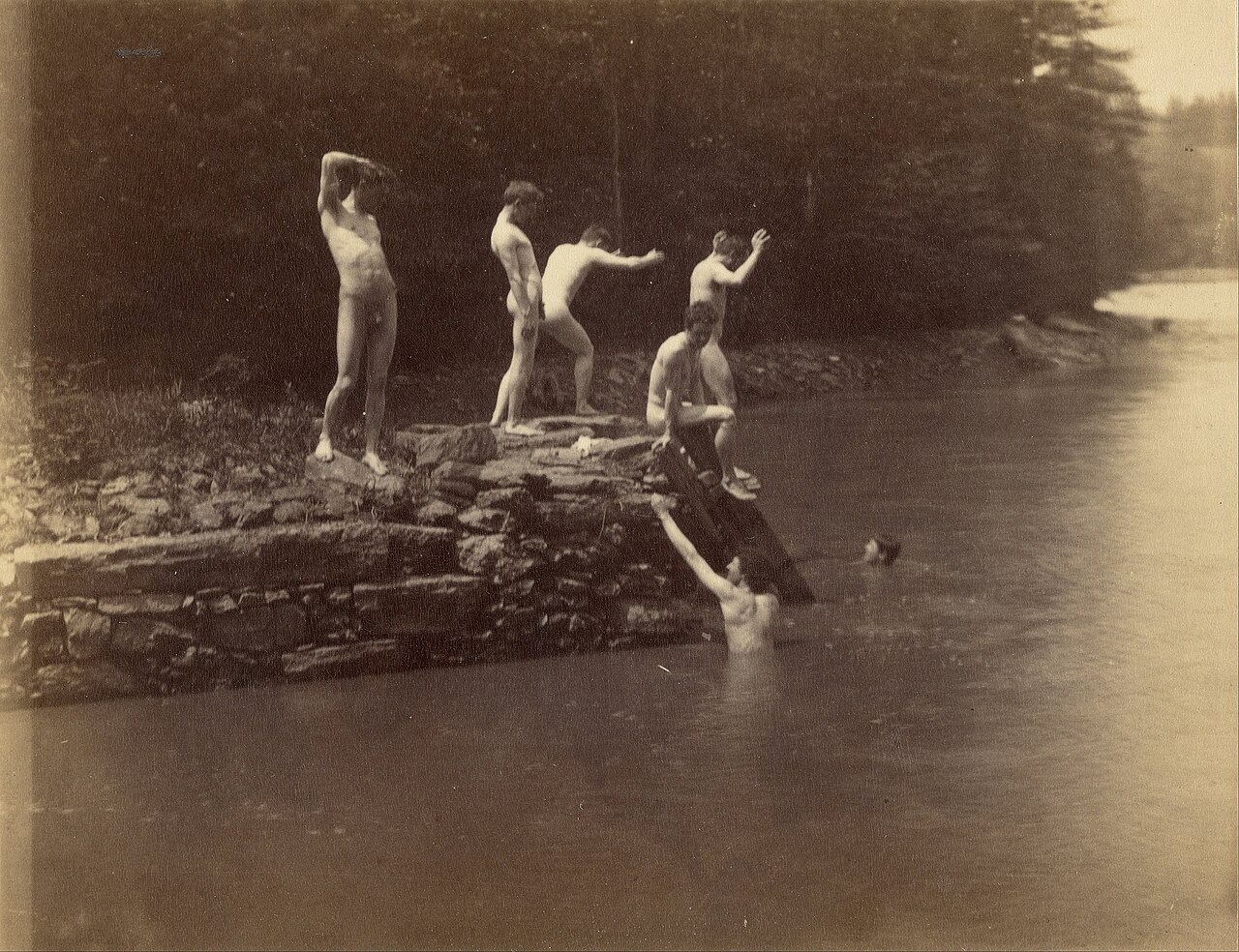
The Gaze Problem: Who Gets to Look at Men?
\n\n\n\nThe history of the male nude in art is, in many ways, the history of a gaze that was never quite allowed to name itself. For centuries, the male body could be displayed, studied, and idealized \u2014 but it could not, officially, be desired. The female nude had the opposite problem: she could be desired, openly and enthusiastically, but she was rarely allowed to be a full person. The male nude was a vessel for ideas. The female nude was a vessel for appetite.
\n\n\n\nThis asymmetry began to crack open in the 20th century. Modernism treated the male body as form \u2014 Picasso’s fragmented nudes, Matisse’s simplified outlines \u2014 and in doing so, defused some of the anxiety. Photography pushed further. Robert Mapplethorpe’s black-and-white male nudes of the 1970s and 80s insisted that the male body could be beautiful in the same way a flower or a marble torso was beautiful: honestly, aesthetically, without apology. The culture wars of the late 20th century \u2014 the Mapplethorpe obscenity trial of 1990, the NEA funding battles \u2014 were, at their core, fights about whether the male nude deserved the same aesthetic protection that the female nude had always received.
\n\n\n\nThe Male Nude Today
\n\n\n\nContemporary art has largely normalized the male nude. Kehinde Wiley’s monumental portraits place Black men in the poses of classical equestrian and nude paintings, reclaiming a tradition that excluded them. Catherine Opie’s photographs of queer communities refuse to let the male nude be sanitized into mere anatomy. The gender binary has softened, and with it the old rules about who looks at whom and how. In the life drawing rooms of 2026, models of every gender and body type are drawn by artists of every gender and body type. The male nude is no longer a special case.
\n\n\n\nBut the tension at the heart of the tradition \u2014 the gap between the ideal and the real, between the body as symbol and the body as flesh \u2014 has not disappeared. It has simply become more honest. That, in the end, is what the best male nudes have always done. From the Discobolus to David to The Swimming Hole, they have asked us to look at men the way we look at the world: with full attention, without flinching, and without pretending that looking is not also a form of feeling.
\n\n\n\n—
\n\n\n\nThe male nude in Western art spans 2,500 years of changing ideals, shifting gazes, and an evolving conversation about who gets to look \u2014 and how. At Nude Art LA, we believe every body deserves to be seen clearly.
\n\n