Pierre Bonnard’s Bathing Nudes: Why He Spent 30 Years Painting the Same Woman in the Same Tub
\n\n
In the history of the nude, no artist was more obsessed with a single subject than Pierre Bonnard. From the early 1900s until his death in 1947, he painted his wife Marthe—born Maria Boursin—in the bathtub. Over and over. Same woman. Same room. Same posture of private surrender. And the result is one of the most radical bodies of nude painting in modern art.
\n\n
The Nabis Rebel
\n\n
Bonnard began as one of the Nabis, a Post-Impressionist avant-garde group that included \u00c9douard Vuillard, Paul S\u00e9rusier, and Maurice Denis. The Nabis rejected naturalism in favor of symbolic color, flattened space, and the belief that a painting was above all an arrangement of color on a flat surface. But while Vuillard painted bourgeois interiors and Denis painted religious allegories, Bonnard gravitated toward something quieter—the woman he shared a home with, in the most ordinary of acts.
\n\n
Marthe was not a professional model. She was Bonnard’s companion, collaborator, and gatekeeper. She controlled access to him, managed his studio, and posed for hundreds of works. But she was never painted as a conventional nude. Bonnard’s nudes are not posed for the viewer. They are caught in the act of being themselves.
\n\n
The Bath as Modernist Sanctuary
\n\n
What makes Bonnard’s bathing nudes so radical is not what they reveal but how they frame it. The body is there—frankly, unapologetically naked—but it is often dissolved into its surroundings. The pink of Marthe’s skin melts into the pink of the bathroom tiles. The blue water of the tub bleeds into the blue of the window curtain. The body becomes a pattern among patterns, a shape that competes with the architecture of the room for the viewer’s attention.
\n\n
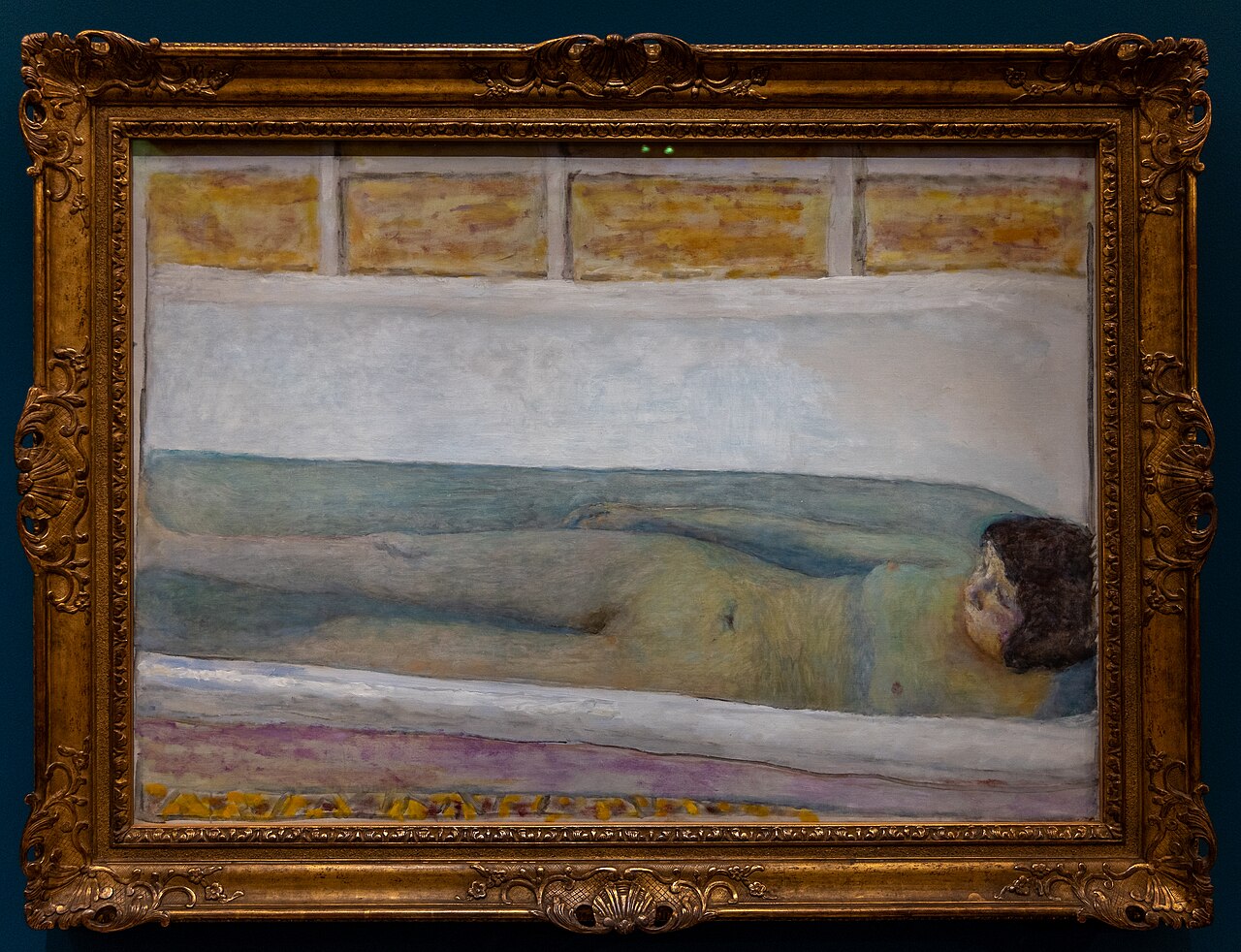
Look at Nu dans le bain (1925), featured above. Marthe sits in the tub, knees drawn up, body compressed into one corner of the frame. The composition is almost aggressively cropped—a modernist device Bonnard absorbed from Japanese prints and photography. We are not looking at a woman in a bath. We are looking at a private moment that refuses to perform for us. The body is present, but it does not acknowledge our presence.
\n\n
 \n
\n\n\n
The Nude Without Allegory
\n\n
This is perhaps Bonnard’s most important contribution to the history of the nude. For centuries, Western artists had justified the naked body by embedding it in myth (Venus, Diana, the Three Graces) or in moral narrative (Adam and Eve, Susanna and the Elders). The nude was never just a nude. It was always a vehicle for something else—beauty, virtue, sin, redemption.
\n\n
Bonnard stripped that away. His Marthe in the bath needs no mythological justification. She is not Venus. She is not a goddess. She is a woman with her knees up in a zinc tub, water reflecting the afternoon light, tiles catching the glow. And that is enough.
\n\n
This was a radical position in 1925, when the Paris art world was still debating whether abstraction or figuration would define modernity. Bonnard answered the debate by painting a nude with no allegory, no narrative, no moral. Just presence. The body as a fact of the world, not a symbol of something beyond it.
\n\n
Color and Memory
\n\n
Bonnard worked from memory, not from life. He would make quick pencil sketches of Marthe in the bath, then retreat to his studio to paint from recollection—months, sometimes years later. This gave his nudes their luminous, hallucinatory quality. Color was liberated from the tyranny of observation. The bathroom could be blue, yellow, gold, or violet depending on what Bonnard remembered feeling, not what he saw.
\n\n
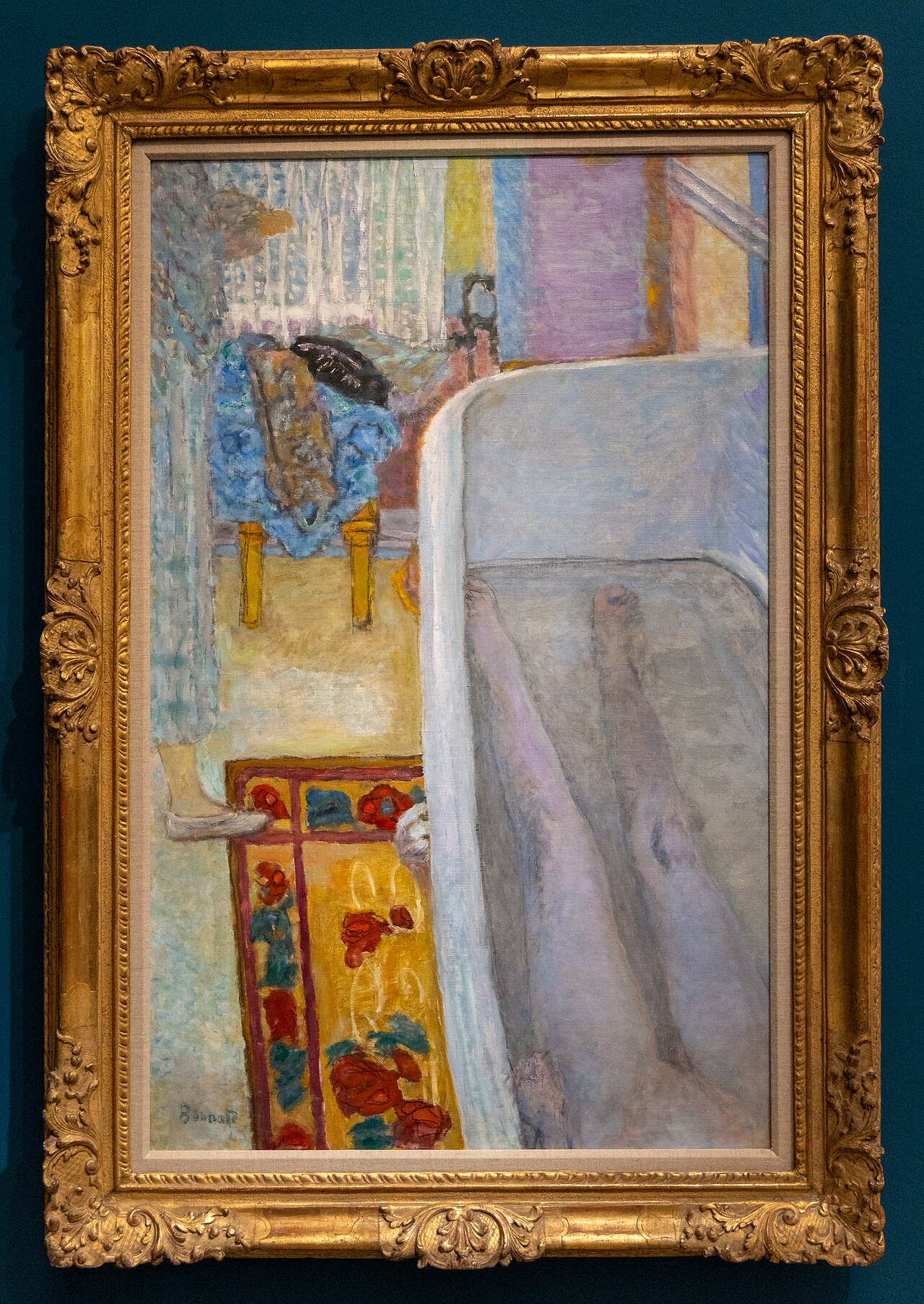
Nu dans la baignoire (1925), below, exemplifies this approach. The composition is tight, intimate—Marthe’s body folded into the tub, the tiles and water creating an abstract mosaic of warm and cool tones. The figure is almost lost in the riot of color, and that is precisely the point. For Bonnard, the nude was not the center of the painting. It was a part of a unified field of visual experience.
\n\n
 \n
\n\n\n
Marthe and the Gaze
\n\n
There is a curious power dynamic in Bonnard’s bathing nudes that art historians still debate. Is this obsessive painting of an intimate moment voyeuristic? Marthe’s face is often obscured—turned away, hidden by shadow, or simply cropped out of the frame. Does Bonnard erase her personhood in the service of his visual project?
\n\n
Or is something more subtle happening? Marthe was a famously private woman who rarely left the house and controlled every aspect of Bonnard’s daily life. By choosing the bath—the one room where privacy is absolute—she may have been collaborating in a shared project: the depiction of a body that belongs to no one but itself. These are not public nudes. They are private documents of a shared life, offered to us as witness, not invitation.
\n\n
Legacy: The Nude Reclaimed
\n\n
Bonnard’s influence on the modern nude is immense. Matisse admired his color. Picasso, who dismissed Bonnard as a decorative painter, nevertheless borrowed his intimate framing. Abstract Expressionists found in Bonnard’s dissolving figures a precedent for their own abandonment of representation. And contemporary painters such as Peter Doig and Marlene Dumas owe a clear debt to the Bonnardian nude—the body that refuses to stand center stage, preferring instead to inhabit the painting as atmosphere rather than statement.
\n\n
In the end, Bonnard’s bathing nudes ask us to reconsider what the nude in art is for. Not beauty. Not desire. Not allegory. Just the quiet, radical fact that the human body is here, in the world, caught in the ordinary act of being alive. And that is enough.
\n