When Simon Vouet died in Paris on June 30, 1649 \u2014 377 years ago today \u2014 he left behind a French art world that looked nothing like the one he had inherited. Before Vouet, French painting was provincial, earnest, still clutching its late-Mannerist manners. After Vouet, it was sensual, luminous, and beginning to understand what the nude body could do on canvas when you stopped apologizing for it.
\n\n\n\nVouet spent fifteen years in Italy \u2014 Rome, mostly, with a crucial stint in Genoa \u2014 and he arrived at exactly the right moment. Caravaggio had just died, but his revolution was still reverberating. The Carracci had reinvented classical composition at the Palazzo Farnese. Vouet absorbed all of it: Caravaggio’s theatrical light, the Carracci’s volumetric figures, Guido Reni’s silken grace. He became, by 1624, the president of Rome’s Accademia di San Luca \u2014 the first Frenchman ever to hold the post. Then Louis XIII called him home.
\n\n\n\nThe king wanted a French Raphael. What he got was better: a painter who understood that the nude body \u2014 not the altarpiece, not the battle scene \u2014 was the ultimate vehicle for Baroque expression.
\n\n\n\nThe Toilet of Venus: A French Sensuality Is Born
\n\n\n\nVouet’s Toilet of Venus \u2014 painted around 1628, shortly after his return to Paris \u2014 is the painting that announced French Baroque nudes had arrived. Venus sits at her dressing table, attended by cupids, her upper body bare, her skin glowing with a pearlescent light that owes nothing to Caravaggio’s harsh chiaroscuro and everything to Vouet’s emerging decorative instinct. The composition is intimate without being prurient, mythological without being academic. She looks at herself in a mirror held by a putto, but the real mirror is the painting itself: a reflection of what French art was about to become.
\n\n\n\n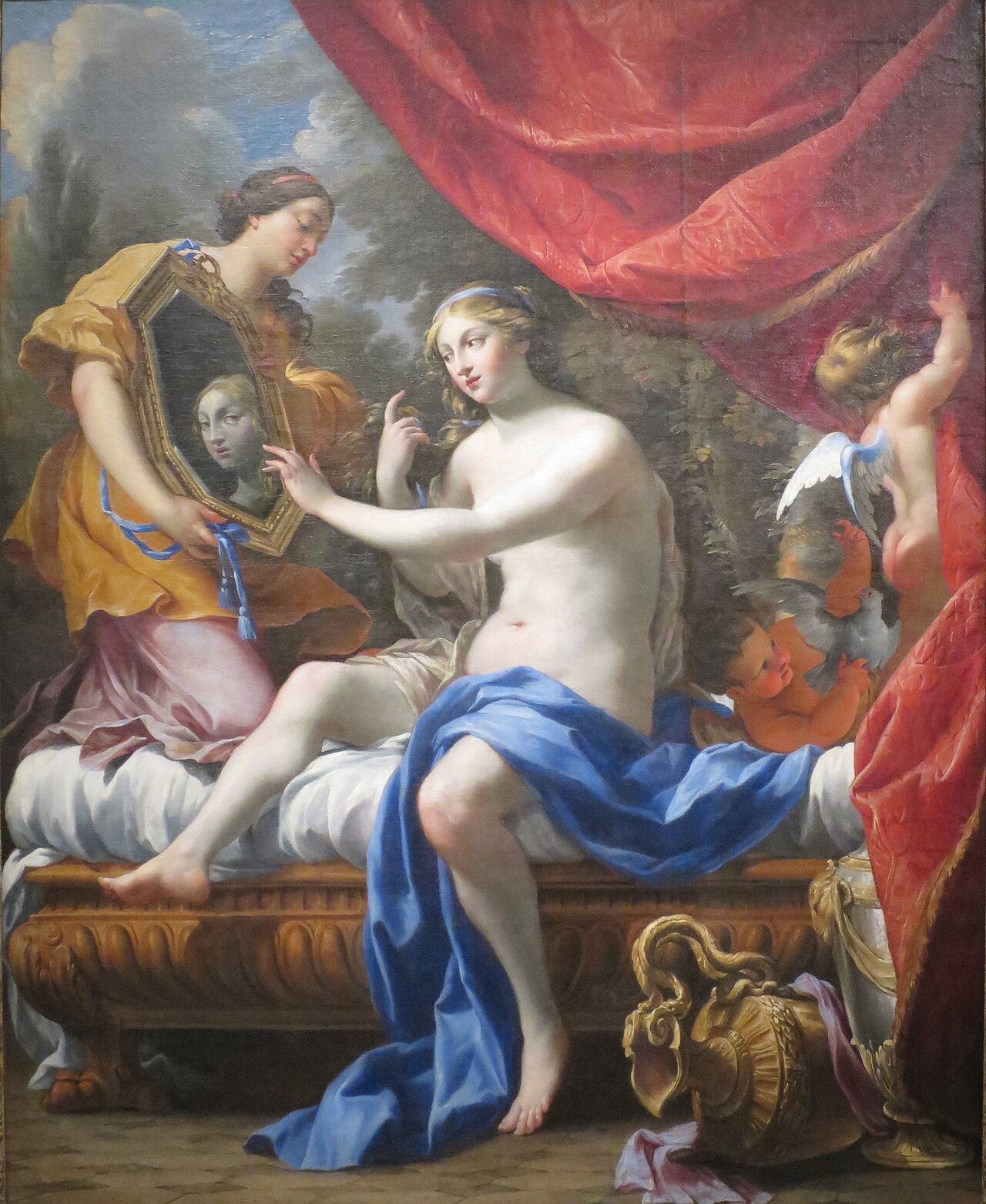
This wasn’t just another Venus. Titian had painted the goddess reclining, Correggio had made her coy, but Vouet gave her something new: presence. She occupies the canvas like a woman who knows she’s being looked at and has made peace with it. The gaze isn’t confrontational \u2014 it’s architectonic. She’s building something, and that something is the visual language of French art for the next hundred years.
\n\n\n\nThe Italian Apprenticeship That Made Everything Possible
\n\n\n\nTo understand what Vouet accomplished, you have to understand what he left behind. Rome in the 1610s and 1620s was the most competitive art market in Europe. Vouet didn’t just survive there \u2014 he thrived. He won major commissions for St. Peter’s. He absorbed Caravaggio’s tenebrism so thoroughly that early works like The Fortune Teller (c. 1618) were sometimes mistaken for the master’s own. But he also understood Caravaggio’s limitations: the relentless darkness, the refusal of decoration, the insistence that beauty was somehow suspect.
\n\n\n\nVouet’s genius was synthesis. He took Caravaggio’s drama and the Carracci’s monumentality and fused them with a French instinct for elegance. The result was a painting style in which the nude body could be both powerful and graceful \u2014 a combination that Italian Baroque, for all its brilliance, never quite achieved. Caravaggio’s bodies are too gritty. Reni’s are too ethereal. Vouet’s are flesh.
\n\n\n\nVenus and Adonis: The Body as Tragedy
\n\n\n\nIf the Toilet of Venus established Vouet’s decorative mastery, Venus and Adonis \u2014 painted around 1642, now at the Getty Center \u2014 proved his emotional range. The myth is brutal: Venus, goddess of love, falls for the mortal hunter Adonis. She begs him not to go hunting. He goes anyway. A boar kills him. She finds his body.
\n\n\n\n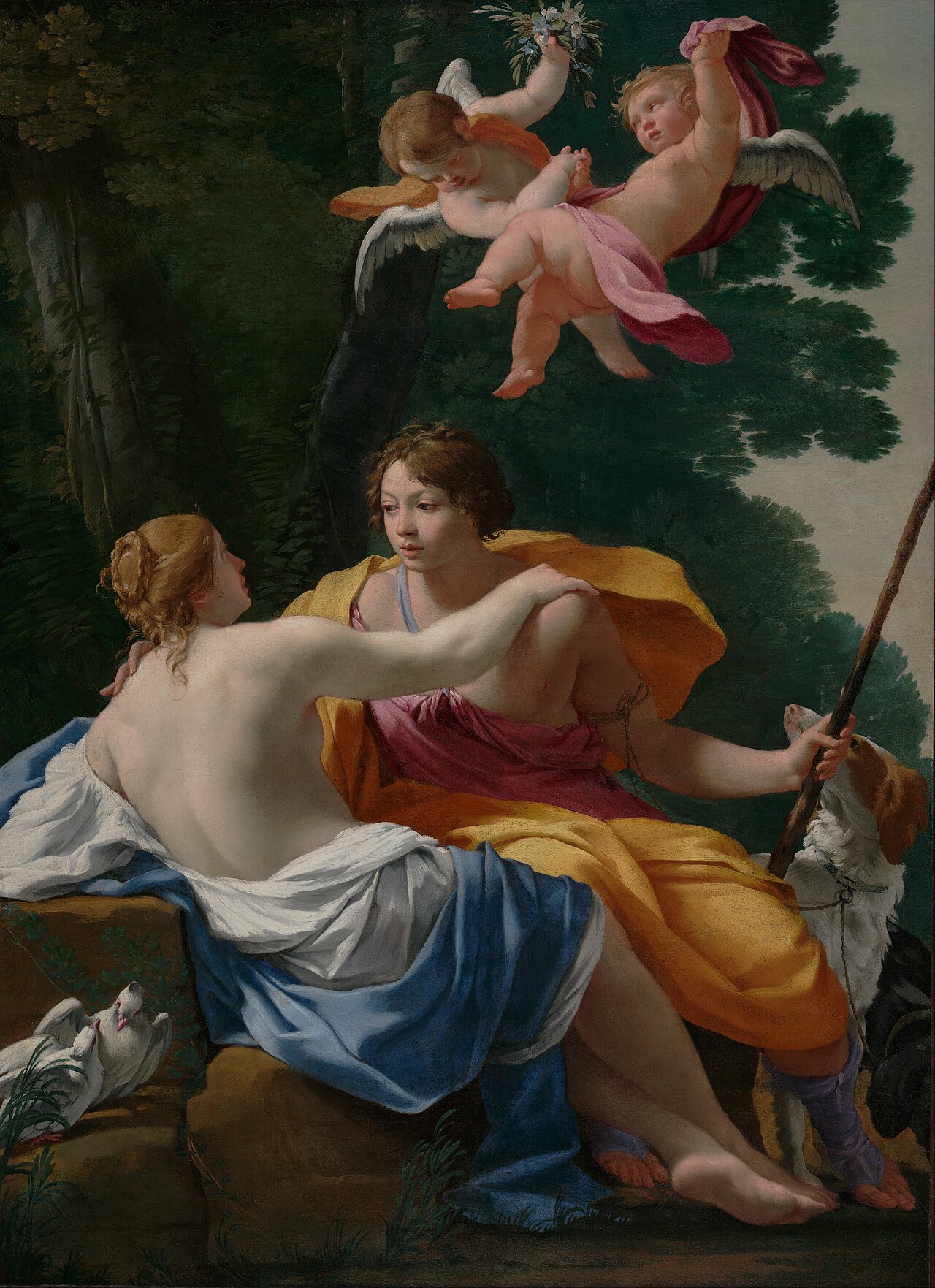
Vouet captures the moment before the departure \u2014 Venus clinging to Adonis, her body pressed against his in desperate persuasion. Her nudity isn’t decorative here; it’s structural. The exposed flesh is vulnerability itself, the visible argument against his leaving. Adonis, half-turned away, is already half-lost. The composition is a coiled spring of pending grief. No French painter before Vouet had used the nude body this way \u2014 not as an ornament to a story, but as the story’s emotional engine.
\n\n\n\nThe Studio That Built a Century
\n\n\n\nVouet’s most consequential contribution to French art may not have been any single painting, but the workshop he ran in the Louvre. From roughly 1627 until his death in 1649, his studio was the training ground for the generation that would define French painting under Louis XIV. Charles Le Brun \u2014 the future architect of Versailles’ decorative program \u2014 studied there. So did Eustache Le Sueur, Pierre Mignard, and Fran\u00e7ois Perrier. Vouet taught them all the same lesson: the nude body is the foundation of everything.
\n\n\n\nThis wasn’t just technique. It was ideology. The Acad\u00e9mie Royale de Peinture et de Sculpture, founded in 1648 \u2014 one year before Vouet’s death \u2014 would enshrine the nude as the highest genre of painting, the grand genre from which all other pictorial knowledge flowed. Vouet didn’t live to see the Academy’s full flowering, but its hierarchy was built on the pedagogical foundation his studio had laid. Le Brun, who became the Academy’s first director, was essentially executing Vouet’s vision at institutional scale.
\n\n\n\nDiana and the Limits of Decoration
\n\n\n\nBy the mid-1630s, Vouet’s style had lightened considerably. The Caravaggesque darkness of his Roman years had given way to a palette of creams, corals, and sky blues. Diana Leaving for the Hunt (c. 1635-40) is a product of this mature decorative phase. Diana, goddess of the hunt, prepares to depart with her bow; the composition is airy, almost Rococo in its lightness. The body here isn’t dramatic \u2014 it’s architectural, part of a larger decorative scheme designed for a private h\u00f4tel particulier.
\n\n\n\n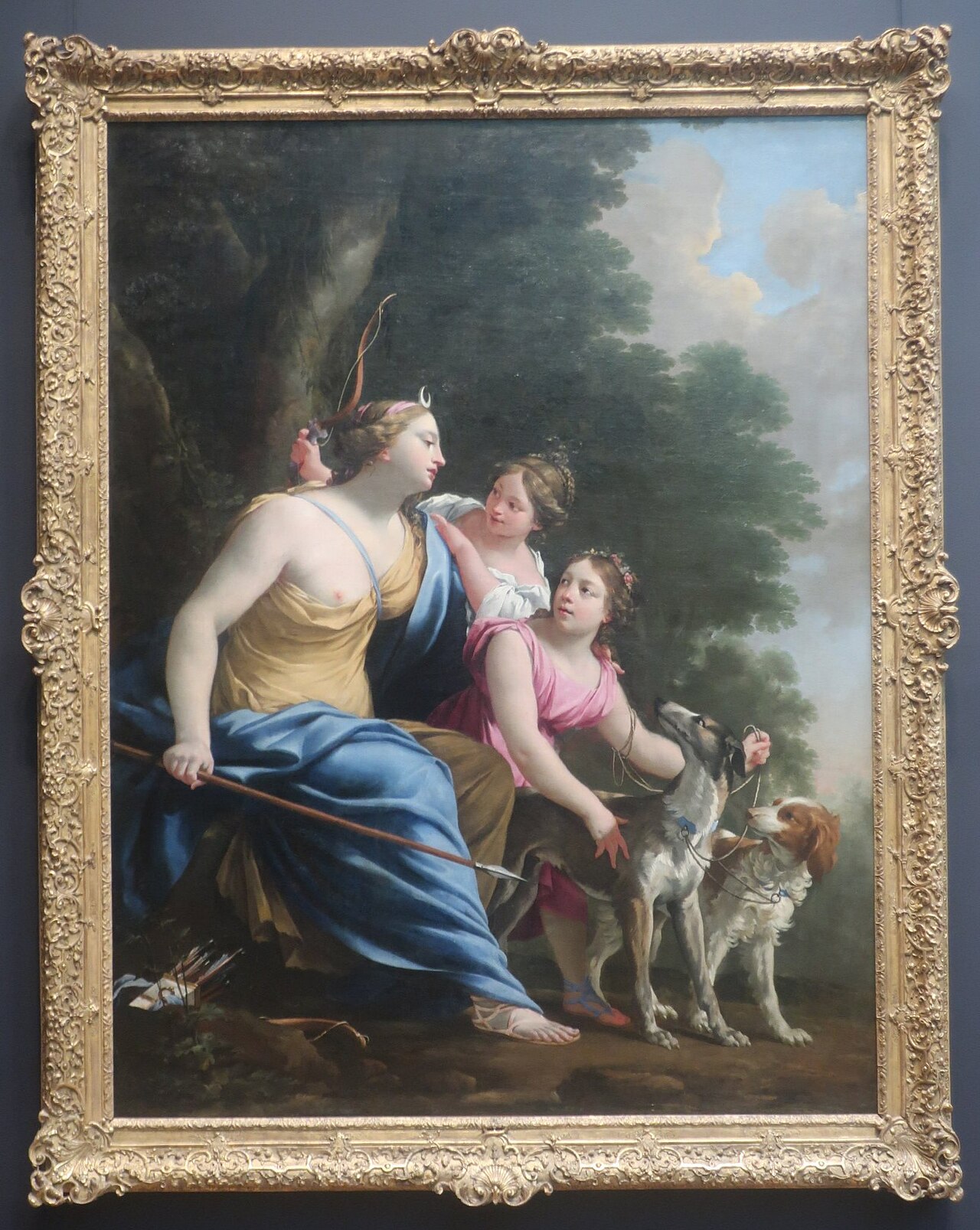
Critics \u2014 then and now \u2014 have sometimes dismissed Vouet’s later work as too pretty, too accommodating to aristocratic taste. But this misses the point. Vouet understood that the nude body could be both serious and beautiful, both intellectually rigorous and sensually immediate. He was making paintings for rooms where people lived, loved, and conducted politics \u2014 not for the theology faculty. The decorative is not the enemy of meaning; it’s one of meaning’s most durable vehicles.
\n\n\n\nWhat Vouet Left Us
\n\n\n\nVouet died at 59, still at the height of his powers, still running the most important studio in France. Within a generation, his style would be eclipsed by Poussin’s severe classicism \u2014 Poussin, who had stayed in Rome while Vouet came home, and whose intellectual austerity made Vouet’s sensuality look frivolous by comparison. The Poussinistes won the theoretical battle. But the painters kept painting like Vouet.
\n\n\n\nBoucher’s pink-and-cream goddesses, Fragonard’s tumbling lovers, Watteau’s melancholy idylls \u2014 none of them make sense without Vouet’s precedent. He taught French painting that the nude body could carry emotion without sacrificing grace, that mythology could be intimate rather than remote, and that sensuality was not the opposite of seriousness but one of its most powerful forms.
\n\n\n\nThree hundred and seventy-seven years after his death, in an art world that has seen the nude pass through realism, impressionism, abstraction, and conceptual critique, Vouet’s contribution can seem quaint \u2014 just another Old Master who painted pretty goddesses for kings. But look again at the Toilet of Venus. Look at how the light falls on her shoulder, how the composition holds her gaze in perpetual equipoise between self-awareness and self-possession. That isn’t quaint. That’s a painter who understood, at the deepest level, that the human body is the only subject that never exhausts itself \u2014 because it’s the only subject that is, simultaneously, form, content, and argument.
\n\n\n\nVouet gave France permission to take the nude seriously. Every French painter who followed \u2014 from Boucher to Manet to Bonnard \u2014 owes him a debt they rarely acknowledge. Today, on the anniversary of his death, let’s acknowledge it.
\n\n