Nudity vs. Nakedness: The Art-History Distinction That Still Defines How We See the Body
\n\n\n\nIn 1956, the British art historian Kenneth Clark published a book that would become one of the most quoted \u2014 and debated \u2014 texts in the entire discipline. The Nude: A Study in Ideal Form opened with a distinction so clean, so memorable, that it has been repeated in lecture halls and gallery tours for nearly seventy years:
\n\n\n\n\n\n\n\n“To be naked is to be deprived of our clothes, and the word implies some of the embarrassment most of us feel in that condition. The word ‘nude,’ on the other hand, carries, in educated usage, no uncomfortable overtone.”
\u2014 Kenneth Clark, The Nude: A Study in Ideal Form (1956)
In Clark’s formulation, nakedness is a fact: a body without clothes. The nude is an art form: a body transformed by culture, proportion, and idealization into something that transcends mere biology. Nakedness is private and vulnerable. The nude is public and composed. One is what you are in the shower. The other is what you see on a museum wall.
\n\n\n\nIt’s a brilliant piece of rhetoric. It is also a deeply incomplete picture of what art actually does with the body \u2014 and the past seven decades of scholarship, exhibition, and social change have complicated Clark’s neat binary in ways that make it more useful, not less.
\n\n\n\nThe Classical Ideal that Invented the Nude
\n\n\n\nClark was describing something real. The Greeks invented the nude as a category \u2014 not just a body without clothes, but a body remade according to mathematical and philosophical principles. The Doryphoros of Polykleitos wasn’t a portrait of any particular athlete. It was a system: a canon of proportion that embodied the Greek conviction that beauty was a measurable quantity, a harmony between parts that corresponded to a larger cosmic order.
\n\n\n\n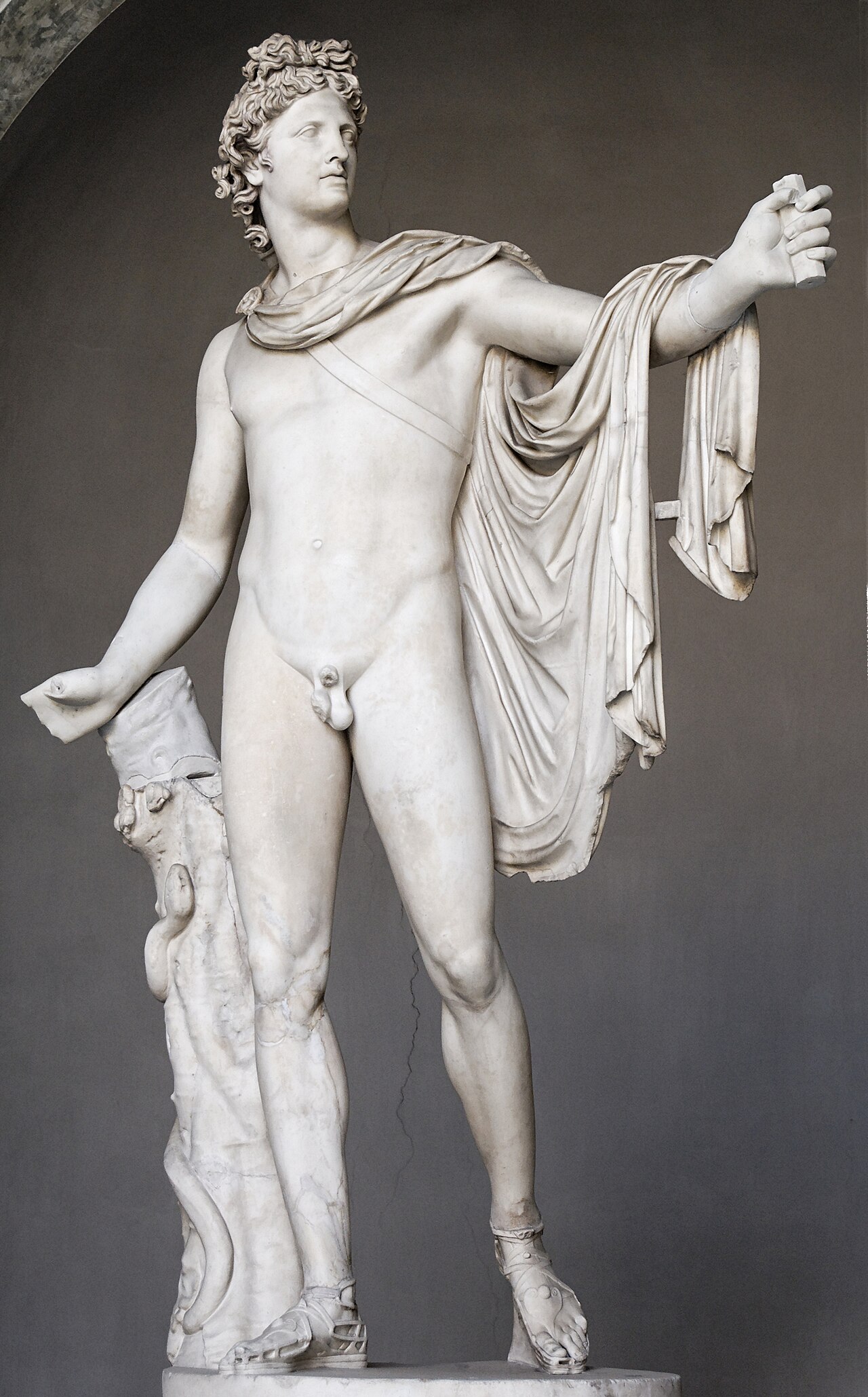
This tradition ran through the Renaissance like a current. Michelangelo’s David is not a gangly teenager who just killed a giant \u2014 he’s a Platonic ideal of male beauty, every muscle surface articulated with a clarity no living body ever possessed. Botticelli’s Birth of Venus presents the goddess not as a woman stepping ashore but as a theological argument about divine beauty made visible. The Renaissance nude, like the Greek one, was a body that had been thought about more than it had been observed.
\n\n\n\nClark’s distinction was built to describe exactly this tradition. The nude was an achievement of civilization. Nakedness was the raw material left behind.
\n\n\n\nWhen Art Refused the Distinction
\n\n\n\nThe problem, as art history kept demonstrating, was that the boundary between nude and naked couldn’t hold. It started cracking almost as soon as Clark drew it \u2014 and in truth, it had been cracking for centuries.
\n\n\n\nConsider Rembrandt’s late self-portraits, where the aging painter scrutinizes his own sagging flesh with a clinical honesty that refuses all idealization. Or Goya’s Naked Maja, who meets the viewer’s gaze with a directness that strips away mythological pretext \u2014 she is not Venus, she is not an allegory, she is a specific woman looking back at you. Or Courbet’s The Origin of the World (1866), which reduces the nude to a single, unflinching anatomical close-up that still has the power to shock.
\n\n\n\n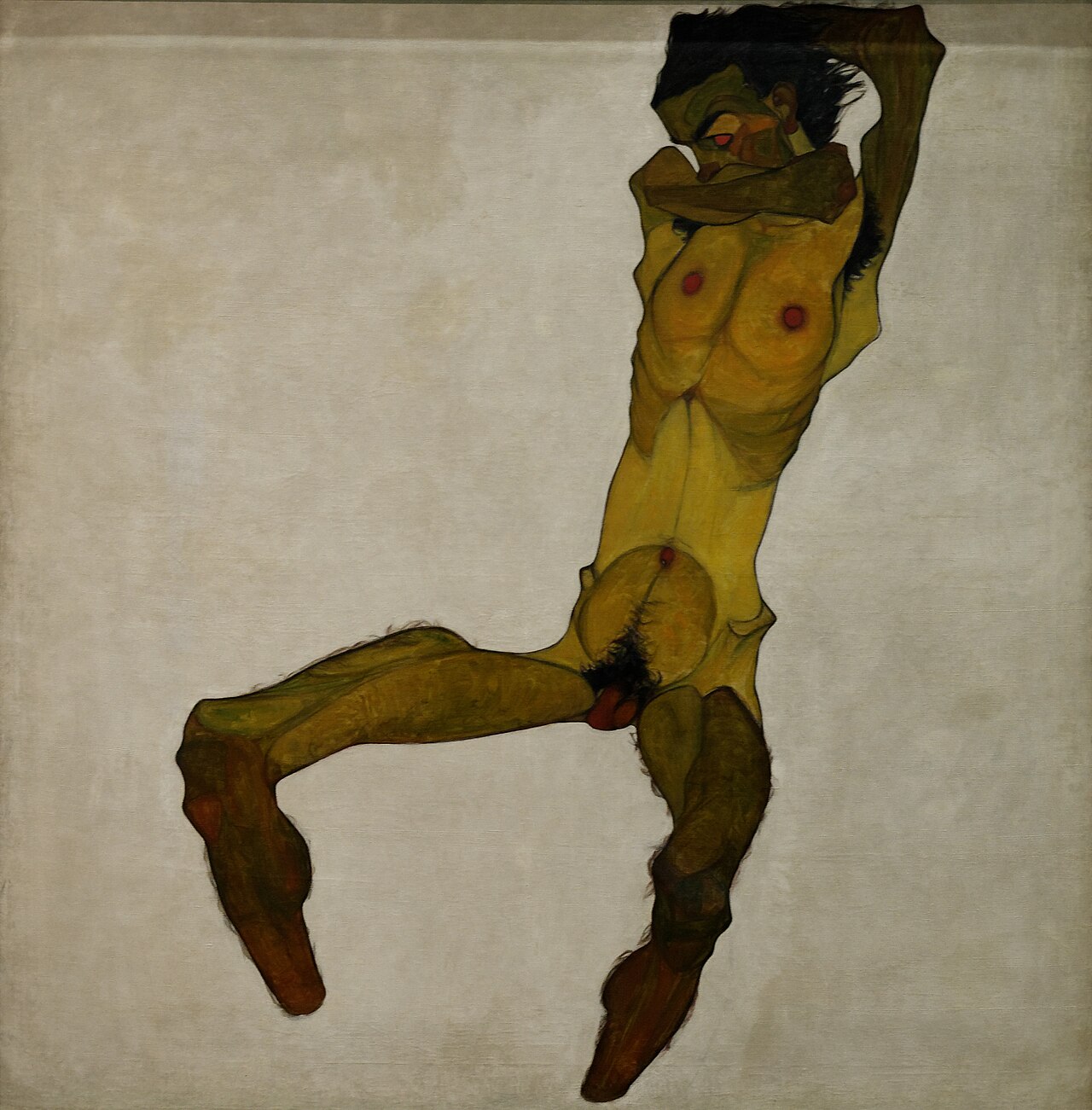
Egon Schiele pushed this refusal to its limit. His nudes \u2014 gaunt, angular, twisted into improbable poses \u2014 are bodies stripped not just of clothing but of the consolations of beauty itself. A Schiele figure doesn’t offer itself for contemplation. It accuses. It demands. It refuses to be the smooth, perfected surface that Clark’s definition assumes. These bodies are naked in Clark’s sense \u2014 exposed, vulnerable, unpolished \u2014 but they are also art in the most complete sense, deliberately composed, stylized to the point of distortion. They shatter the binary.
\n\n\n\nWhy the Distinction Still Matters
\n\n\n\nSo if Clark’s distinction was always too neat, why does it persist? Because it names a real tension that every artist working with the body must navigate. The body is simultaneously the most universal subject in art \u2014 every culture, in every era, has depicted it \u2014 and the most contested. It carries the weight of religion, morality, politics, gender, and power. To paint a nude is to enter a conversation that has been running for two and a half millennia, and every brushstroke is an argument.
\n\n\n\nContemporary artists inherit both sides of Clark’s equation. Jenny Saville’s monumental female nudes, with their bruise-toned flesh and surgical scar lines, insist on the body’s material reality \u2014 its weight, its vulnerability, its capacity for pain \u2014 while simultaneously claiming the grand scale and compositional gravity of history painting. They are naked and nude at the same time. The tension is the point.
\n\n\n\nThe distinction also matters because it reveals something about the viewer. When we look at a nude in a museum, we feel authorized \u2014 the frame, the pedestal, the wall text all tell us this is Culture, not pornography. When we see the same body in a different context, the reaction shifts. Clark’s definition describes not just the object but the institutional machinery around it: the museum, the academy, the critic’s vocabulary. The nude is a social agreement as much as an aesthetic category.
\n\n\n\nBeyond the Binary
\n\n\n\nSeven decades after The Nude, we can see Clark’s distinction for what it was: a powerful tool for thinking about one tradition \u2014 the classical-to-Renaissance ideal \u2014 that becomes less useful the further you move from that center. It doesn’t account for the body in African sculpture, where different traditions of idealization operate under different rules. It doesn’t handle the camera, which collapses the distance between observation and art in ways Clark’s framework can’t process. And it was written before the feminist art history of the 1970s transformed the discipline’s understanding of the gaze, power, and the politics of looking.
\n\n\n\nBut Clark was right about one essential thing: the body in art is never just a body. It is always an argument \u2014 about beauty, about power, about what it means to be human and visible. The Greeks made it a system of proportions. The Renaissance made it a theology. Schiele made it a wound. And every artist who approaches the figure today inherits all of it.
\n\n\n\nMaybe the most honest thing we can say about the distinction between nudity and nakedness is that the best art refuses to choose. It gives us bodies that are naked in their honesty and nude in their ambition \u2014 vulnerable and composed, raw and transcendent, flesh that has been looked at so hard it becomes something else entirely.
\n\n\n\n\n\n\n\n
Kenneth Clark’s The Nude: A Study in Ideal Form remains in print from Princeton University Press. The lectures that became the book were delivered as the A.W. Mellon Lectures in the Fine Arts at the National Gallery of Art, Washington, D.C., in 1953.
\n\n