 \n\n
\n\n
Every artist you’ve ever admired started the same way: in a room with a naked stranger and a piece of charcoal.
\n\n
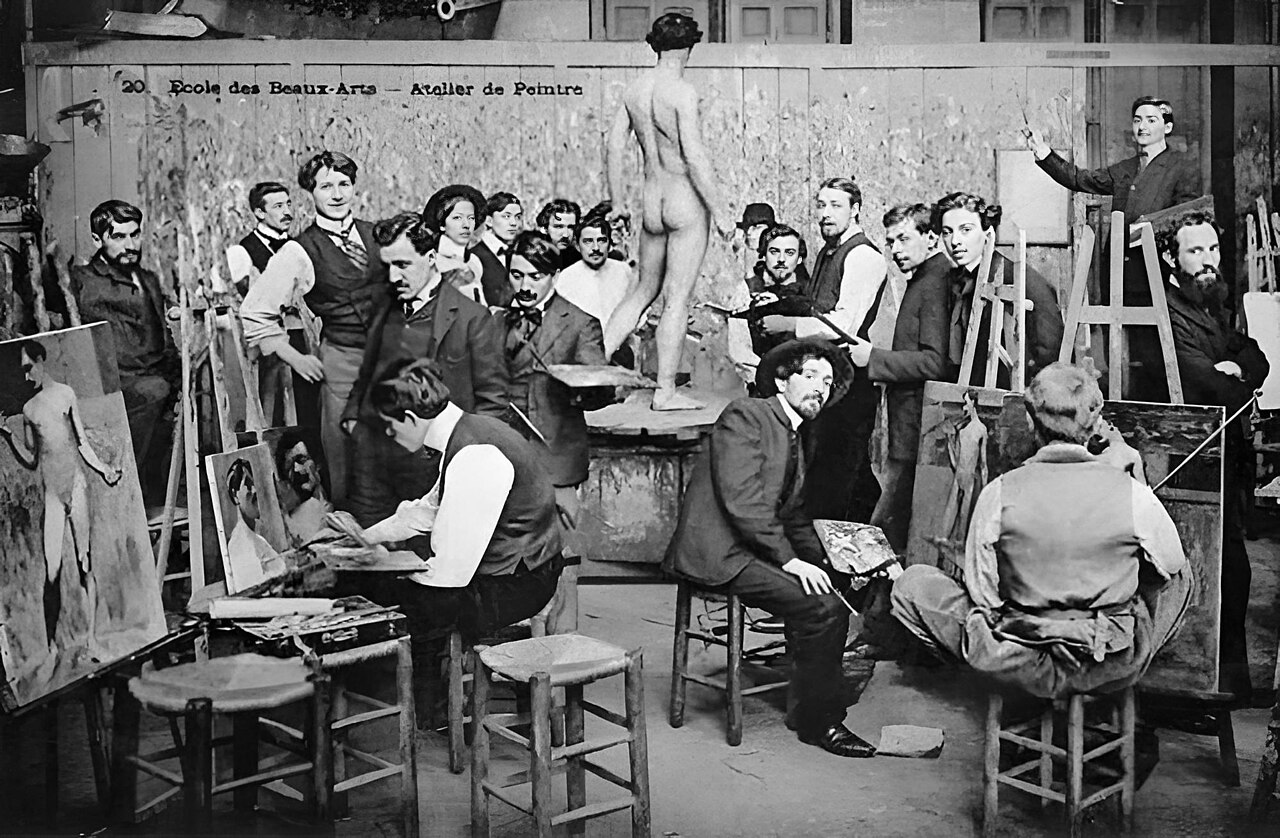
For five centuries, the life room has been art’s true classroom. Not the lecture hall. Not the museum. Not the studio. The life room \u2014 a plain space with wooden easels, north-facing windows, and a model on a platform. It’s the place where looking becomes seeing, where the body becomes language, and where every serious artist has had to confront the oldest subject in the book: another human being, unclothed and unguarded.
\n\n
This is the story of why the nude has always been art’s first lesson.
\n\n
The Accademia del Disegno: Where It All Began
\n\n
The life room as we know it was born in Renaissance Italy. In 1563, Giorgio Vasari founded the Accademia del Disegno in Florence \u2014 the first formal art academy. Before that, artists learned in workshops, copying their masters. But the Accademia introduced something radical: drawing directly from the live nude model as a structured educational practice.
\n\n
The Carracci family took the idea north to Bologna in the 1580s, founding an academy that trained a generation of Baroque painters. Their curriculum was brutally simple: draw from casts of classical sculpture first, then graduate to the live model. Only after mastering the nude body could a student attempt color, composition, or narrative.
\n\n
The logic was unassailable. If you can’t draw the human figure \u2014 its proportions, its weight, its balance, its gesture \u2014 you can’t draw anything that matters. Every story worth telling in Western art involved bodies: the body of Christ, the body of Venus, the body of the hero, the body of the martyr. The nude wasn’t a subject among many. It was the foundation of everything.
\n\n
The French Academy: Systematizing the Body
\n\n
France took the Italian model and turned it into a machine. The Acad\u00e9mie Royale de Peinture et de Sculpture, founded in 1648, and its successor the \u00c9cole des Beaux-Arts, built the most rigorous figure-drawing curriculum in history.
\n\n
Students competed for the privilege of drawing from the model. The hierarchy was precise: beginners drew from plaster casts. Intermediate students drew from the live model in the evening, after the professors had gone home. Only the most advanced \u2014 those who had won medals in the Academy’s competitions \u2014 drew from the live model during the day, under the gaze of a master.
\n\n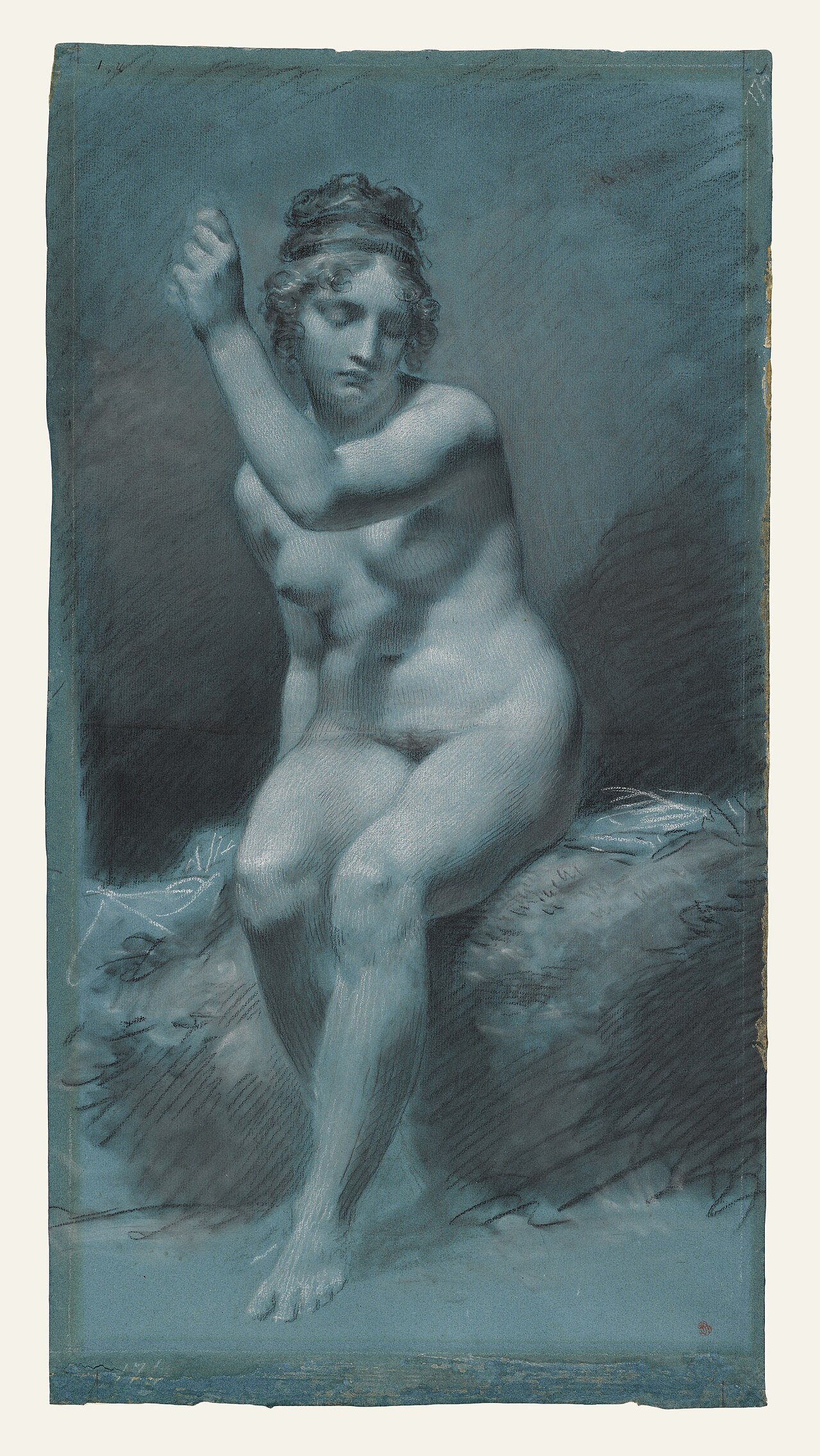 \n\n
\n\n
The product of this system was the acad\u00e9mie \u2014 a finished figure drawing, usually in chalk or charcoal on tinted paper, of a single nude model in a carefully posed attitude. These weren’t expressive sketches. They were demonstrations of technical mastery: perfect anatomy, controlled lighting, classical contrapposto. A good acad\u00e9mie could make a career. A bad one could end it.
\n\n
Every French artist working between 1650 and 1900 produced acad\u00e9mies. Jacques-Louis David. Ingres. Delacroix. G\u00e9ricault. Bouguereau. Manet. Degas. C\u00e9zanne. The acad\u00e9mie wasn’t a style \u2014 it was a shared language, a baseline competence that connected artists across two and a half centuries of radically changing taste.
\n\n
Who Got to Draw, and Who Got to Pose
\n\n
For most of its history, the life room was an all-male space. Women were barred from drawing the nude male model \u2014 it was considered indecent, impossible, a threat to feminine virtue. Female art students made do with plaster casts, drapery studies, and, in some cases, animal carcasses for anatomy practice. The Royal Academy in London didn’t admit women to life drawing until 1893 \u2014 and even then, the model had to be partially draped.
\n\n
The model, meanwhile, was almost always working class. Posing was grueling, poorly paid, and socially stigmatized. Male models were often veterans, laborers, or street performers. Female models were frequently sex workers or domestic servants \u2014 people for whom the boundary between posing and other forms of bodily labor was already blurred. The life room’s great artistic product was built on a transaction that was never quite neutral.
\n\n
Yet it was also, for some, a path to something like dignity. In 1863, the painter Thomas Couture paid his model \u2014 a woman named Apollonie Sabatier, known as “La Pr\u00e9sidente” \u2014 enough that she could host one of the most famous salons in Paris. Models were invisible to art history, but they were present in every great painting ever made.
\n\n
The Body Under the Knife: Anatomy as Curriculum
\n\n
Drawing from the live model was only half the training. The other half was anatomy \u2014 sometimes involving actual dissection. The \u00c9cole des Beaux-Arts required students to attend anatomy lectures and study from cadavers. You learned the body’s surface by understanding what lay beneath it: muscles, bones, tendons, the mechanics of a raised arm or a bent knee.
\n\n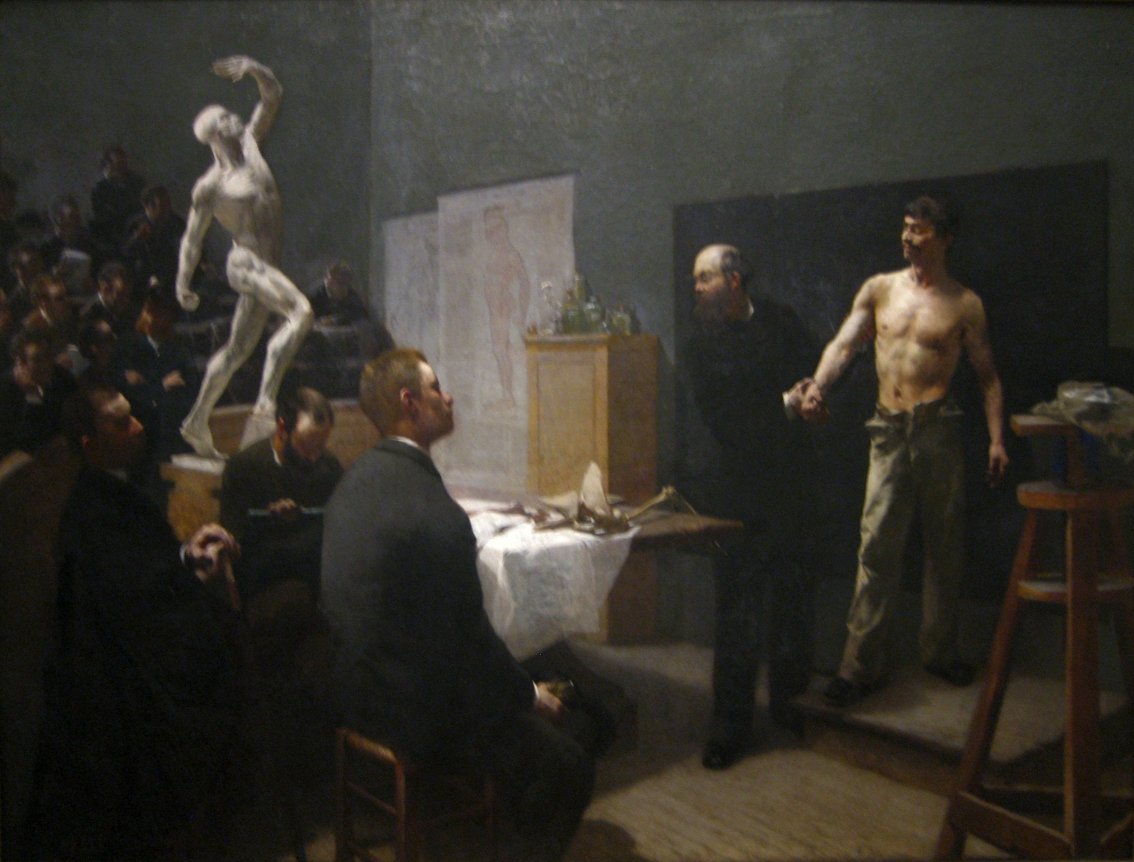 \n\n
\n\n
This wasn’t medical training. It was artistic training. The goal was to draw a figure that felt alive \u2014 that carried its weight convincingly, that moved through space with anatomical plausibility. The greatest figure artists \u2014 Michelangelo, Rubens, Eakins \u2014 were also obsessive students of anatomy. Michelangelo dissected corpses in Florence’s Santo Spirito hospital. Thomas Eakins took anatomy classes alongside medical students in Philadelphia. For these artists, the nude wasn’t an aesthetic choice. It was a form of knowledge.
\n\n
Why It Still Matters
\n\n
Today, the life room is less a requirement than a choice. Most art schools still offer figure drawing, but the old hierarchy is gone. You can graduate from a prestigious MFA program without ever drawing from a live model. Photography, video, installation, performance \u2014 the contemporary art world has moved far beyond the charcoal-and-newsprint discipline of the Acad\u00e9mie.
\n\n
And yet.
\n\n
Walk into any open life-drawing session in any city on any Tuesday evening and you’ll find the room full. Not just art students \u2014 designers, animators, tattoo artists, hobbyists, retirees. People who want to understand the body not through theory but through practice. Who want the slow, humbling, deeply satisfying work of translating a living, breathing person onto a two-dimensional surface.
\n\n
The life room persists because it offers something that no other art education can: the experience of sustained attention. You can’t rush figure drawing. The model holds a pose for two minutes, five minutes, twenty. Your hand moves. Your eye measures. Your mind quiets. For the duration of the pose, nothing exists except the body in front of you and the mark you’re about to make.
\n\n
That’s why the nude has been art’s classroom for 500 years. Not because it’s titillating. Not because it’s transgressive. But because the human body is the most complex, expressive, and endlessly variable subject in the visible world \u2014 and learning to see it honestly is the beginning of learning to see anything at all.
\n\n
Want to experience the life room yourself? Check out our Get Involved page for figure-drawing sessions in your area \u2014 or visit our Collections to see how contemporary artists are keeping the tradition alive.
\n