The Man Who Drew the Invisible
\n\nOdilon Redon died on July 6, 1916 \u2014 110 years ago today \u2014 and the art world still hasn’t finished catching up to him. He was 76. He’d spent the first half of his career making images no one wanted: charcoal drawings of floating eyes, grinning spiders, disembodied heads. His dealer called them “things that cannot exist.” The critics called them the work of a madman. Redon called them his noirs \u2014 his blacks \u2014 and for twenty-five years he drew almost nothing else.
\n\nThen, around 1890, something broke open. Redon discovered color. Pastels, oils, canvases filled with flowers, mythological women, luminous dreamscapes. And into these new works walked the nude \u2014 not the classical nude of the academy, all ideal proportion and heroic posture, but something stranger: the nude as a dream the body was having.
\n\nToday, when we talk about the nude in modern art, we usually talk about Picasso shattering it, Schiele electrifying it, Modigliani elongating it. Redon did something different. He didn’t deform the body \u2014 he dissolved it. He made it porous to the unconscious. His nudes occupy a space between waking and sleeping, between myth and memory, between the visible world and whatever lies just beyond it.
\n\nThe Cyclops: A Dream Looking at Itself
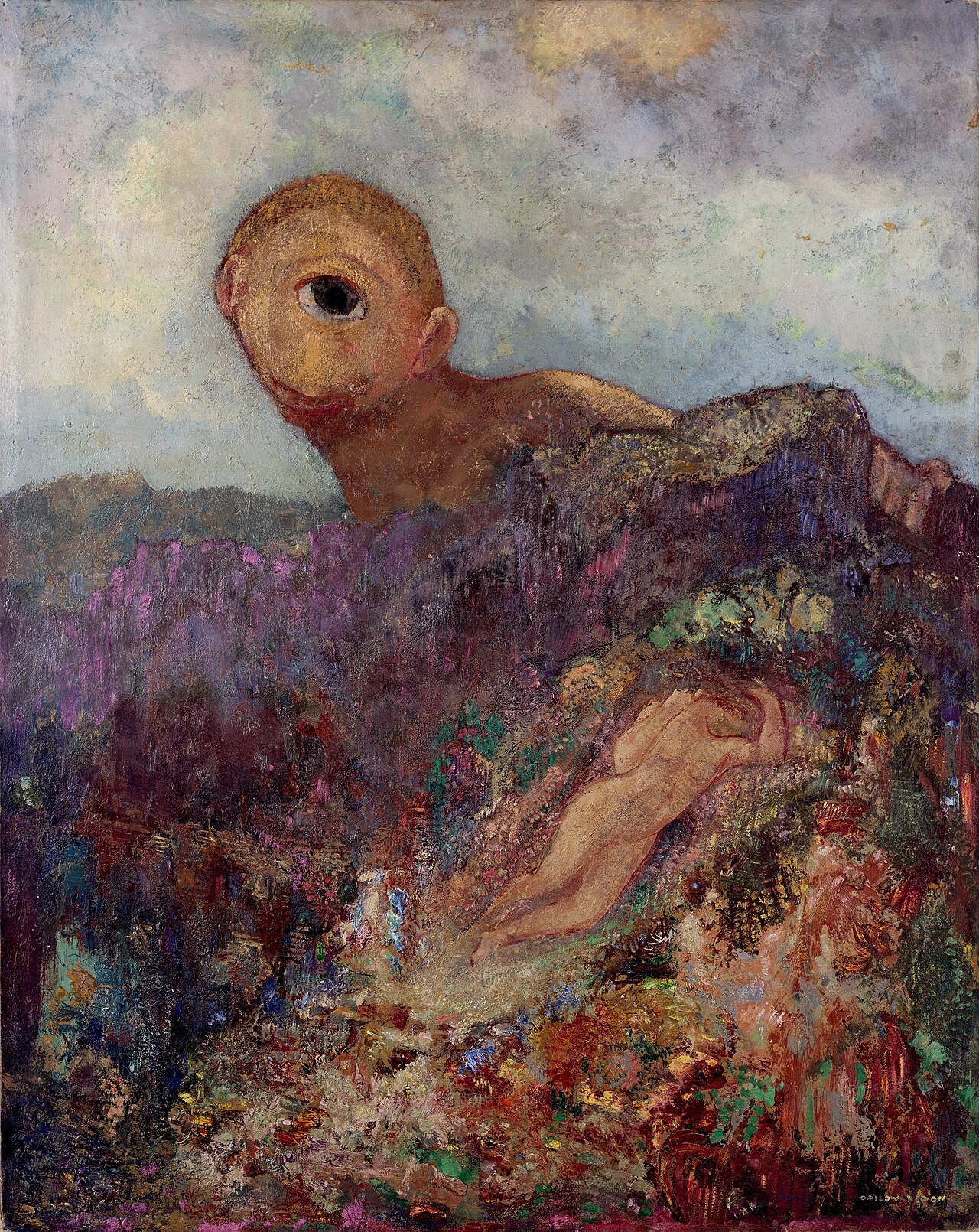
\n\nYou know the painting even if you don’t know you know it. The Cyclops (c. 1914), now in the Kr\u00f6ller-M\u00fcller Museum, is Redon’s most famous image \u2014 and one of the strangest nudes in Western art. A woman lies sleeping in a field of impossible flowers. Above her, filling the upper half of the canvas, looms the enormous head of Polyphemus, the one-eyed giant of Greek myth. He’s watching her. Longing for her. She’s the sea nymph Galatea, and she doesn’t know he’s there.
\n\nWhat makes the painting so unsettling \u2014 and so extraordinary \u2014 is that Redon refuses to make the Cyclops a monster. The giant’s eye is soft, almost tender. His expression isn’t predatory; it’s reverent. He looks at Galatea the way a child looks at a butterfly: fascinated, helpless, a little heartbroken. The nude body at the center of the painting isn’t being menaced \u2014 it’s being dreamed.
\n\nThis is Redon’s fundamental insight: the nude isn’t just something we look at. It’s something that looks back. It’s an image that carries the weight of our own desire, our own fear, our own interior life. Every nude is a self-portrait of the person who painted it \u2014 and every nude is also a portrait of the person who’s looking.
\n\nMythology as Interior Geography
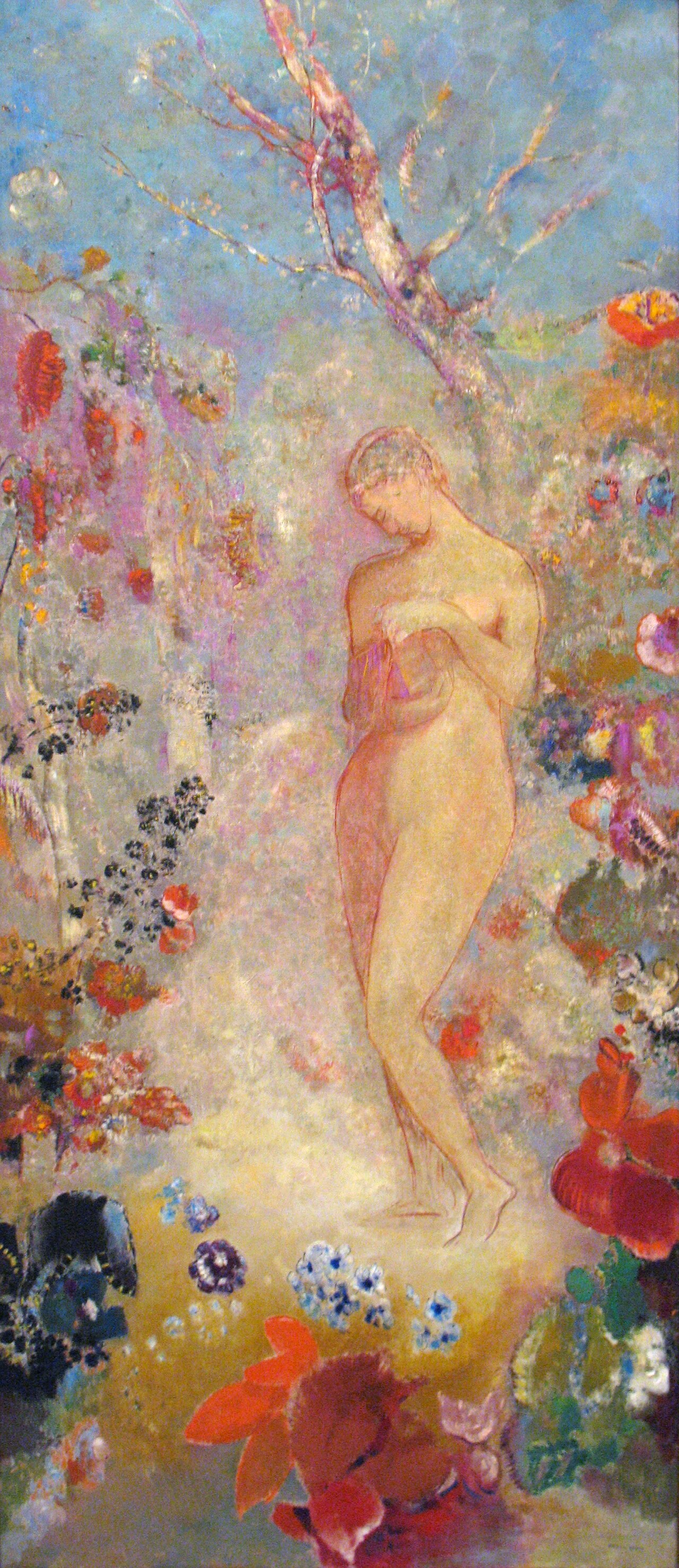
\n\nRedon returned to myth again and again in his late period, and his mythological women \u2014 Pandora, Sita, Ophelia, Eve \u2014 are never quite of this world. In his Pandora (1914), the first woman of Greek myth stands naked in a field of flowers, her body half-materialized from the surrounding color. She’s surrounded by blooms that seem to have grown out of the paint itself. Her face is calm, inward. She’s holding something \u2014 the famous box? \u2014 but Redon has made it a small, dark flower. The instrument of all human suffering, reduced to a botanical detail.
\n\nThis is not Pandora as cautionary tale. This is Pandora as psychological truth: the woman who opened the container of human experience, who released everything \u2014 hope included \u2014 into the world. Redon treats myth not as illustration but as a map of the psyche. His mythological nudes are figures out of dreams: legible, luminous, just out of reach.
\n\nWhat changed, when Redon found color? He’d spent decades mastering black \u2014 “one must respect black,” he wrote. “Nothing prostitutes it.” His noirs were probing, unsettling, full of creatures that emerged from the charcoal like symptoms from a fever. But when he turned to color, the nightmares softened. The body returned. Human figures appeared \u2014 not as anatomical studies but as presences, as visitations. The charcoal had been a descent; the pastels were an ascent. And the nude was the form that made that ascent possible.
\n\nThe Body That Dreams Itself
\n\nRedon once described his method with a sentence that could serve as the mission statement for Symbolism itself: “My drawings inspire, and are not to be defined. They place us, as music does, in the ambiguous realm of the undetermined.”
\n\nThis is exactly what his nudes do. They don’t sit for a portrait. They don’t pose for the academy. They appear, the way figures appear in dreams \u2014 fully present, fully mysterious, fully themselves. The body in Redon’s work is never just a body. It’s a threshold. It’s the border between the visible and the invisible, between what we can name and what we can only feel.
\n\nThe Surrealists understood this immediately. Andr\u00e9 Breton called Redon “the precursor of Surrealism.” When the movement launched in 1924, eight years after Redon’s death, his influence was everywhere \u2014 in the dream-logic of Dal\u00ed, in the floating figures of Magritte, in the conviction that the real subject of art was not the external world but the internal one. Redon had spent his entire career insisting on exactly that.
\n\nA Different Kind of Realism
\n\nThere’s a temptation, when you write about Symbolism, to treat it as a retreat from reality \u2014 a flight into fantasy. That gets Redon exactly backward. He wasn’t fleeing the real. He was arguing that the real is larger than what we can see. His nudes are not escapes from the body \u2014 they’re investigations of it. They ask: What does the body look like from the inside? What does it feel like to be a body, not just to look at one?
\n\nThis is what makes Redon’s nudes feel contemporary 110 years after his death. We live in an era obsessed with the surface of the body \u2014 photographed, filtered, scanned, optimized. Redon reminds us that the body has an interior. It dreams. It remembers. It trembles at things it cannot name. The nude, in his hands, becomes not an object to be consumed but a mystery to be lived.
\n\nRedon died in Paris in the middle of the First World War. The European civilization that had produced him was tearing itself apart. His late paintings \u2014 all those flower-women, all those dreaming nudes \u2014 were made in the shadow of catastrophe. You can read them as an escape, and maybe they were. But you can also read them as an insistence: that even in the worst of times, the body remains a site of wonder. That the nude is not a retreat from reality but a deeper way of attending to it.
\n\nOne hundred and ten years later, we could use that reminder.
\n\n\n\n
Further Reading: The Kr\u00f6ller-M\u00fcller Museum in the Netherlands holds the largest collection of Redon’s work. His lithographic series Dans le R\u00eave (1879) and Les Origines (1883) are available in the public domain through the Metropolitan Museum of Art and the Art Institute of Chicago.
\n\n\n