When F\u00e9licien Rops was born in Namur, Belgium, on July 7, 1833 \u2014 193 years ago today \u2014 the academic nude was in its final, exhausted flowering. Ingres was painting odalisques with impossible vertebrae. Cabanel was coating goddesses in porcelain finish. The nude body in official art was a lie: sanitized, idealized, drained of everything that makes flesh flesh. Rops would spend his career setting fire to that lie \u2014 and using the naked body not as an object of desire but as a weapon of critique.
\n\n\n\nIf you know one image by Rops, it is Pornokrat\u00e8s (1878). A woman walks forward, nude except for black stockings, gloves, a feathered hat, and a blindfold. She is led by a pig on a leash \u2014 a golden leash. Above them, three cherubs scatter petals. The composition is part religious procession, part burlesque parade. The woman is not a victim. She is not a temptress. She is something more unsettling: she is in control, and she has chosen blindness. The pig \u2014 the animal of base appetite \u2014 is her guide. The cherubs are not blessing her; they are decorating the route.
\n\n\n\n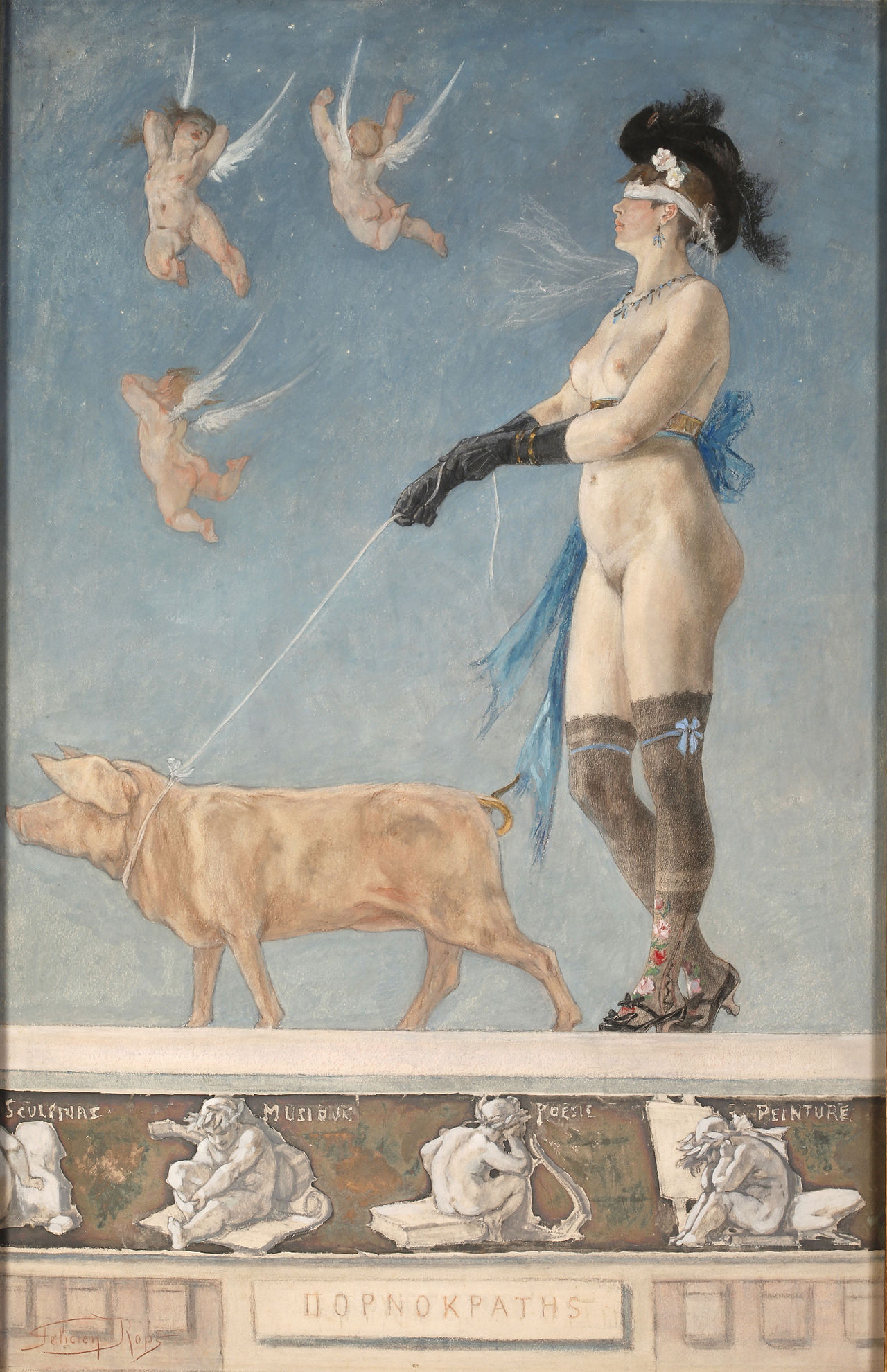
Pornokrat\u00e8s \u2014 “the rule of the prostitute” \u2014 was Rops’s thesis statement. It announced what the rest of his career would elaborate: that the nude body in art is never just a body. It is always carrying the anxieties of the culture that produced it. And in late nineteenth-century Europe, the culture was terrified of what the body wanted. Rops simply refused to pretend otherwise.
\n\n\n\nThe Decadent Mirror
\n\n\n\nRops belonged to the Decadent movement, that feverish offshoot of Symbolism that took Baudelaire’s Les Fleurs du mal as its scripture. The Decadents believed that civilization was rotting from within \u2014 and that the artist’s job was not to offer consolation but to hold up a mirror to the rot. Rops’s nudes are that mirror. They do not invite. They accuse.
\n\n\n\nThis was a radical inversion of the academic tradition. For centuries, the female nude in Western art had been a vehicle for idealization \u2014 Venus, Diana, Susanna, the anonymous odalisque. The body was offered for contemplation, arranged for the pleasure of the (presumed male) viewer. Rops’s women refuse that role. They are not goddesses. They are modern women in modern Paris \u2014 prostitutes, courtesans, dancers \u2014 and their nudity is not an invitation but an indictment. Look, they seem to say. This is what you want. Now look at what you are.
\n\n\n\n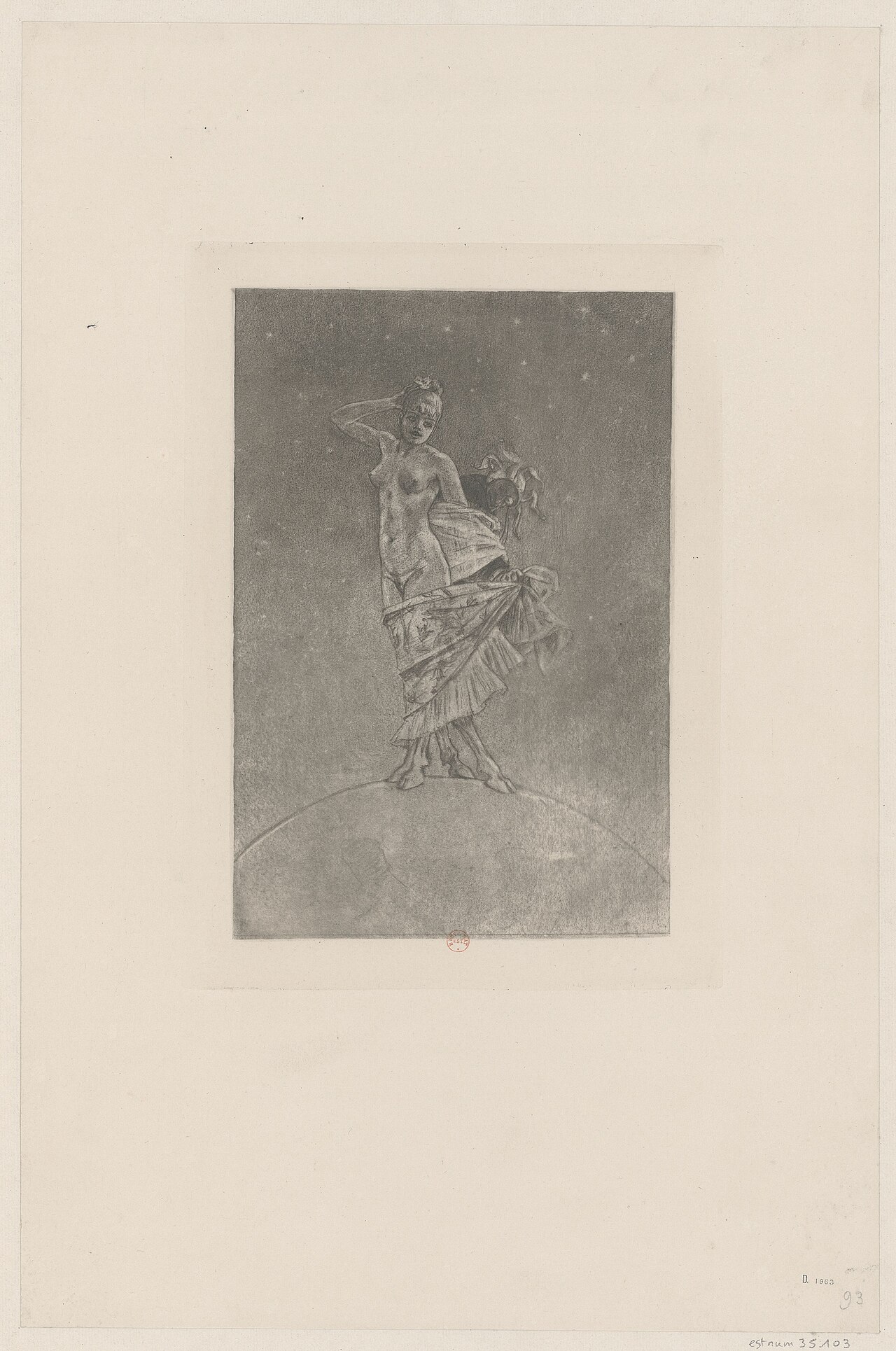
Les Sataniques: The Body as Battleground
\n\n\n\nIn the 1880s, Rops produced Les Sataniques, a series of etchings that remain among the most unsettling images in the history of printmaking. They are not illustrations of Satanism in any literal sense. They are studies of the body as a site of moral and metaphysical combat. In Satan semant l’ivraie (“Satan Sowing Tares”), a skeletal figure strides over a sleeping city, scattering seeds that will grow into the corruption below. The bodies in these prints are not idealized \u2014 they are thin, angular, mortal. They look like they belong to people who have suffered, or are about to.
\n\n\n\nThe series was never about devil worship. It was about what happens when a culture worships appearances while rotting underneath. The nude body in Les Sataniques is not the object of the drama; it is the stage on which the drama plays out. Rops understood something that would take Freud another two decades to articulate: the body carries what the mind refuses to acknowledge.
\n\n\n\n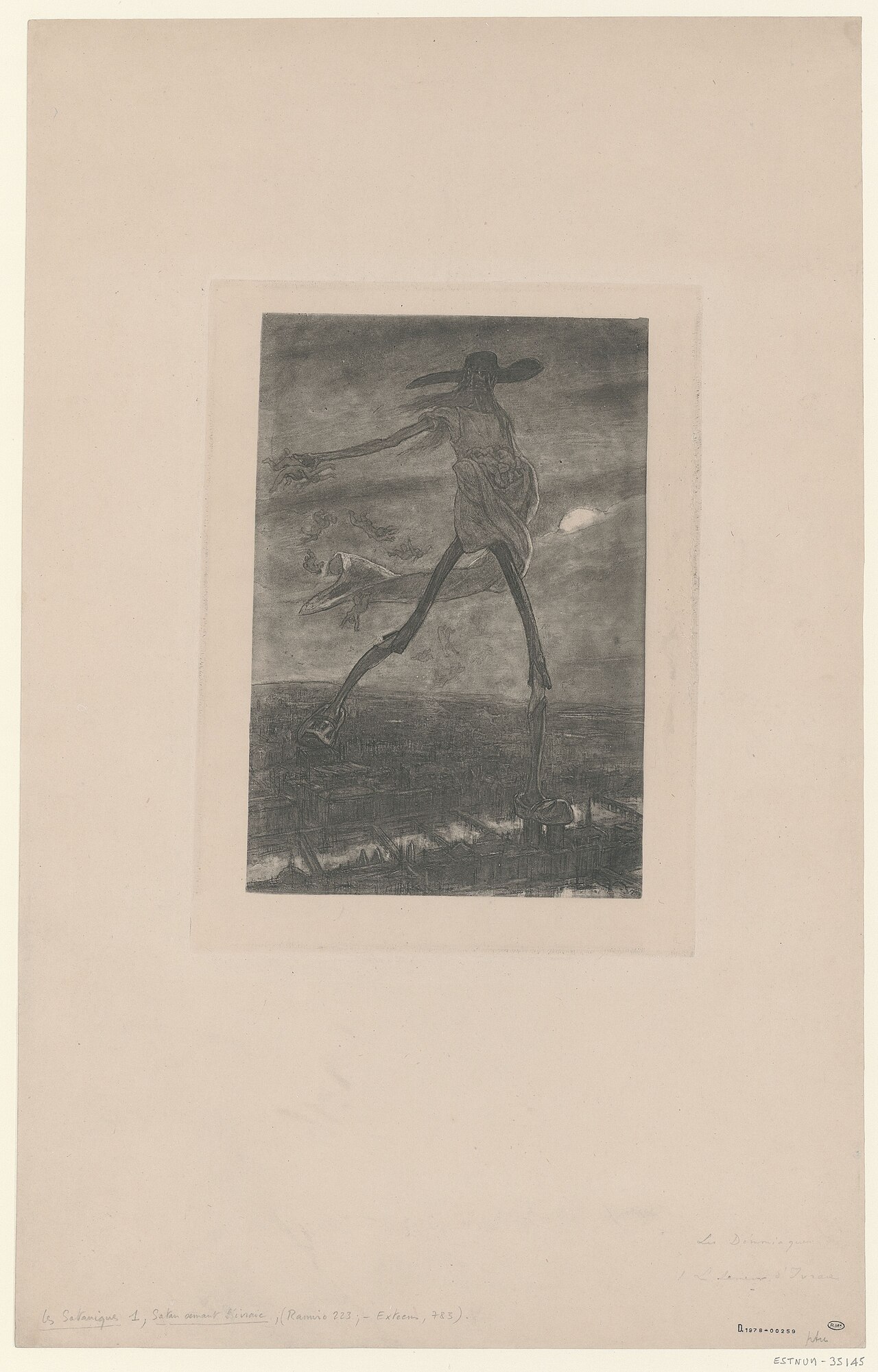
The Etching as Confession
\n\n\n\nIt matters that Rops was primarily an etcher. Etching is an intimate medium. It happens in private, on copper plates, in acid baths. The prints are small. You have to lean in. You cannot view an etching by Rops from across a museum gallery the way you can an academic canvas. The medium enforces proximity \u2014 and proximity is uncomfortable when the subject is a blindfolded woman being led by a pig, or a skeleton scattering corruption over Paris.
\n\n\n\nRops chose etching deliberately. It was the medium of Rembrandt and Goya \u2014 artists who also understood that the nude body, rendered without flattery, could reveal depths that polished painting could not. The burin and the acid bite gave Rops’s nudes a quality that oil paint could not: a kind of nervous energy, a shiver. These bodies look caught, not posed. They belong to a moment of exposure rather than a moment of display.
\n\n\n\nWhy Rops Still Matters
\n\n\n\nThere is a temptation to read Rops as a misogynist \u2014 an artist who used the female body as a prop for moralizing. And to be sure, his imagery is saturated with the anxieties of his era about female sexuality. But that reading misses what is genuinely subversive about his work. Rops did not blame women for what he saw in Paris. He blamed the men who consumed them \u2014 the bourgeois gentlemen who attended the opera by night and the brothel afterward, who demanded purity in their wives and depravity in their mistresses, who built a society on the exploitation of bodies while pretending those bodies did not exist.
\n\n\n\nHis nudes are not celebrations of sin, but they are not condemnations of sinners either. They are questions \u2014 uncomfortable, unanswerable questions \u2014 about what we demand from the nude body in art and in life. Do we want truth or flattery? Revelation or concealment? A mirror or a mask?
\n\n\n\nOne hundred and twenty-eight years after his death, those questions have not aged a day. Every conversation about the nude in art \u2014 about censorship, objectification, the male gaze, the female body as territory \u2014 traces back, in some way, to the ground Rops broke open. He did not give us comfortable nudes. He gave us honest ones. And honesty, in art as in life, is harder to look at than beauty \u2014 and far more necessary.
\n\n\n\n\u2014 Chris Wallace, NALA
\n