
On July 8, 1593, a girl was born in Rome who would do something no woman had done before: paint the female nude from the inside. Artemisia Gentileschi didn’t just depict women’s bodies — she put their experience on the canvas. The fear. The fury. The quiet resolve. Four hundred and thirty-three years later, her nudes still hit differently than anything else in Baroque art. They don’t perform for the viewer. They don’t apologize. They inhabit themselves.
This isn’t just about representation. It’s about what happens when the person holding the brush has actually lived inside the body being painted.
The Nude That Looked Back
Artemisia was seventeen when she painted Susanna and the Elders (1610) — her first signed work and, remarkably, the first known female nude painted by a woman in the history of Western art. The biblical story was a favorite of Baroque painters: two lecherous elders spy on Susanna bathing, then blackmail her with false adultery accusations when she refuses them. Every male painter before Artemisia had treated the scene as an invitation — Susanna as unwitting pinup, the garden as peepshow, the viewer recruited into the elders’ gaze.
Artemisia’s Susanna is different. She twists away from the elders with genuine physical anguish — her body contorted, her face registering revulsion, her hands raised in a gesture that reads as both self-protection and a plea to heaven. There is nothing erotic about this woman’s nakedness. She is being violated by the act of looking, and Artemisia makes sure you feel it.
This was not just painterly genius. It was autobiography before the autobiography had happened.
The Trial and the Body as Evidence
In 1611, Artemisia was raped by Agostino Tassi, a painter her father Orazio had hired to tutor her. When Tassi refused to marry her — the standard remedy for “restoring honor” in 17th-century Rome — Orazio brought charges. The trial that followed was brutal. Artemisia was subjected to the sibille, a form of torture in which cords were tightened around her fingers, to test her testimony. She held firm. “This is the ring you gave me,” she reportedly told Tassi in court, “and these are your promises.”
The trial records survive, and they are chilling reading. But what matters for art history is what happened next: Artemisia painted Judith Slaying Holofernes.
The Nude That Fights Back
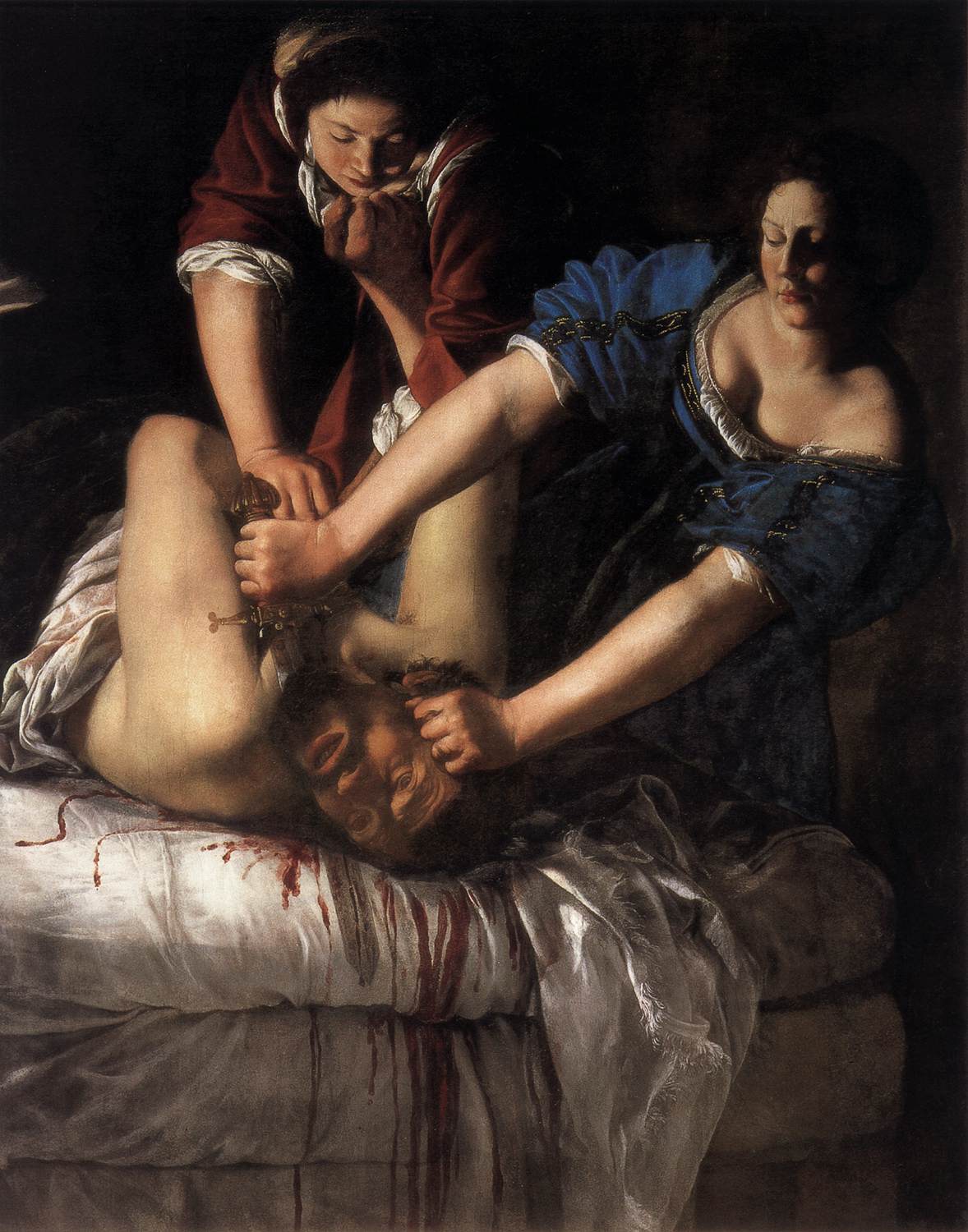
Everyone who studies this painting has the same reaction: she meant it. The biblical heroine Judith, aided by her maidservant Abra, saws through the neck of the Assyrian general Holofernes. Blood spurts across white sheets. Judith’s sleeves are rolled up like a butcher’s. Her expression is not horror or ecstasy — it is focused, professional determination. This is work being done.
Compare it with Caravaggio’s version of the same scene, painted a decade earlier. Caravaggio’s Judith is dainty, tentative, holding the sword at arm’s length like it might bite her. His Abra is a passive crone watching from the sidelines. Artemisia’s Judith and Abra are a team — two strong women holding a man down and finishing him. The nude body here is not an object of contemplation. It is an instrument of justice.
Artemisia painted this within a year or two of her rape trial. Whether you read it as catharsis, revenge fantasy, or simply an artist claiming her subject matter — the painting radiates something unprecedented in the history of the nude: a female body that is not being looked at but is doing the acting.
The Body Beyond the Trial
It would be a mistake to reduce Artemisia’s entire career to the Tassi assault. She was the first woman admitted to the Accademia delle Arti del Disegno in Florence — a feat of recognition that few male artists of her era achieved. She ran a successful workshop in Naples. She corresponded with Galileo. Her patrons included the Medici and Charles I of England.
And throughout, she kept painting women’s bodies — not as allegorical vessels or decorative afterthoughts, but as sites of agency, thought, and interior life.
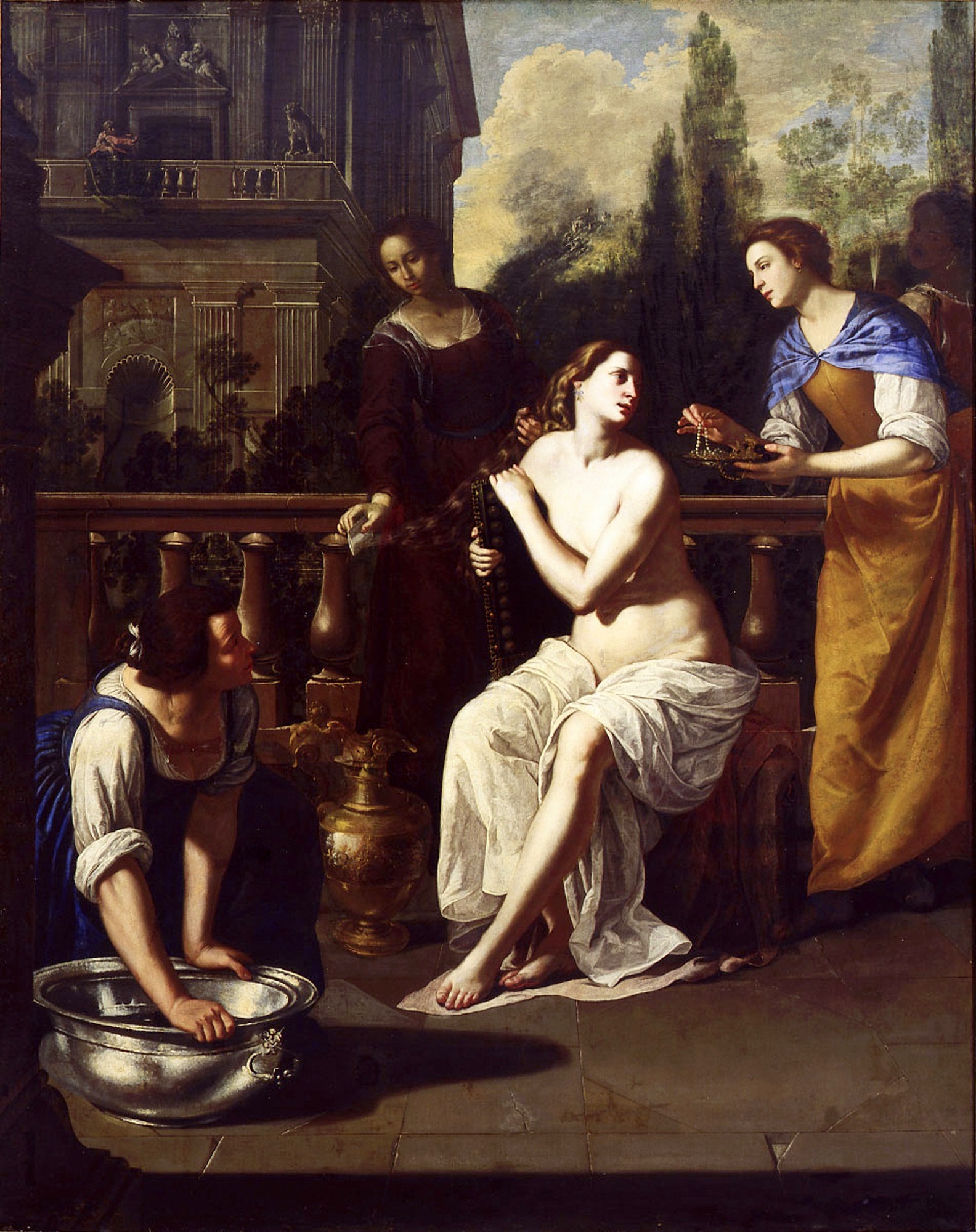
Her Bathsheba (c. 1636-1637) shows the biblical queen at her bath, attended by two maidservants. In the distance, on a balcony, King David watches. But Bathsheba doesn’t notice him — she’s absorbed in her own reflection, her own world. The nude here is unconscious of being watched, which is the rarest thing in Baroque art. Most painters would have angled her toward the viewer, or toward David, inviting us into the voyeurism. Artemisia gives us a woman who is, for this one moment, simply alone with herself.
Her Lucretia shows a woman about to drive a dagger into her own chest — fully clothed above the waist but exposed below, caught in the unbearable vulnerability of deciding to die rather than live with dishonor. Her Cleopatra is dying from the asp’s bite, but the body is monumental, almost sculptural — not a fallen woman but a queen choosing her own ending.
Across all of these, the same thread: the female nude as a body that makes its own choices.
Why She Still Matters
Artemisia Gentileschi was largely forgotten after her death around 1653. Her works were attributed to her father, to Caravaggio, to anonymous followers. The rediscovery began in earnest only in the 20th century, driven by feminist art historians like Mary Garrard who recognized that something fundamentally different was happening in these canvases.
In 2018, the National Gallery in London acquired a self-portrait of Artemisia as Saint Catherine of Alexandria — the first work by a female Old Master the Gallery had bought in 27 years. In 2020, a newly discovered Lucretia sold for €4.8 million. She is no longer invisible. But the real question her work poses is more uncomfortable: why did it take a rape survivor in 17th-century Rome to paint a female nude that felt true?
Because here’s the thing about Artemisia’s nudes: they don’t invite. They don’t perform. They don’t arrange themselves for your pleasure. They exist in their own interior space, having experiences that belong to them, not to you. And that, four centuries before Instagram, four centuries before #MeToo, was the most radical thing a painter could do with the human body.
Happy 433rd birthday, Artemisia. You’re still ahead of us.
— NALA