James McNeill Whistler was born 192 years ago today \u2014 July 11, 1834 \u2014 in Lowell, Massachusetts. He would become the most influential American artist of the 19th century, the man who sued John Ruskin for libel and won (a farthing), the dandy who painted Whistler’s Mother and then spent the rest of his career insisting it wasn’t about his mother at all. “Art should be independent of all claptrap,” he wrote. “It should stand alone, and appeal to the artistic sense of eye or ear, without confounding this with emotions entirely foreign to it.”
\n\n\n\nThat philosophy \u2014 art for art’s sake \u2014 would reshape how the Western world looked at painting. But its most radical application was to the one subject that had never been allowed to stand alone: the nude body.
\n\n\n\nThe Body Without a Story
\n\n\n\nFor four centuries before Whistler, the nude in Western art came with an explanation. Venus needed her mythological CV. Susanna required elders. Bathsheba came with a king. Even Courbet’s Origin of the World \u2014 the most confrontational nude of the 19th century \u2014 carried the weight of a thesis statement. The naked body was never just a body. It was always an argument.
\n\n\n\nWhistler disagreed. Not loudly, not polemically \u2014 he was too much the aesthete for manifestos \u2014 but systematically. When he painted the nude, he treated it the way he treated a nocturne on the Thames: as an arrangement of color, tone, and line. The body wasn’t Venus or Eve or a scandal. It was a formal problem.
\n\n\n\nThis was genuinely new. Titian had made nudes beautiful. Rubens had made them abundant. Goya had made them political. Whistler made them abstract \u2014 not in the 20th-century sense, but in the sense that the body’s meaning receded behind its visual properties. What mattered was how the flesh tone related to the gray-green background, how the contour echoed the curve of a wave.
\n\n\n\n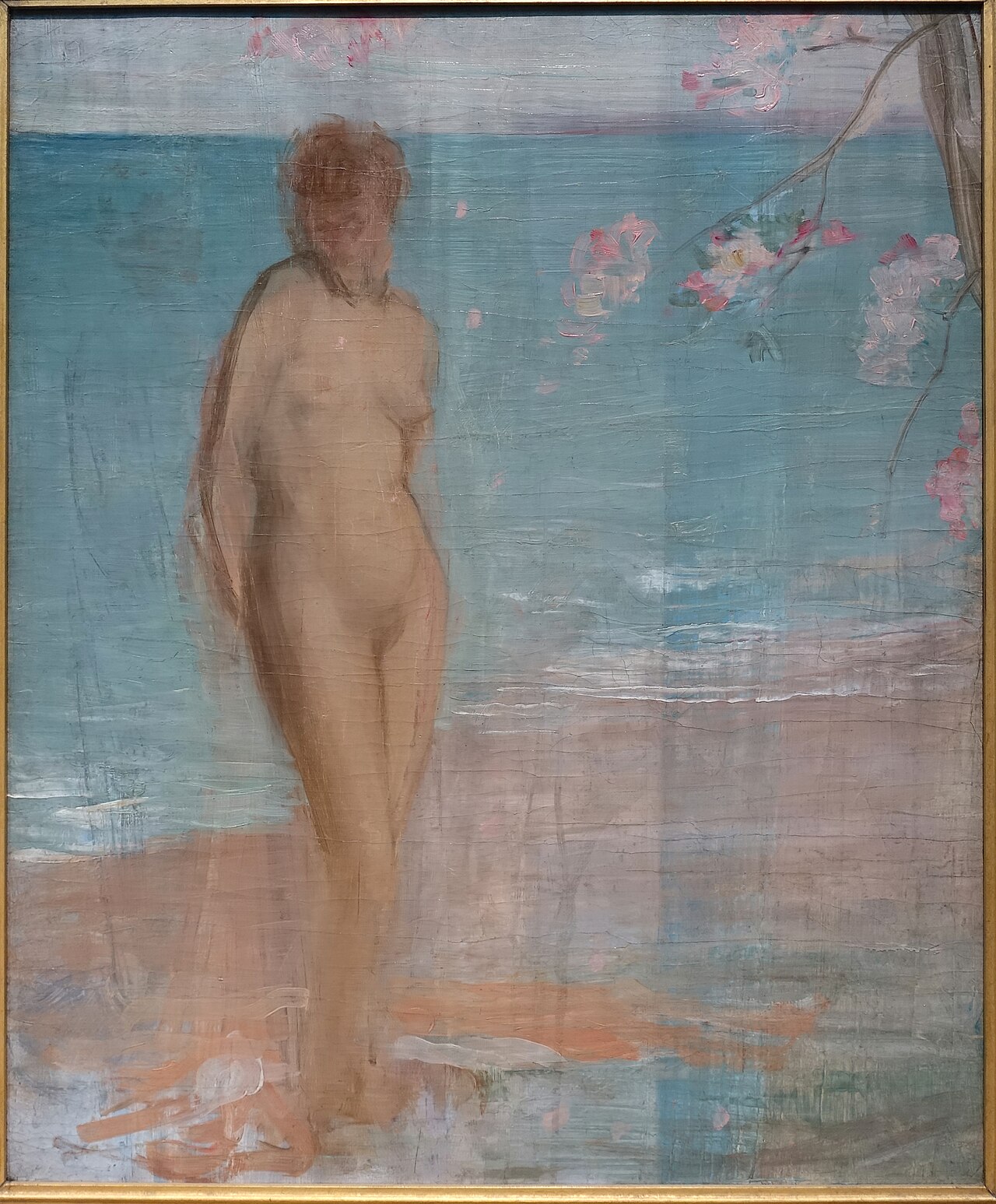
Venus in Gray and Silver
\n\n\n\nTake Venus Rising from the Sea (c. 1866\u20131870), now in the Freer Gallery. The title suggests mythology \u2014 Aphrodite born from the foam \u2014 but look at what Whistler actually painted. The figure is barely distinguishable from the sea and sky around her. Her flesh is the same gray-pink as the horizon. Her hair dissolves into the water. There are no identifying attributes, no shell, no putti, no narrative context whatsoever.
\n\n\n\nThis is a Venus who exists entirely as a pictorial event. Whistler might as well have titled it Arrangement in Flesh and Gray \u2014 which, knowing him, is probably what he wanted to call it. The painting doesn’t tell you a story. It asks you to look.
\n\n\n\nCritics at the time found this baffling. The Victorians expected their nudes to come with moral justification \u2014 classical precedent, biblical authority, at minimum a fig leaf of allegory. Whistler’s Venus offered none of that. She was simply there, suspended between sea and sky, between representation and abstraction, asking nothing of the viewer except sustained attention.
\n\n\n\nThe Model as Arrangement
\n\n\n\nIf the painted nudes were rare \u2014 Whistler completed perhaps half a dozen in his lifetime \u2014 the lithographic nudes were plentiful. Working with the printer Thomas Way in London, Whistler produced a remarkable series of lithographs depicting nude and semi-nude models in his studio. They are among the most intimate works in his entire output.
\n\n\n\n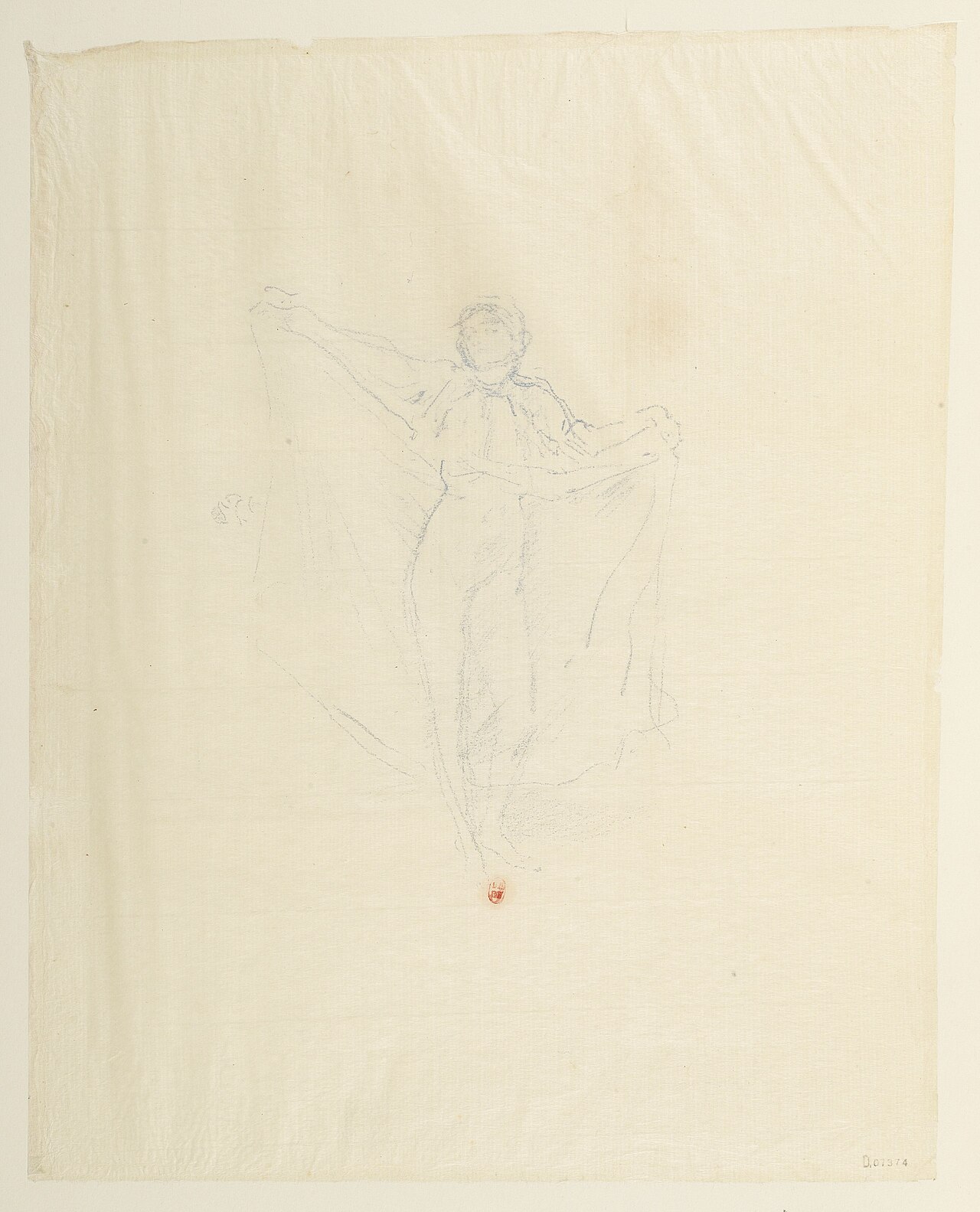
La Danseuse: A Study of the Nude shows a model in a pose that suggests movement \u2014 one arm raised, weight shifted \u2014 but the real subject is the quality of the lithographic line itself. Whistler drew directly on the stone with a crayon, building tone through the grain of the limestone rather than through hatching or cross-hatching. The result is a figure that seems to emerge from the paper like mist from water. Again, the body dissolves into its medium.
\n\n\n\nThe Little Nude Model, Reading goes further. A young woman sits on a draped stool, absorbed in a book, entirely unaware of the artist \u2014 or rather, performing unawareness with the casual grace of a professional model. There is no pose here, no classical contrapposto, no appeal to the viewer’s gaze. She is reading. Her nudity is incidental. The image is less a nude than a portrait of a person who happens not to be wearing clothes.
\n\n\n\n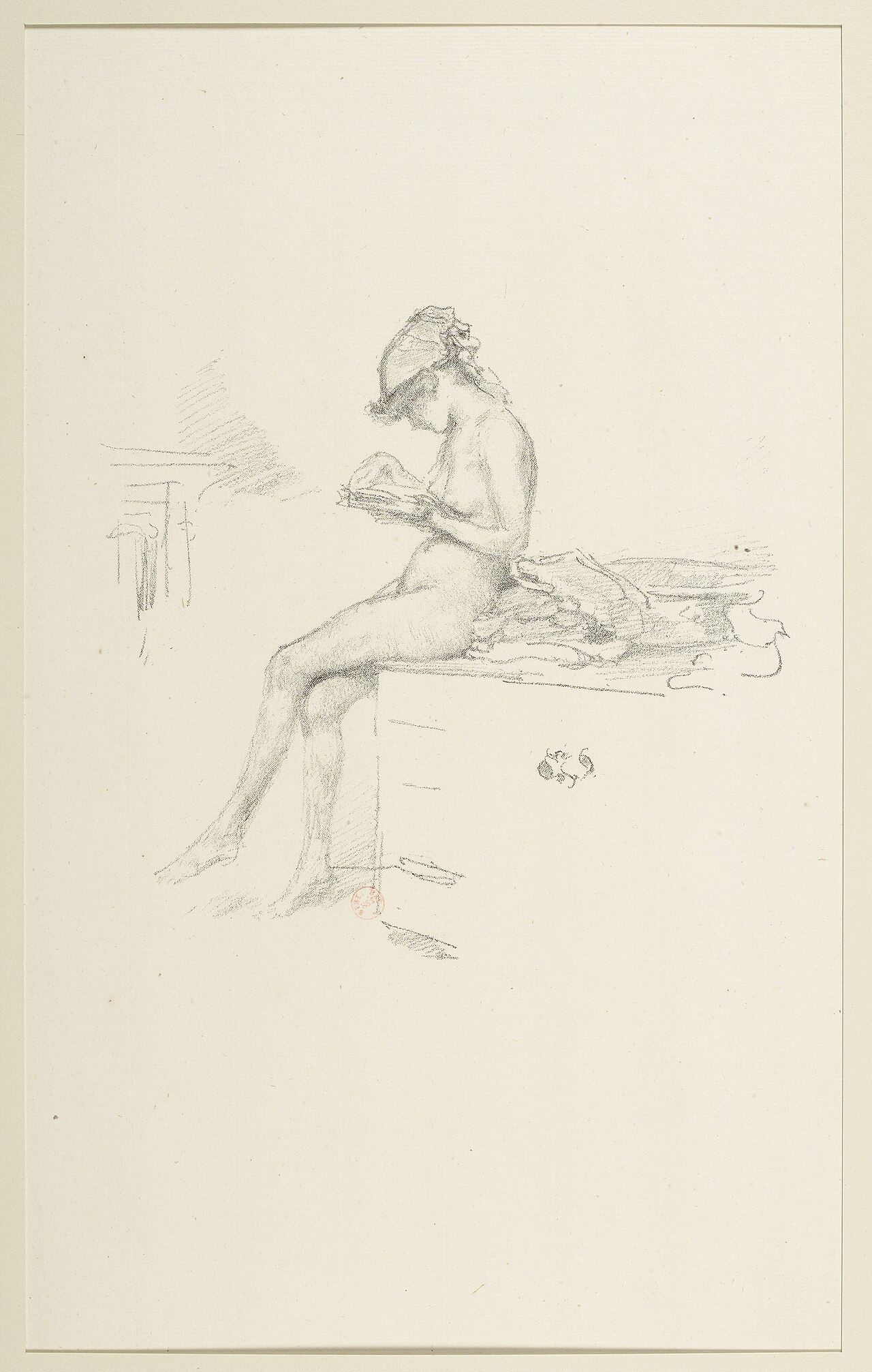
What Whistler Gave Modernism
\n\n\n\nThe Aesthetic Movement gets a bad rap in art history surveys. It’s often dismissed as the decadent prelude to modernism \u2014 all peacock feathers and japonisme and Wildean epigrams \u2014 rather than a genuine intellectual revolution. But Whistler’s contribution was real, and it was specifically about the body.
\n\n\n\nBy insisting that the nude required no narrative justification, no mythological alibi, no moral frame, Whistler cleared the ground for everything that followed. Matisse’s Blue Nude \u2014 pure color, pure form \u2014 is unthinkable without Whistler’s premise. So is Modigliani’s reduction of the body to a series of rhythmic curves. So is the entire 20th-century project of treating the figure as a formal problem rather than a storytelling device.
\n\n\n\nWhistler didn’t live to see that inheritance fully realized. He died in 1903, four years before Picasso painted Les Demoiselles d’Avignon and six years before the Futurists declared war on the past. But his ghost is everywhere in that rupture. When the modernists jettisoned narrative from painting, when they insisted that a canvas was a flat surface covered with colors arranged in a certain order, they were quoting Whistler \u2014 whether they knew it or not.
\n\n\n\nThe Body Is Enough
\n\n\n\nThere’s a tendency, even now, to treat the nude in art as something that needs defending. We reach for historical precedent, for cultural significance, for the artist’s intentions \u2014 anything to retrofit a justification onto the simple fact of a painted body. Whistler would have found this exhausting.
\n\n\n\nHis argument \u2014 made through paint, through lithographic crayon, through decades of stubborn insistence \u2014 was simpler and more radical: the body is enough. It doesn’t need a story. It doesn’t need an alibi. It can stand alone, an arrangement of flesh tones and gray horizons, and appeal directly to the eye. That, in the end, is what art for art’s sake really meant. Not escapism. Not decadence. Just the quiet, revolutionary proposition that looking is a sufficient response to being looked at.
\n\n\n\nHappy 192nd birthday, Mr. Whistler. The body is still enough.
\n