
Rembrandt van Rijn was born 420 years ago today, on July 15, 1606, in Leiden. Four centuries and two decades later, his name still means something specific in art history: light and shadow, yes, but also something rarer. He made the nude body human \u2014 not a classical ideal carved from marble fantasy, but actual flesh that sags, folds, bears weight, and carries the unmistakable burden of having lived. In a century that gave us Rubens’s magnificent whirlwinds of pink abundance and the Dutch interior painters’ moralizing caution, Rembrandt alone looked at the naked body and saw a person looking back.
\n\n
That was new. It is still new.
\n\n
The Woman in the Letter
\n\n
Nothing in Rembrandt’s career makes the point more powerfully than Bathsheba at Her Bath (1654), now in the Louvre. The biblical story is simple enough: King David sees Bathsheba bathing from his rooftop, summons her, impregnates her, and arranges her husband’s death. Every painter before Rembrandt who took up the subject painted the moment of looking \u2014 David’s gaze, Bathsheba’s display. Rembrandt painted the aftermath.
\n\n
His Bathsheba sits alone, an attendant washing her feet, a letter \u2014 presumably David’s summons \u2014 in her hand. She is nude, but the nudity is not the point. The point is her face: eyes downcast, mouth slightly open, lost in a thought she cannot share. She knows what the letter means. She knows she has no power to refuse. Rembrandt has given us not a biblical vignette but a portrait of someone absorbing devastating news. The body is secondary. The mind is everything.
\n\n
This is what separates Rembrandt from every painter of the nude who came before him. Titian’s Venuses invite. Botticelli’s floats above the world. Even Michelangelo’s figures, for all their sculptural power, are vehicles for divine geometry. Rembrandt’s nudes are people first, bodies second. Bathsheba is not a nude painting \u2014 it is a painting of a woman, and she happens to be naked.
\n\n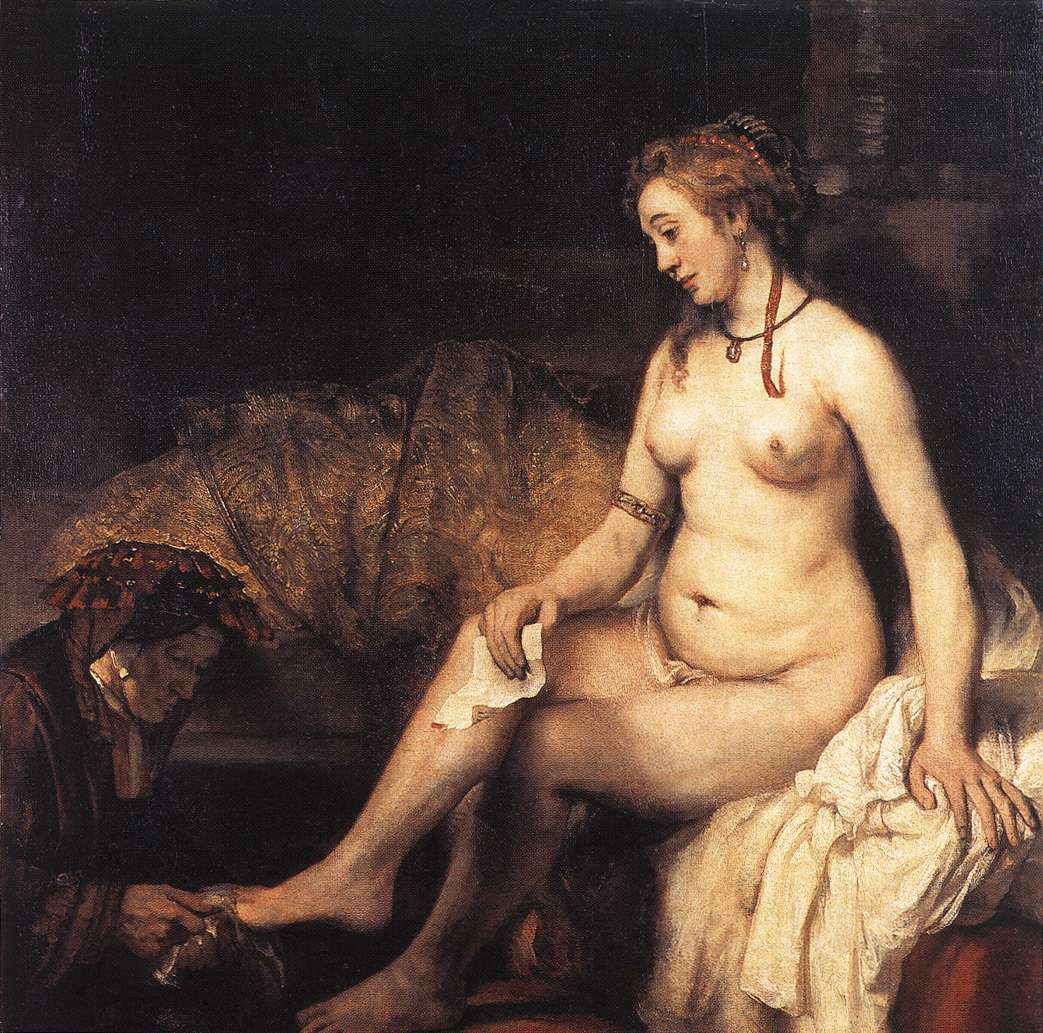 \n\n
\n\n
The Woman in the Bedchamber
\n\n
Two decades earlier, Rembrandt had already begun dismantling the mythology that propped up the classical nude. His Dana\u00eb (c. 1636, Hermitage Museum) depicts the moment the imprisoned princess of Greek myth receives Zeus in the form of a shower of gold. The traditional rendering would show a reclining beauty, perhaps with cupids, the golden light streaming elegantly through parted curtains. Rembrandt gives us something stranger and truer: a woman in her actual bed, reaching toward a light source we cannot quite see, her expression suspended between anticipation and uncertainty.
\n\n
The painting is intimate in a way mythological nudes rarely are. The bedclothes are rumpled. The old servant \u2014 Rembrandt added her years after the initial composition \u2014 peers from behind the curtain. The golden light is not decorative but transformative, dissolving the boundaries between divine visitation and ordinary morning. When a deranged visitor slashed the canvas in 1985, it took the Hermitage twelve years to restore it. The scars are still faintly visible. Rembrandt would have understood: his Dana\u00eb was always a painting about the vulnerability of the body, and the body in the painting proved vulnerable too.
\n\n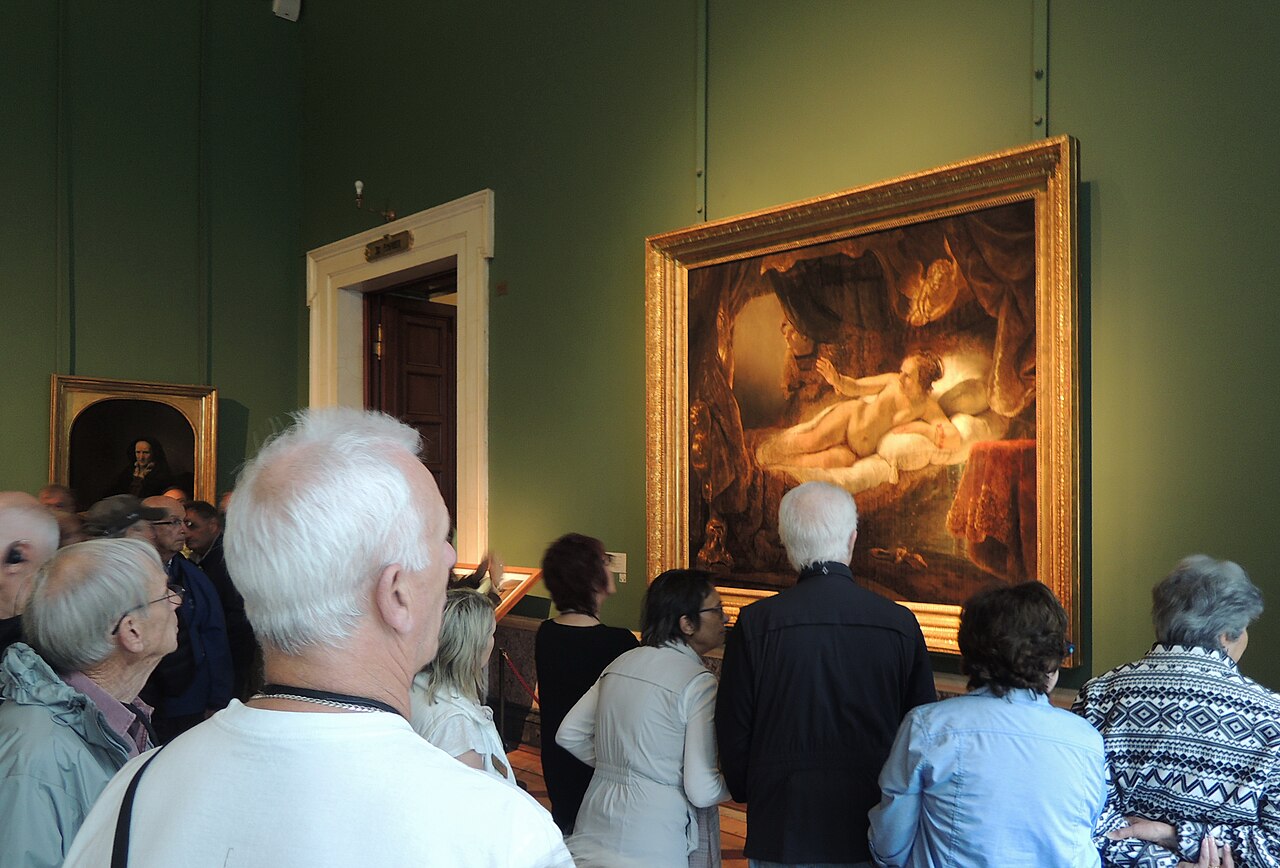 \n\n
\n\n
The Woman Who Is Not an Object
\n\n
Rembrandt’s Susanna Bathing (1636, Mauritshuis) takes the same radical approach to a subject that had been, for centuries, an excuse for voyeurism. The biblical Susanna, spied upon by two elders while bathing, was a favorite of Baroque painters \u2014 and almost always depicted from the elders’ point of view. She is exposed, she is beautiful, she is afraid but somehow also on display for us.
\n\n
Rembrandt reverses the gaze. His Susanna has seen the elders before we see her. She turns toward us \u2014 toward them \u2014 with an expression that is not coy or seductive but caught. Her hands attempt to cover herself, but the gesture is not coquettish; it is desperate. She is a woman mid-violation, and Rembrandt forces us to recognize our own position as witnesses. Are we complicit? The painting does not let us off the hook. It is the first major Susanna in Western art that belongs to Susanna, not to the elders \u2014 and not to the viewer.
\n\n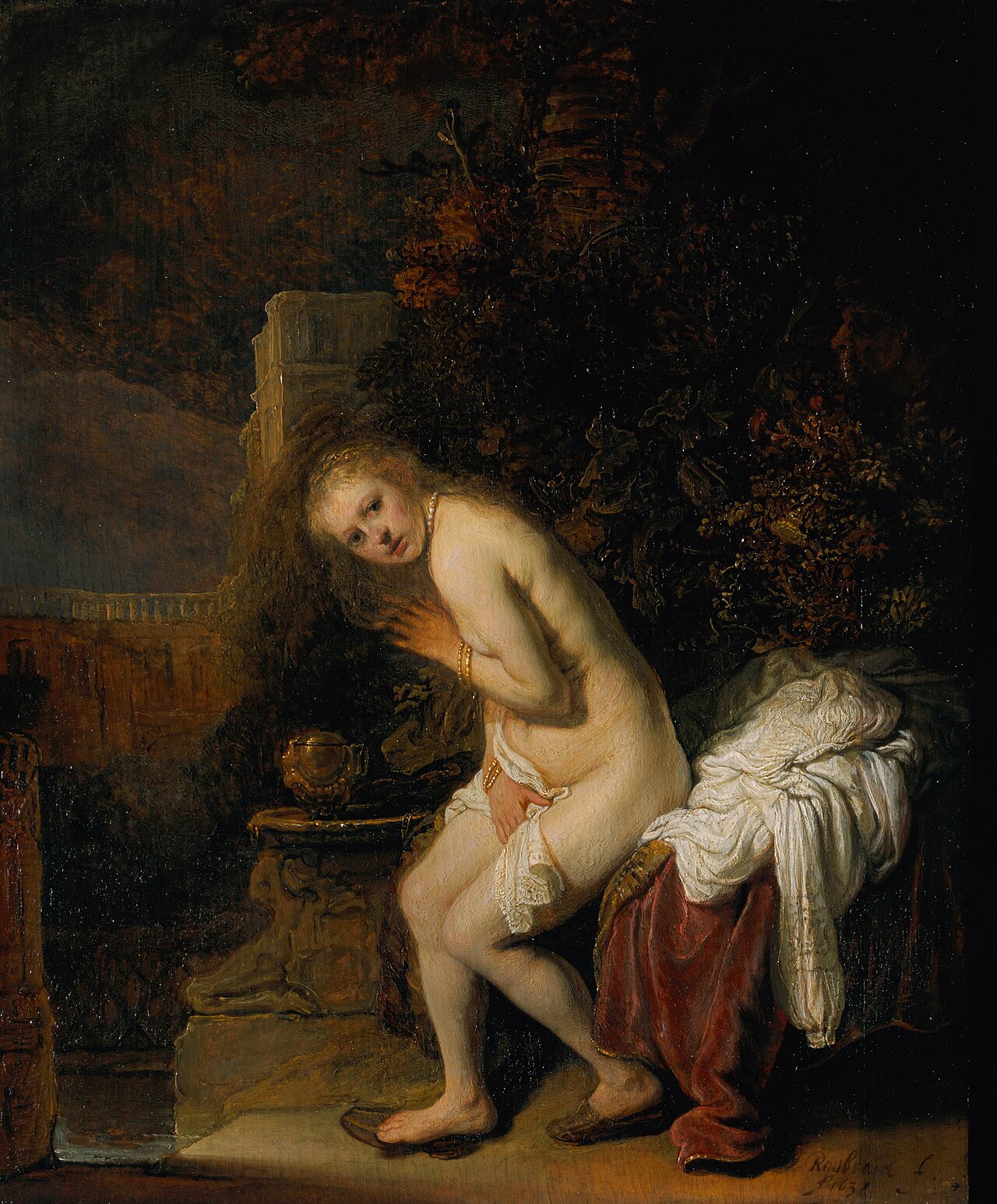 \n\n
\n\n
What Rembrandt Understood
\n\n
The nude in Western art has a long history of being about everything except the person wearing the body. It has been about geometry, divinity, allegory, desire, power, sin, and redemption. Rembrandt was the first major painter to suggest \u2014 consistently, across a career \u2014 that the nude body might simply be the home of a human being, and that this was more than enough subject matter for great art.
\n\n
He did not flatter. He did not idealize. His late self-portraits, painted in the years after bankruptcy and personal tragedy, document his own body’s decay with the same unsparing attention he gave to Bathsheba. The sagging flesh, the tired eyes, the knowledge that time is a thief \u2014 these are not failures of the painter’s craft. They are its highest expression.
\n\n
Four hundred and twenty years after his birth, Rembrandt’s nudes remain more honest than most of what we see. In an era of filters, retouching, and algorithmic beauty, his insistence that the body \u2014 unimproved, un-apologized-for \u2014 is sufficient stands as both a rebuke and an invitation. He painted people, not ideals. He painted flesh that had lived. And he trusted us to look at it, and at ourselves, and see something true.