Jean-Baptiste-Camille Corot \u2014 born 230 years ago today, on July 16, 1796 \u2014 is remembered as the master of the silvery landscape. The bridge between Neoclassical tradition and Impressionist revolution. The painter of Ville-d’Avray ponds and Roman campagna, the generous teacher who supported Pissarro and inspired Monet, the artist so beloved that his colleagues bought him a house when he fell on hard times. Go to any major museum and you will find a Corot landscape: feathery trees dissolving into pearl-grey light, a world seen through morning mist.
\n\n
But Corot had a secret.
\n\n
For more than four decades, alongside the landscapes that made him famous, he maintained a parallel practice that he kept almost entirely to himself. He painted the female nude. Over fifty of them. And he never once exhibited them at the Paris Salon.
\n\n
\n\n
The Public Corot and the Private One
\n\n
By the 1850s, Corot was one of the most celebrated painters in France. His Salon entries sold reliably. His critical reputation was secure. He served on Salon juries. Young painters flocked to him for advice, and he gave it freely \u2014 and often financially. He was, by all accounts, the gentlest man in French art.
\n\n
But in his studio, away from the jury rooms and the exhibition halls, Corot was doing something that none of his public work prepared anyone for. His nudes hung on those studio walls, seen only by close friends and fellow artists. Charles Baudelaire \u2014 not a man given to empty praise \u2014 visited and declared Corot “the only modern painter who knows how to paint a woman.”
\n\n
Baudelaire understood what made these paintings different. The academic nude, as perfected by Ingres, was a goddess in disguise \u2014 a real woman’s body forced into the posture of Venus, wrapped in mythological justification. Corot’s nudes didn’t bother with the disguise. They weren’t goddesses. They weren’t allegories. They were women, in rooms, being looked at \u2014 and sometimes, disconcertingly, looking back.
\n\n
\n\n
Marietta and the Radical Gaze
\n\n
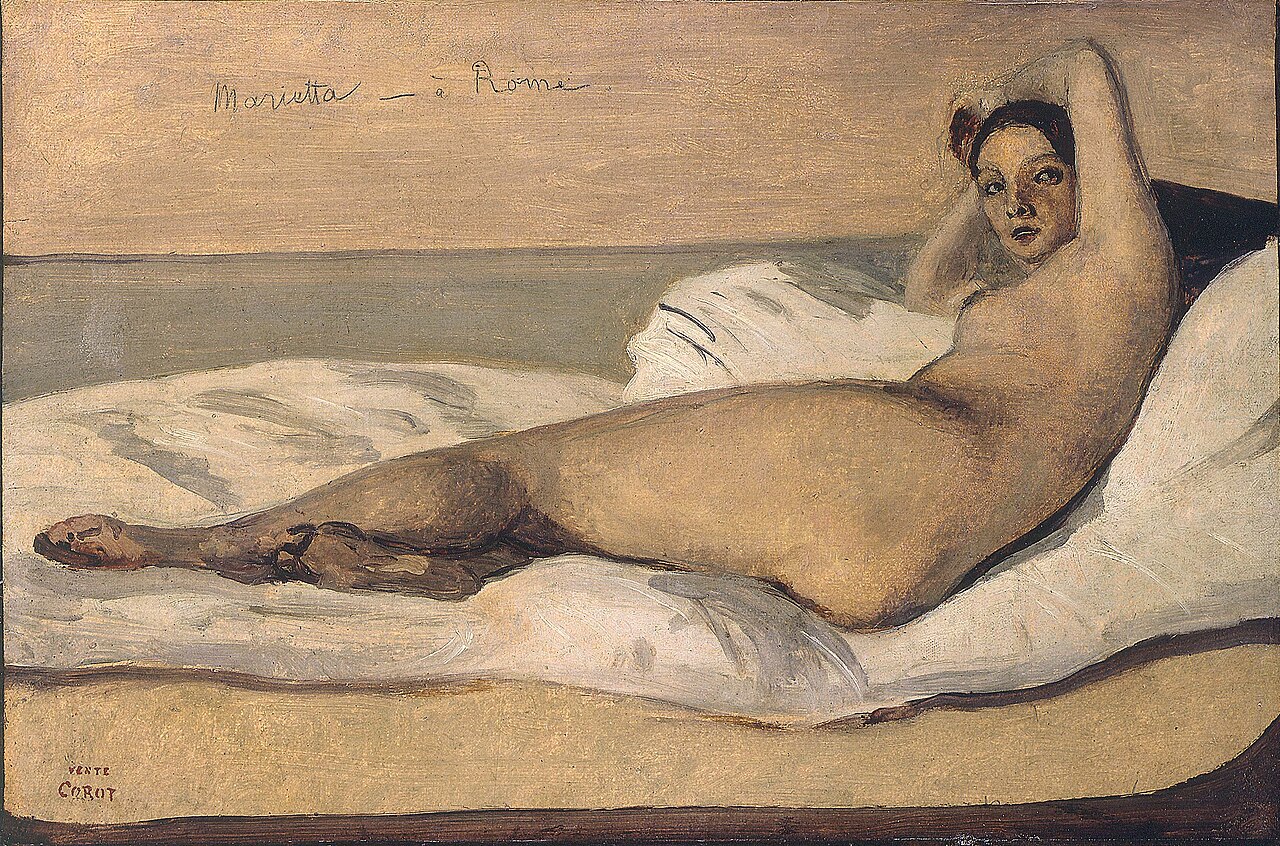
The earliest of Corot’s surviving nudes is Marietta, also known as L’Odalisque Romaine, painted in 1843 during his second stay in Italy. Marietta was a Roman model \u2014 not a professional artist’s model in the academic sense, but a young Italian woman Corot knew and painted repeatedly. She sits in a peasant blouse, one breast exposed, dark hair pulled back, and she looks directly at the painter \u2014 at us \u2014 with an expression that is neither coy nor confrontational. She simply sees the person looking at her.
\n\n
This was radical. The academic nude had a rule, unwritten but absolute: the nude woman does not look back. She offers herself to the gaze but never challenges it. Corot broke this rule without fanfare, without manifesto, without even exhibiting the result. He just painted a woman the way he saw her \u2014 as a presence, not a display.
\n\n
Atmosphere and the Body
\n\n
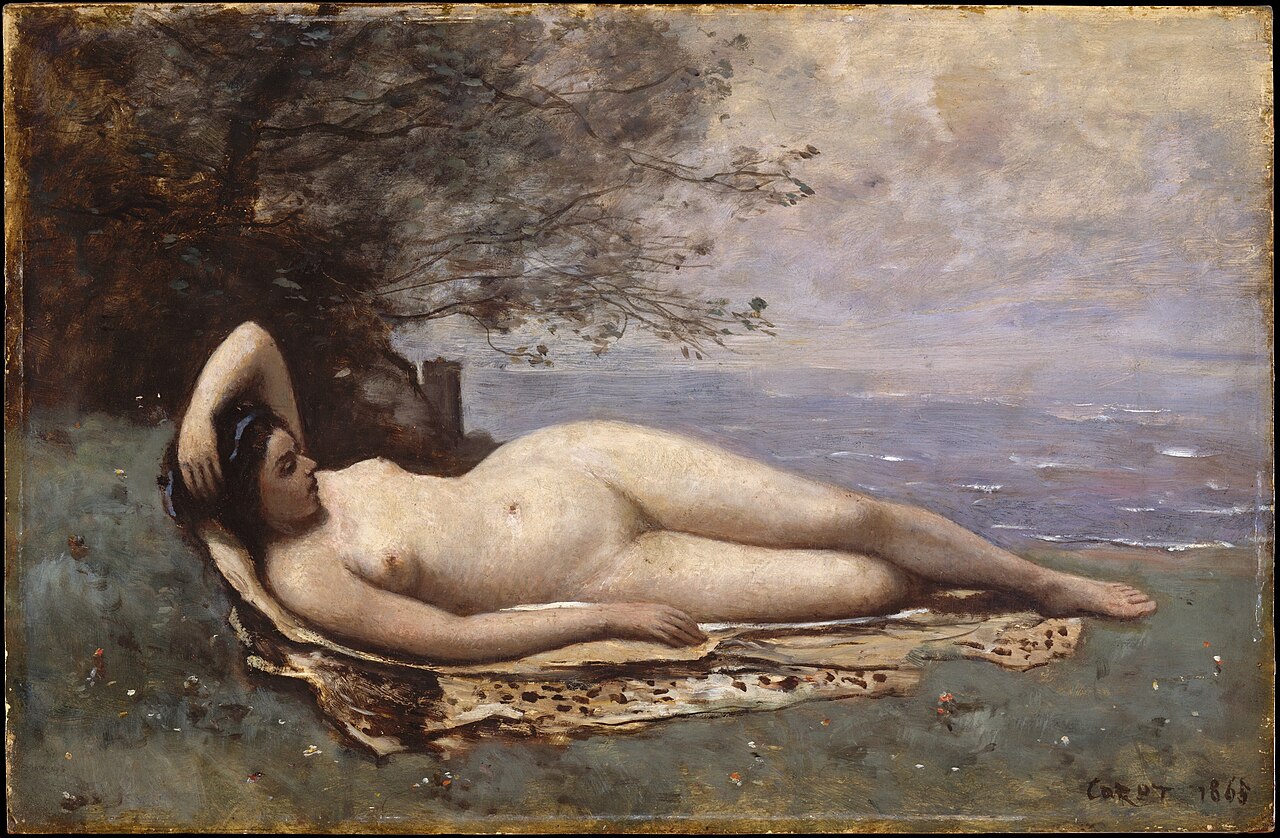
Corot’s nudes share a quality with his landscapes that no other painter of the figure achieved: the body dissolving into atmosphere. In Bacchante by the Sea (1865), the reclining figure’s contours soften at the edges, as if she is becoming part of the shoreline, part of the light. The title gives her a classical identity \u2014 a follower of Bacchus \u2014 but the painting itself refuses the academic contract. There is no crisp outline, no sculptural solidity. Just a human form suspended in silvery air.
\n\n
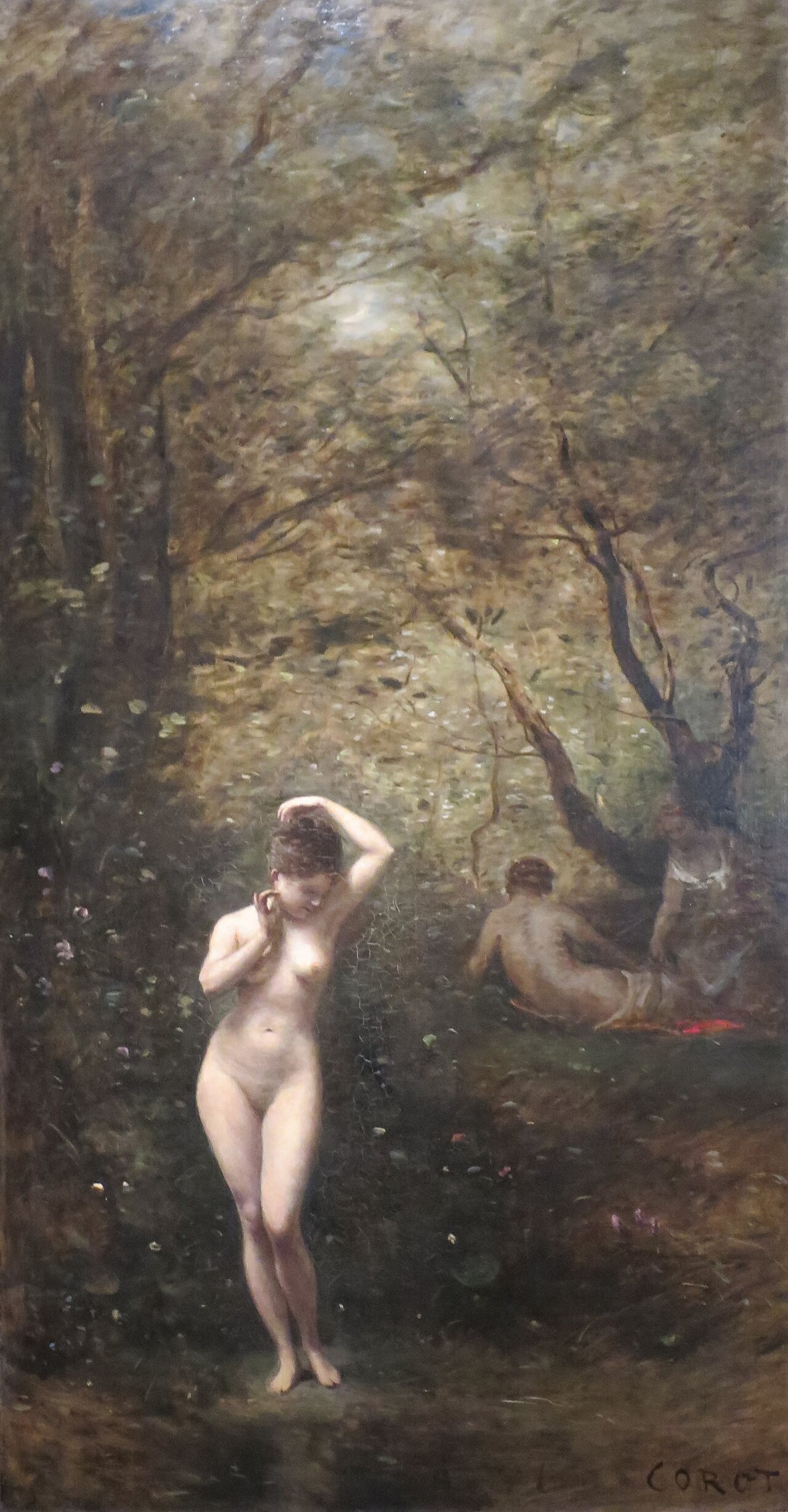
His late Diana Bathing (1873\u201374), painted when Corot was in his late seventies, pushes this even further. Diana’s companions are barely visible; the goddess bathes alone, unaware of Actaeon, unaware of us. Corot treats a mythological subject with the intimacy of someone who happened upon a private moment and decided to stay quiet and watch the light change.
\n\n
\n\n
Why the Secrecy?
\n\n
Why did Corot hide these paintings? The easy answer is strategy. The nude was the most scrutinized genre in French academic painting, judged against the impossible standard set by Ingres. A landscape painter submitting nudes to the Salon would have invited ridicule \u2014 or worse, indifference. Corot was too savvy, or too modest, for that fight.
\n\n
But the deeper answer may be simpler and more interesting: these paintings weren’t for the Salon. They weren’t for critics or buyers or posterity. They were for Corot. They were the work he did when nobody was watching, the investigations he pursued because they interested him, not because they advanced his career. In an art world that has always rewarded consistency \u2014 pick your genre, perfect it, repeat \u2014 Corot allowed himself the luxury of a second self.
\n\n
The Hidden Half
\n\n
When Corot’s nudes were finally exhibited after his death in 1875, they changed how art historians understood him. Here was not just a landscape poet but a painter of the human body in its most unguarded state \u2014 psychological, atmospheric, startlingly modern. Degas saw them and recognized a kindred spirit. The Impressionists, who had already claimed Corot as a forefather for his landscapes, found in his nudes a second lineage: the body observed without rhetoric, painting as an act of attention rather than performance.
\n\n
Two hundred and thirty years after his birth, Corot’s nudes still feel contemporary in a way his Salon landscapes do not. The landscapes are beautiful \u2014 among the most beautiful ever painted \u2014 but they belong to their century. The nudes belong to ours. They remind us that an artist’s most important work is sometimes the work they never show, the private investigations that push past what the public is ready to see. The truest art, Corot proved, is often the art made for no audience at all.
\n\n
Corot died in Paris on February 22, 1875, at the age of 78. His nudes can be found today at the Metropolitan Museum of Art, the Louvre, the Pushkin Museum, and the National Gallery of Art.
\n