Before the gallery, before the exhibition, before the critics and the collectors and the canon — there was a room with bad lighting, a raised platform, and a stranger who took off their clothes.
This was the life room. For five hundred years, it was where Western art actually happened. Not in the salon. Not in the studio of genius. In a crowded, stuffy chamber where students in smocks drew the human body in silence, charcoal dust coating every surface, the model holding a pose until their limbs went numb.
The life room was the foundation of artistic training from the Renaissance through the early twentieth century. Every painter you have heard of — Michelangelo, Rubens, David, Ingres, Degas, Sargent — spent hundreds of hours in these rooms, drawing naked strangers over and over until the human body became a language they could speak without thinking.
And then, almost overnight, the life room disappeared. Modernism killed it. Or thought it did.
The académie: when the body was a problem to solve
The academic tradition treated the nude not as art but as grammar. Before you could compose a painting, you had to learn the alphabet — and the alphabet was the human figure. Students at the French Academy spent their first years copying engravings of classical sculpture. Only after proving mastery of plaster casts were they admitted to the life room, where a live model stood on the pose — a raised platform under controlled light.
The drawings produced in these sessions were called académies — finished figure studies meant to demonstrate anatomical knowledge, proportion, and control of light and shadow. They were not meant for exhibition. They were homework. Exercises. The artistic equivalent of scales on a piano.
Edgar Degas, who would later help dismantle the academic system, produced exquisite académies as a young man. His Academic Study of a Nude Man demonstrates exactly what the life room demanded: a body rendered with scientific precision, every muscle accounted for, the pose studied and restudied until it became second nature. Degas would spend the rest of his career rebelling against this training, but he could only rebel because he had absorbed it so completely.
The rituals of looking
The life room had rules, and they reveal something uncomfortable about the culture that produced them. Male and female students were segregated. Women were often barred from drawing male nudes entirely — the Royal Academy in London did not admit women to the life room until the 1890s, and even then male models wore loincloths. The female nude was available for study by anyone; the male nude was cordoned off, policed, treated as dangerous.
The model, meanwhile, occupied an ambiguous social position. Paid a modest wage, expected to hold poses for hours, they were at once essential to the enterprise and invisible within it. The art that resulted from their labor hangs in museums; their names are almost entirely lost.
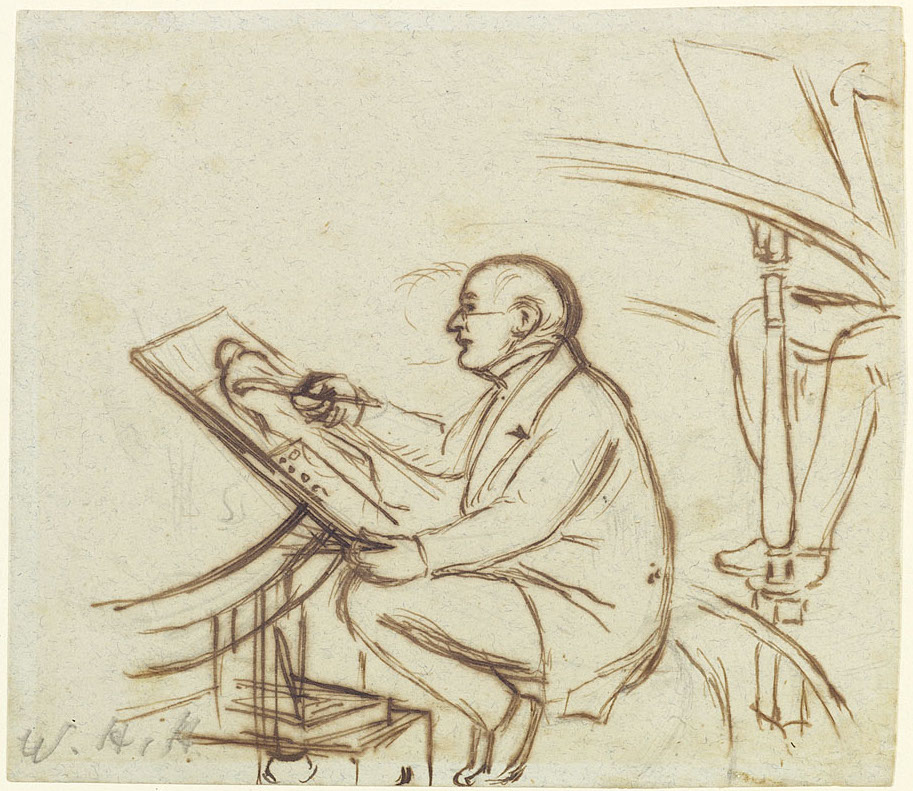
William Holman Hunt’s painting William Etty at the Life Class captures the atmosphere — the hush, the concentration, the way every student occupies their own private transaction with the body on the platform. Etty himself was notorious for his obsessive devotion to the nude, spending so many hours in the life room that his colleagues considered him monomaniacal. He would later say: “Finding God’s most glorious work to be Woman, and that all human beauty had been concentrated in her, I resolved to dedicate myself to painting — not the Draper’s and Milliner’s work — but God’s most glorious work.”
What the camera couldn’t teach
The life room began its long decline in the mid-nineteenth century. Photography promised to make figure drawing obsolete — why spend years learning anatomy when a camera could capture the body in a fraction of a second? The Impressionists, meanwhile, abandoned the studio altogether, taking their easels outside and dismissing the academic tradition as sterile and out of touch.
But the life room’s defenders understood something the camera couldn’t replicate: drawing from life is not about recording what you see. It is about learning to see in the first place. The camera captures light bouncing off surfaces. Drawing captures understanding — weight, tension, the relationship between bone and muscle, the way a pose communicates emotion through the angle of a shoulder or the turn of a wrist.
A photograph of a body is evidence. A drawing of a body is knowledge. The life room produced knowledge, not records.
The return of the room
The twentieth century declared the life room dead. Bauhaus replaced it with abstract exercises. Conceptual art dismissed representation entirely. Art schools dropped figure drawing from their core curricula, and a generation of artists graduated without ever having drawn a human body from observation.
But reports of the death were exaggerated. In the past two decades, ateliers and private academies have revived the life room with remarkable energy. Studios in Florence, New York, London, and Los Angeles now teach the same academic methods that Degas learned — sight-size measurement, comparative anatomy, the long pose, the short gesture. Students who grew up with screens are discovering charcoal and newsprint, and finding in the life room something the digital world cannot offer: sustained, silent attention to another human body.
The revival is not about nostalgia. It is about a recognition that some forms of knowledge cannot be transmitted through a screen. The life room forces you to look — really look — at a person standing three meters away, under natural light, breathing, shifting almost imperceptibly, the weight settling from one hip to the other. You cannot scroll past it. You cannot speed it up. You sit, and you draw, and you learn something about bodies that no photograph can teach you.
What the life room teaches about the nude in art
The life room’s disappearance — and its quiet return — tells us something important about how we think about the nude body in art. When figure drawing was mandatory, the nude was not a subject. It was a skill. The erotic charge of the unclothed body was neutralized by technique, by the sheer difficulty of getting the drawing right. The model was not a body to be consumed but a problem to be solved.
When figure drawing stopped being mandatory, something shifted. Without the discipline of the life room, the nude became primarily an image — something to look at rather than something to work through. The body in art stopped being a practice and became a product.
The artists reviving the life room today are not trying to turn back the clock to 1850. They are recovering something that was lost in the twentieth century’s rush to abandon tradition: the understanding that the nude body is not just a subject for art. It is the tool with which artists learn their craft. It is the grammar. And grammar, however unglamorous, is what makes poetry possible.
The life room is still there, in basements and converted warehouses and ateliers with north-facing windows. The models still climb onto the platform. The charcoal still covers everything. And art students still learn, in the quiet hum of concentrated attention, that before the body can become a painting, it has to become a drawing. Before it can be art, it has to be practice.
At Nude Art LA, we believe the nude body belongs in art — and that understanding how it got there matters. Explore more at nudeartla.com/get-involved.