Ilya Repin was born on this day, August 5, 1844, in the small Ukrainian town of Chuhuiv. He would become the most important Russian painter of the nineteenth century, the man behind Barge Haulers on the Volga and Ivan the Terrible and His Son Ivan. But long before those monumental canvases, Repin was a teenager in a provincial icon-painting workshop, and then a student at the Imperial Academy of Arts in Saint Petersburg, spending six days a week in the life room. Drawing the nude human body. Learning that the figure was not decoration. It was the engine.
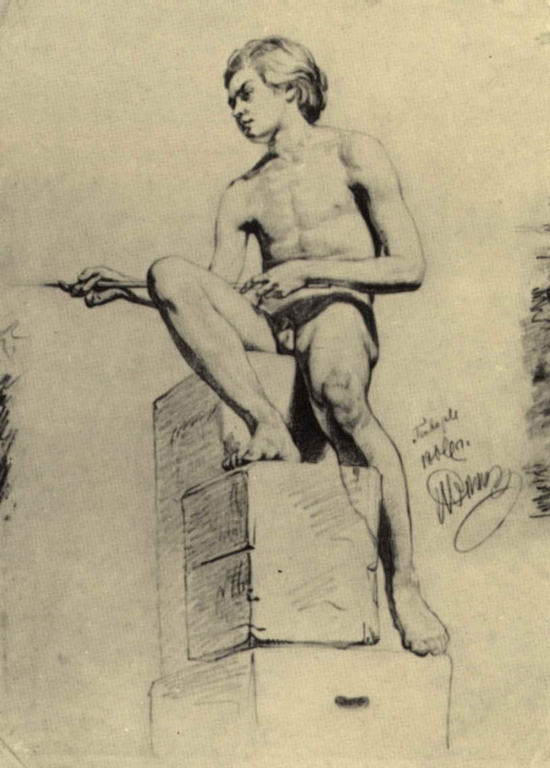
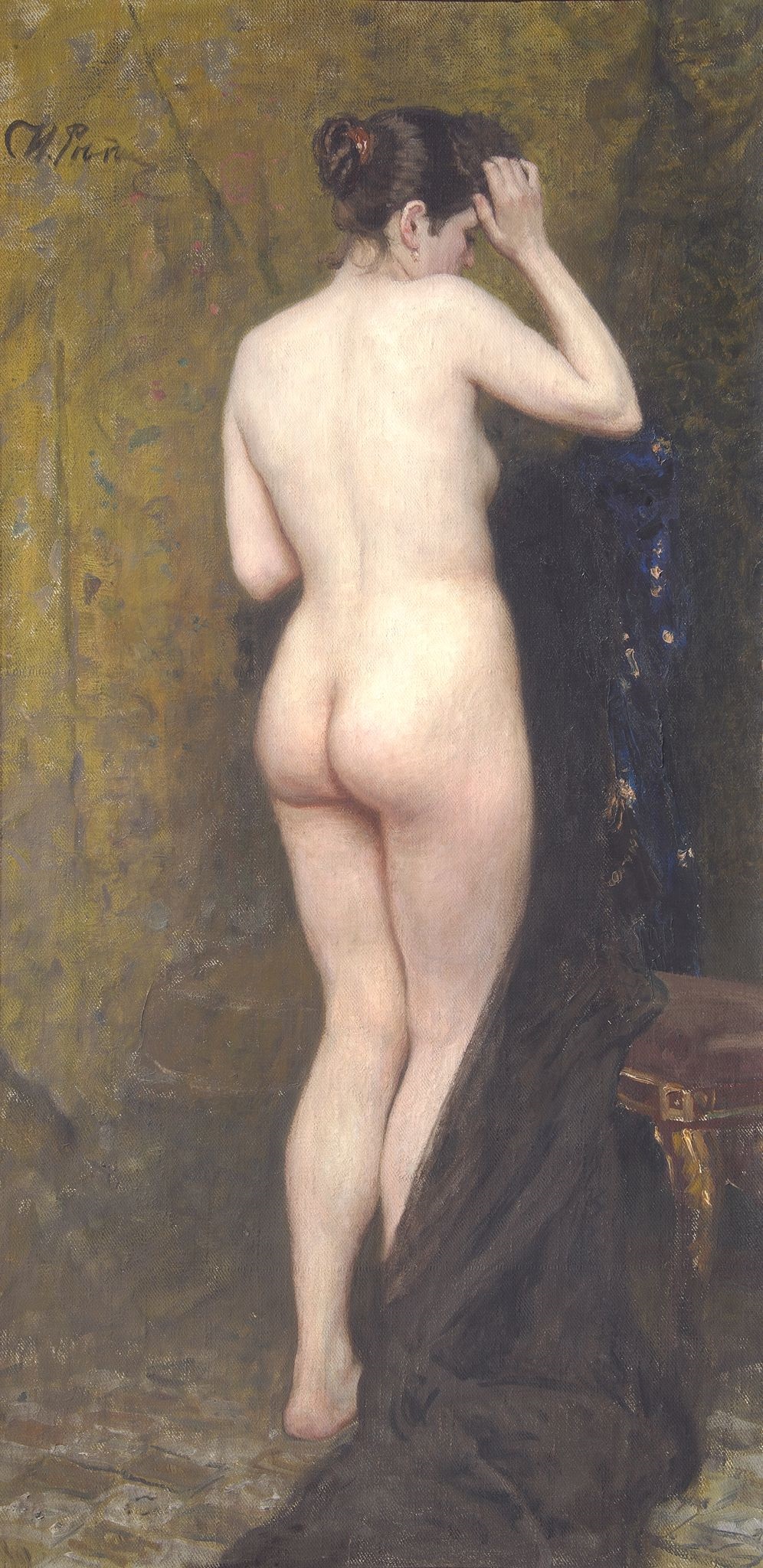
The Russian nineteenth century was not a comfortable place for the nude. The Academy taught it as a technical exercise, a prerequisite for history painting. The Orthodox Church distrusted it. The Tsarist state regulated it. Repin absorbed all of this and then pushed past it. His nude studies from the 1860s and 1870s are not academic exercises performed for a grade. They are acts of seeing. A seated male youth from 1866, rendered with an almost sculptural attention to weight and posture. A female nude from behind, observed with the kind of directness that made the Academy nervous. These were not idealized bodies. They were actual bodies, recorded by an artist who believed that the first duty of painting was to tell the truth.
Repin understood something that his European contemporaries were discovering at the same time: the nude body was not a costume for mythological storytelling. It was the fastest route to emotional reality. When he painted a nude, he was not painting Venus or a nymph. He was painting a person with gravity, with mass, with presence. That presence is what made his historical canvases so devastating. You do not get Ivan the Terrible, with its horrifying intimacy between a murderer and his dying son, without those hundreds of hours in the life room studying how a body holds grief, how a spine curls under trauma, how a hand registers shock.
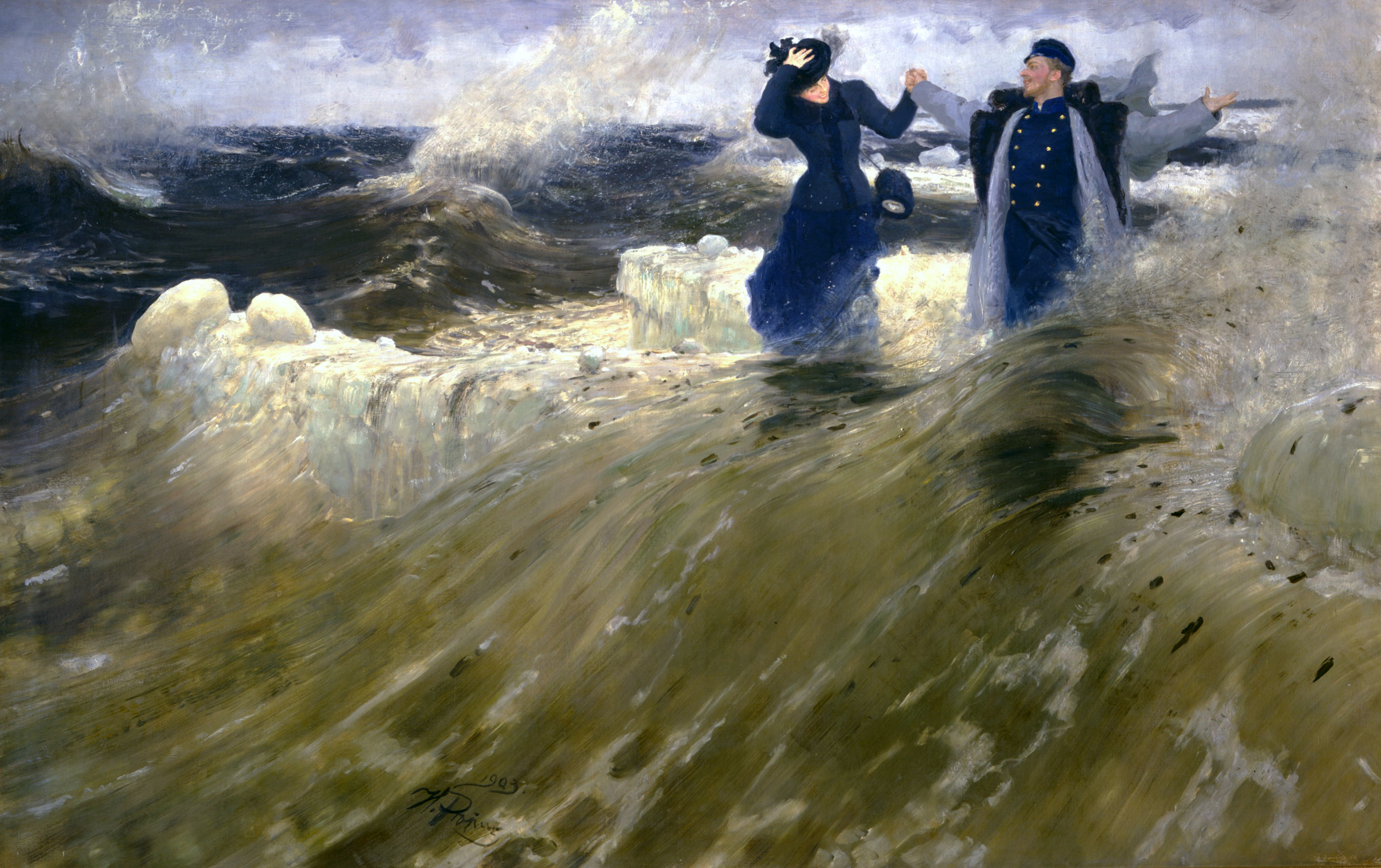
There is one Repin painting that brings everything together. What Freedom! (1903) shows a young man and woman, both nude or nearly so, standing in waist-deep surf, facing an open sea. The woman’s hair streams in the wind. The man raises his arm in a gesture of release. They are not mythological figures. They are not saints or heroes. They are two people in the water, and the water is cold, and the sky is enormous, and the painting asks a single question: what does it feel like to be a body at the exact moment of liberation? Repin, at nearly sixty years old, was still chasing the same thing he chased as a twenty-two-year-old in the Academy. The naked truth.
Repin lived to be eighty-six, dying in 1930 at his estate in Kuokkala, Finland, having fled the Revolution he once supported. He painted portraits of Tolstoy and Mussorgsky. He taught an entire generation of Russian realists. He gave the world Reply of the Zaporozhian Cossacks and Religious Procession in Kursk Province. But the foundation under every one of those paintings was the same hundred figure studies, the same nude model observed for the five hundredth time, the same belief that painting begins where the body does. Repin was born a hundred and eighty-two years ago today. The body still has not found a more honest witness.
Further reading: Repin’s works are held at the Russian Museum in Saint Petersburg, the Tretyakov Gallery in Moscow, and the Ateneum in Helsinki. Elizabeth Kridl Valkenier’s Ilya Repin and the World of Russian Art (Columbia University Press, 1990) remains the definitive English-language study.