Before the soup cans and the Brillo boxes and the Marilyns, Andy Warhol drew bodies. In the 1950s, as a commercial illustrator in New York, he made blotted-line drawings of young men — shoes first, then faces, then figures — that already contained the DNA of everything he would become: the line that refuses to commit, the image that holds you at a distance even as it invites you in. Warhol was born on this day in 1928 in Pittsburgh, the son of Slovak immigrants, a sickly kid who spent months bedridden with chorea and emerged with a visual sensibility unlike anyone else’s. He would have been 98 today. And for all the ink spilled about his celebrity portraits and consumer-goods prints, the Warhol that art history has been slowest to reckon with is the one who made the nude body his most radical subject.
The Body as Image, the Image as Product
Warhol’s approach to nudity was a direct extension of his pop-art logic. If a Brillo box could be art — not because of what it looked like but because of what it meant in a system of production and desire — then the same logic applied to the body. His “Torso” series (1977) and “Sex Parts” (1978) screenprinted male nudes with the same dispassionate repetition he brought to dollar signs and electric chairs. The body was not sacred. It was not even particularly special. It was an image among images, a surface to be reproduced, a commodity like any other. This was not cynicism. It was an argument.
The argument went like this: in a culture where everything is for sale, the nude body is too. Desire is not a private interior state. It is public, visible, traded. Warhol’s male nudes — cropped torsos, fragmented anatomies, disembodied erections — refused the entire Western tradition that had positioned the nude as an elevated ideal. There is no ideal in a Warhol nude. There is only iteration. A body printed, and printed again, slightly off-register, in colors that don’t quite belong to skin.
The Polaroid Archive
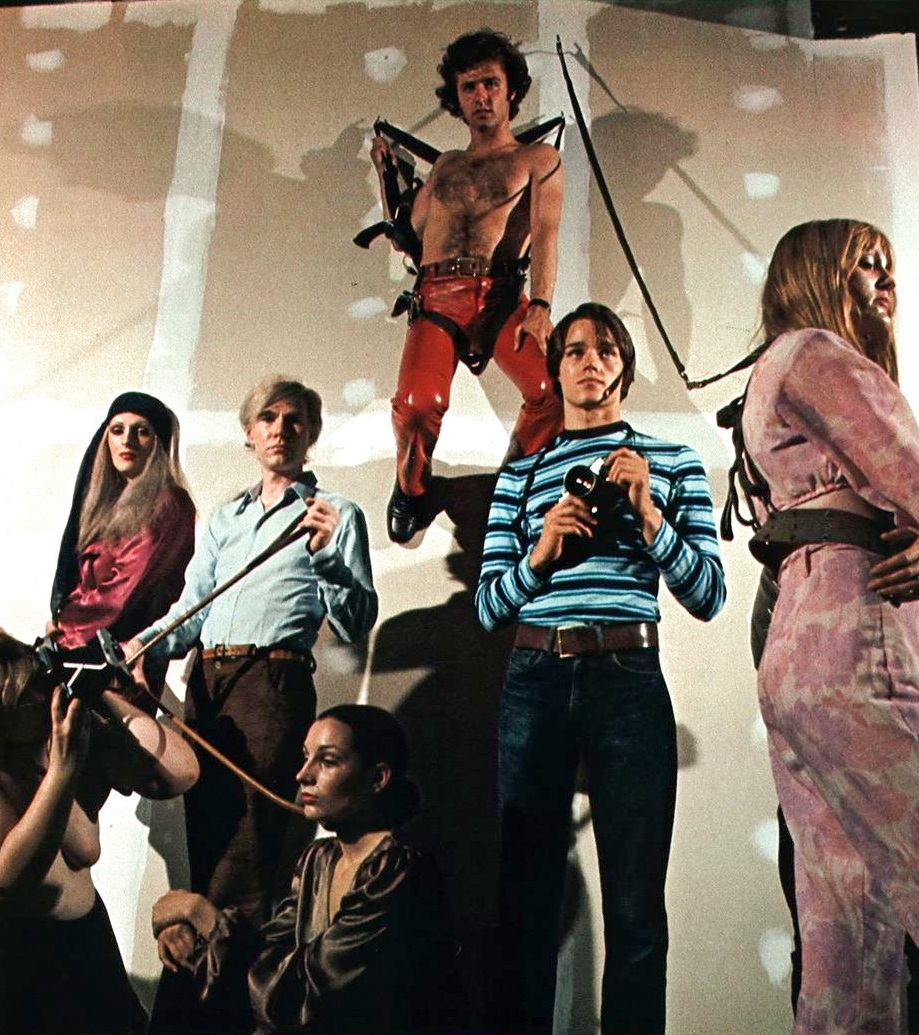
Between the 1960s and his death in 1987, Warhol took tens of thousands of Polaroid photographs. A significant portion of them were nudes — male nudes, mostly, shot in the Factory, in hotel rooms, at parties. The subjects ranged from lovers to celebrities to strangers who wandered in and never quite wandered out. Joe Dallesandro appears. So do unnamed men whose names Warhol may never have known. The Polaroids form a private archive made public by time: bodies captured quickly, chemically, without the apparatus of high-art pretension. They are the furthest thing from the academic nude. They are documents.
What makes these Polaroids different from pornography — and they sit deliberately at that border — is the same thing that makes a Warhol soup can different from a grocery shelf: the frame changes the object. The Polaroids were not published as pornography, though they could have been. They were kept, catalogued, treated as material. Warhol understood that the difference between art and not-art is increasingly just a decision, and he made that decision over and over, with bodies that the art world was not yet ready to call art.
Voyeurism Without Apology
If the history of the nude in Western art is the history of looking — who gets to look, who is being looked at, and on whose terms — Warhol short-circuits the whole apparatus. He does not justify his gaze. He does not pretend to be a disinterested observer, a scientist of anatomy, a seeker of Platonic form. He is a voyeur, and he knows it, and he makes that knowledge the subject of the work. The “Torso” screenprints are not about torsos. They are about the act of looking at torsos. They are about what it means to want to look.
This is why Warhol’s nudes remain uncomfortable decades later. Not because they are explicit — plenty of art is more explicit — but because they refuse to offer the viewer an alibi. When you look at a Michelangelo ignudo, you are supposedly contemplating divine proportion. When you look at a Warhol torso, you are looking at a body cropped like a product shot, and the only thing you are contemplating is your own desire. Warhol strips away the architecture of justification that Western art built around the nude and leaves you alone with the looking itself.
The Legacy: Every Body Is a Brand Now
Warhol died in 1987, but his argument about the body won. We live now in a world where every body is a brand, every image is content, and the distance between the sacred nude and the commercial nude has collapsed so completely that we barely remember there was ever a distinction. Instagram is a Warhol factory. OnlyFans is a Warhol factory. The influencer who monetizes their body, the celebrity who posts a nude selfie as a political statement, the endless scroll of bodies optimized and filtered and reproduced — all of it runs on the logic Warhol identified and accelerated.
What he would make of this is anyone’s guess, but the guess is not hard. He would probably love it. He would probably photograph it. He would probably screenprint it and sell it back to us at a markup. And he would be right to, because the fundamental insight of Warhol’s nudes — that the body is always already a commodity, that desire is always already public, that the frame is the only thing separating art from everything else — has never been more true than it is today. Ninety-eight years after his birth in a Pittsburgh tenement, the kid who drew shoes for Glamour magazine is still teaching us how to look.