The Belvedere Torso has no head. No arms. No legs below the knees. It sits in the Vatican Museums — a hunk of marble carved sometime in the 1st century BCE, signed by an Athenian sculptor named Apollonius whose biography is a blank. And yet this shattered remnant of a seated male figure is one of the most influential nudes in Western art history. Michelangelo called it his teacher. Rodin built an entire philosophy around it. The torso proved something counterintuitive: the body in fragments is often more powerful than the body whole.
The Fragment That Taught the Renaissance
When the Belvedere Torso was unearthed in Rome in the early 15th century, probably from the Baths of Caracalla, it landed in a culture that had spent a thousand years associating nudity with shame. Ancient fragments like this one became, paradoxically, the vehicle for reintroducing the nude body into art. The missing parts were not a defect; they were an invitation. A complete statue tells you what to see. A fragment makes you see what isn’t there.
Michelangelo understood this better than anyone. The story goes that Pope Julius II asked him to “restore” the Torso — add the missing limbs, make it whole again. Michelangelo refused. He studied it instead. The twisting musculature, the torque through the abdomen, the way the body coiled around an absent action — these became the DNA of the Sistine Chapel ignudi, those twenty nude youths who frame the ceiling’s biblical scenes. The Torso taught Michelangelo that the nude body doesn’t need a narrative justification to hold a wall. Its presence alone is enough.
And then there are the Slaves. Michelangelo’s unfinished captives for the tomb of Julius II — the Awakening Slave, the Atlas Slave, the Bearded Slave — were left deliberately incomplete. Or were they? The figures appear to be struggling out of the marble itself, half-formed, emerging and submerged at the same time. Michelangelo spoke of the sculptor’s task as liberating the figure already inside the stone. His unfinished nudes make this process visible. The incompleteness is not failure; it is the whole philosophical point.
Rodin and the Fragment as Revolution
Three and a half centuries later, Auguste Rodin took the logic of the fragment to its extreme. In 1907, he exhibited L’Homme qui marche (The Walking Man) — a bronze figure striding forward, headless and armless. Critics were bewildered. A figure without a head is a figure without identity, without psychology, without the facial expressions that had been central to sculpture since Phidias. Rodin’s answer was simple: the body already says everything.
Rodin had been collecting antique fragments for years, filling his studio at Meudon with broken torsos, detached hands, isolated feet. He understood something about the fragment that his contemporaries missed: when you remove the head, you remove the distraction. The viewer stops asking “Who is this?” and starts asking “What is this body doing?” The torso becomes a landscape. Every muscle, every plane, every shadow carries meaning that a face would only dilute.
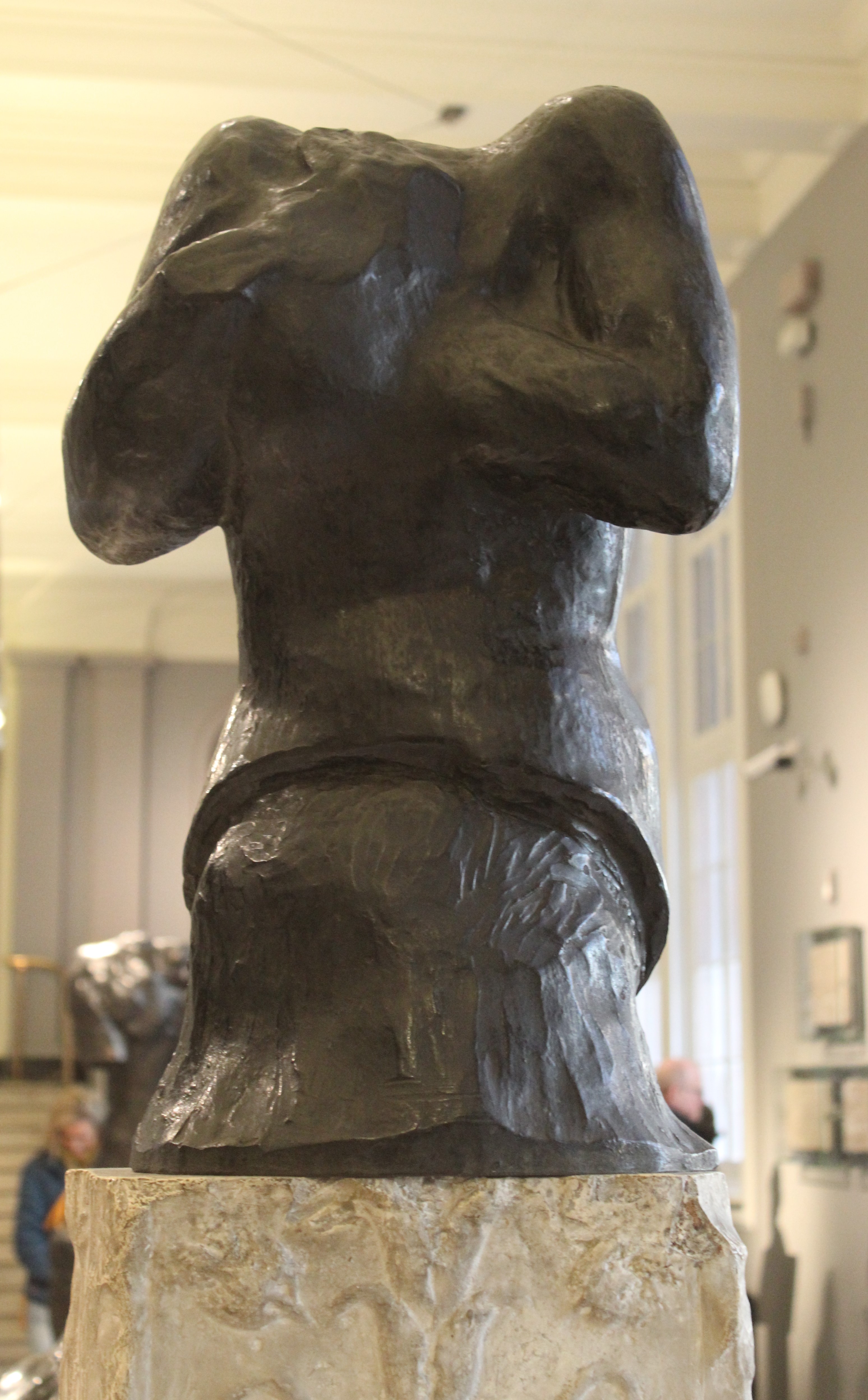
This was not mere aesthetic preference. Rodin was waging war on the academic tradition that demanded completeness, that measured a sculpture’s worth by the number of correctly rendered fingers. His fragments were a declaration: the nude body, even in pieces, is complete. The Belvedere Torso — headless, armless, legless — had been making that case for two millennia. Rodin just said it out loud.
What the Fragment Does That the Whole Body Cannot
There is a psychological mechanism at work here. A complete nude presents a finished statement. You look, you assess, you move on — however beautiful the execution, the conversation ends at the gallery wall. A fragment refuses to end. The eye scans the broken edges, the missing mass, and the mind involuntarily supplies what isn’t there. You become a collaborator in the act of seeing.
This is why the most enduring nudes in art history are often the ones that are not fully present. Think of the Venus de Milo, whose missing arms have generated more fascination than any complete classical Venus. Think of the shattered Greek kouroi that haunt museum galleries, their absent limbs making the remaining marble feel impossibly alive. Think of how contemporary sculptors still return to the torso, the fragment, the partial figure — not because they can’t finish the work, but because finishing would mean closing a door the fragment keeps open.
The fragment also forces a different kind of attention. You cannot skim a torso. The missing context means you must look harder at what remains — the sheer physical presence of stone or bronze shaped into shoulder, spine, ribcage. This is the nude body stripped of narrative, stripped of identity, stripped of everything except its own material existence. It is the nude as pure sculpture, and it demands to be taken on its own terms.
The Unfinished as a Category of Power
Art history teaches us to see the unfinished as failure. A painting left incomplete at an artist’s death, a sculpture abandoned mid-carving — these are catalogued as footnotes, curiosities, what-ifs. But the tradition of the torso tells a different story. From the Belvedere to Michelangelo to Rodin to the present, the unfinished nude has been not a detour from art history but one of its central arteries.
The deliberate fragment is an argument about attention. It says: the body does not need to be intact to be whole. It says: incompleteness is not a lack but a strategy. It says: sometimes the most honest thing you can do with marble is stop before you’ve answered every question. The nude fragment leaves space for the viewer in a way that the finished figure does not. It makes looking an active, creative, even intimate act.
Michelangelo knew this when he refused to restore the Belvedere Torso. Rodin knew it when he lopped the head off a walking man and called it finished. And we know it every time we stand in front of a broken ancient torso in a museum, filling in the blanks with our own imagination, and realizing — somewhere between the intact and the absent — that the most powerful nudes in art history are the ones that ask us to complete them.
What’s your favorite fragment in art history? The Belvedere Torso, Rodin’s partial figures, or something else entirely? Let us know in the comments.