When an artist paints their own naked body, something shifts. The distance between observer and observed collapses. The artist stops being the one who looks and becomes the one who is looked at — simultaneously author, subject, and object. It is the most vulnerable act in Western art and the most radical. It says: I am here. This is what I am. Look at me.
The nude self-portrait is rare. For centuries, artists painted themselves clothed — in studio coats, holding palettes, surrounded by the tools of their trade. The naked body was for models and mythological figures, not for the person holding the brush. To paint yourself nude was to cross a line.
Paula Modersohn-Becker: The First Woman to Claim Her Own Body
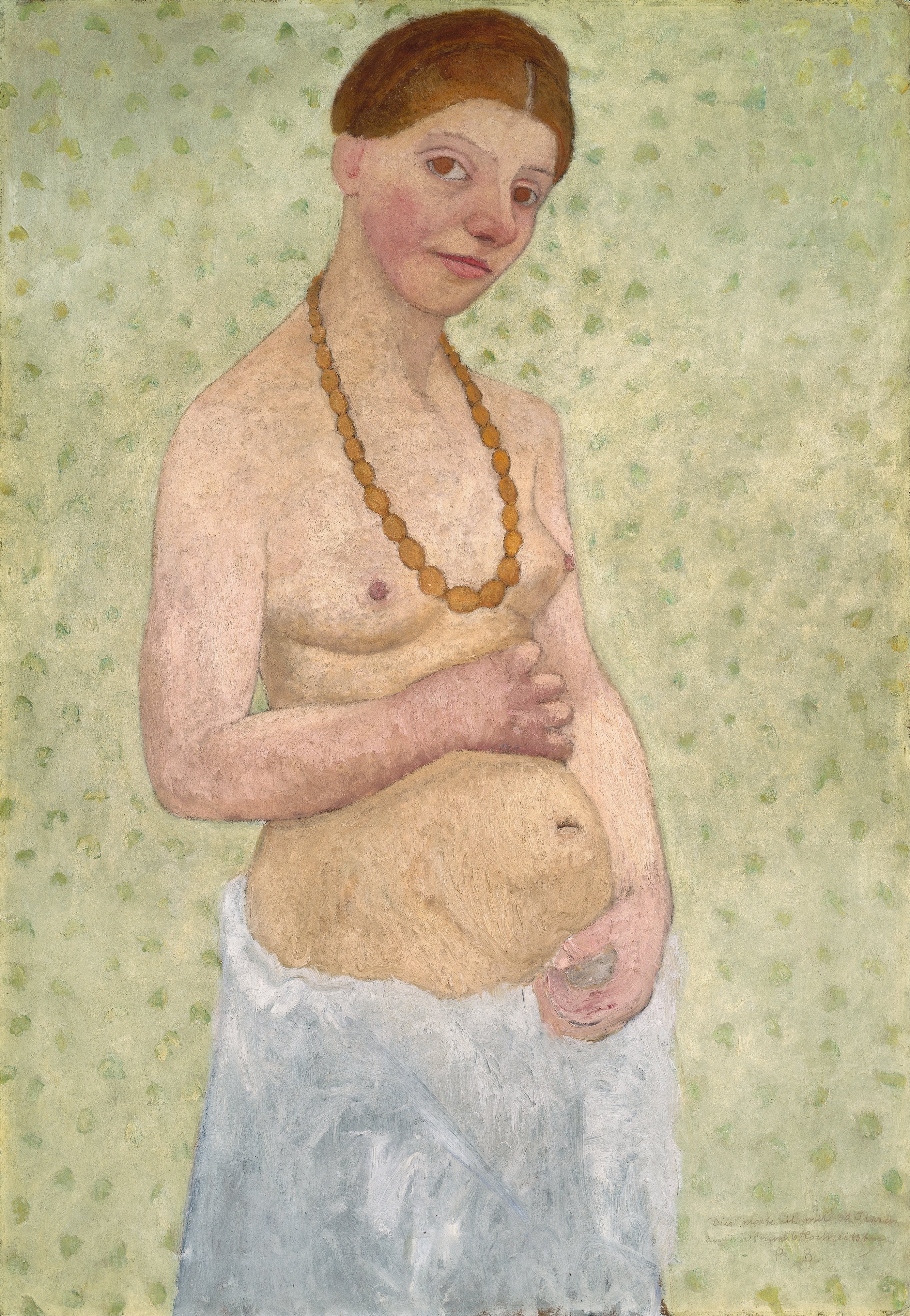
In 1906, Paula Modersohn-Becker did something no woman in Western art had done before. She painted herself nude — not as Venus, not as a bather, not as an allegory — but as herself: Paula, thirty years old, married, an artist, standing before the mirror in her studio in Worpswede, Germany. She painted herself pregnant, though she was not. The rounded belly was a declaration of creative fertility, woman as maker, body as site of origin.
The painting is disarmingly direct. She meets the viewer’s gaze without apology, her face rendered in simplified planes that anticipate Expressionism by a full decade. A green amber necklace circles her throat. Behind her, plants press against the window — the natural world, always present in her work, framing the body without explaining it. She signed it with her married name — Modersohn — though she had already resolved to leave her husband, the painter Otto Modersohn, and return to Paris. Within a year of completing this painting, she would die of an embolism at thirty-one, three weeks after giving birth to her daughter.
Modersohn-Becker painted herself into art history in the most literal sense: her body, her terms, her decision to be seen. Before Frida Kahlo, before Cindy Sherman, there was a German painter in a provincial artists’ colony who looked in the mirror and refused to look away.
Richard Gerstl: The Body as Confession
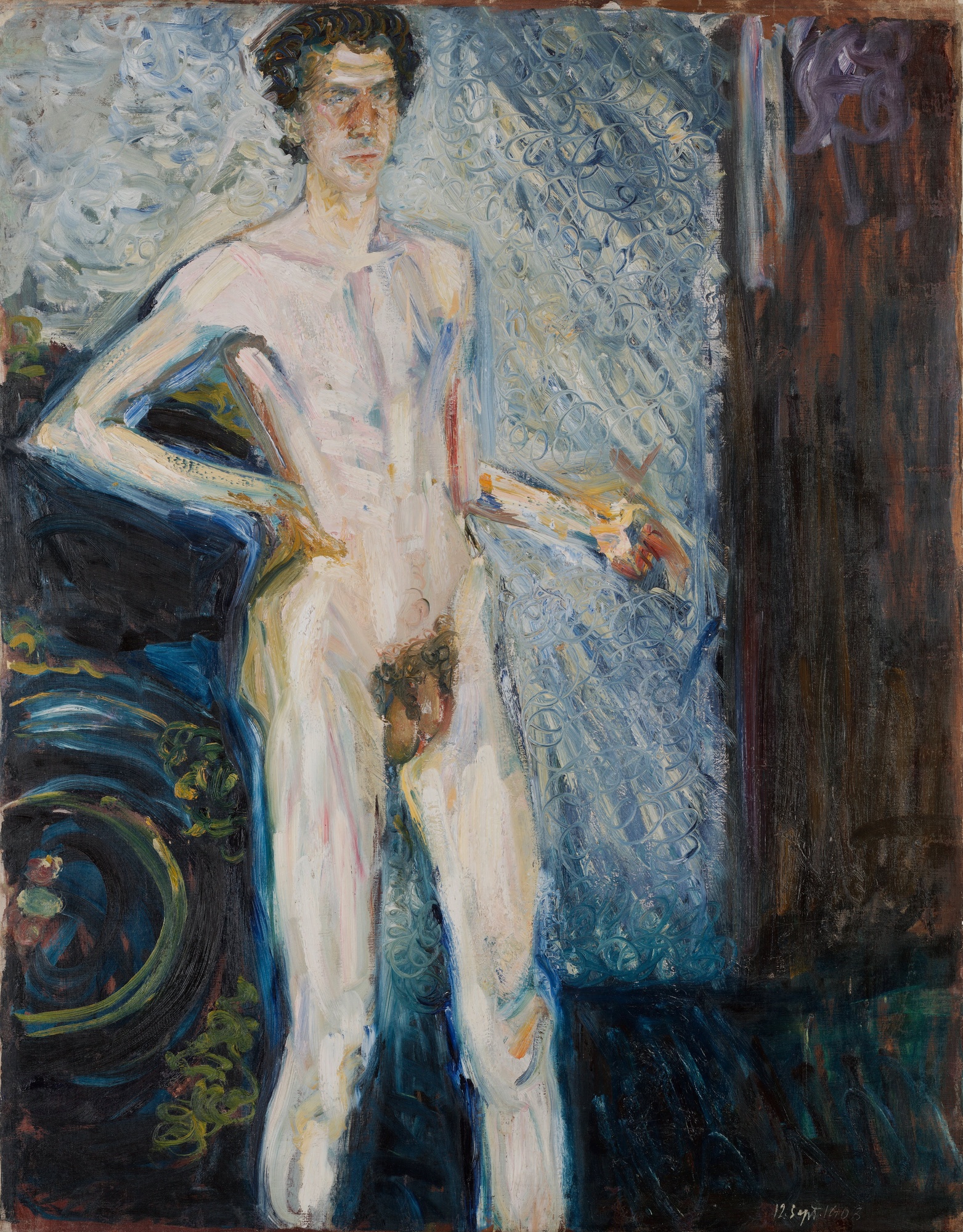
Two years after Modersohn-Becker’s death, in Vienna, a twenty-five-year-old painter named Richard Gerstl stood naked before his own canvas and produced one of the most unnerving self-portraits in the history of art. He is gaunt, angular, his skin a sickly yellow-green. In his left hand he holds a palette — the badge of his profession — but the palette is smeared with the same livid tones that color his flesh. Art and body bleed into each other.
Gerstl’s nude self-portrait is not a celebration of the body. It is an interrogation. The brushstrokes are urgent, almost violent, as if he is trying to paint himself into existence — or out of it. The nudity strips away everything: status, clothing, the social markers that tell us who someone is. What remains is a body and a question.
Gerstl was a Viennese Expressionist before Expressionism had a name, a contemporary of Gustav Klimt and Egon Schiele who burned most of his work before hanging himself in his studio in November 1908, the same year he painted this self-portrait. His affair with Mathilde Schönberg — wife of the composer Arnold Schoenberg — had imploded, and his professional isolation was complete. The nude self-portrait was his last testament: This is all I am. This is all there is.
Lovis Corinth: The Ageing Body Claims Its Place
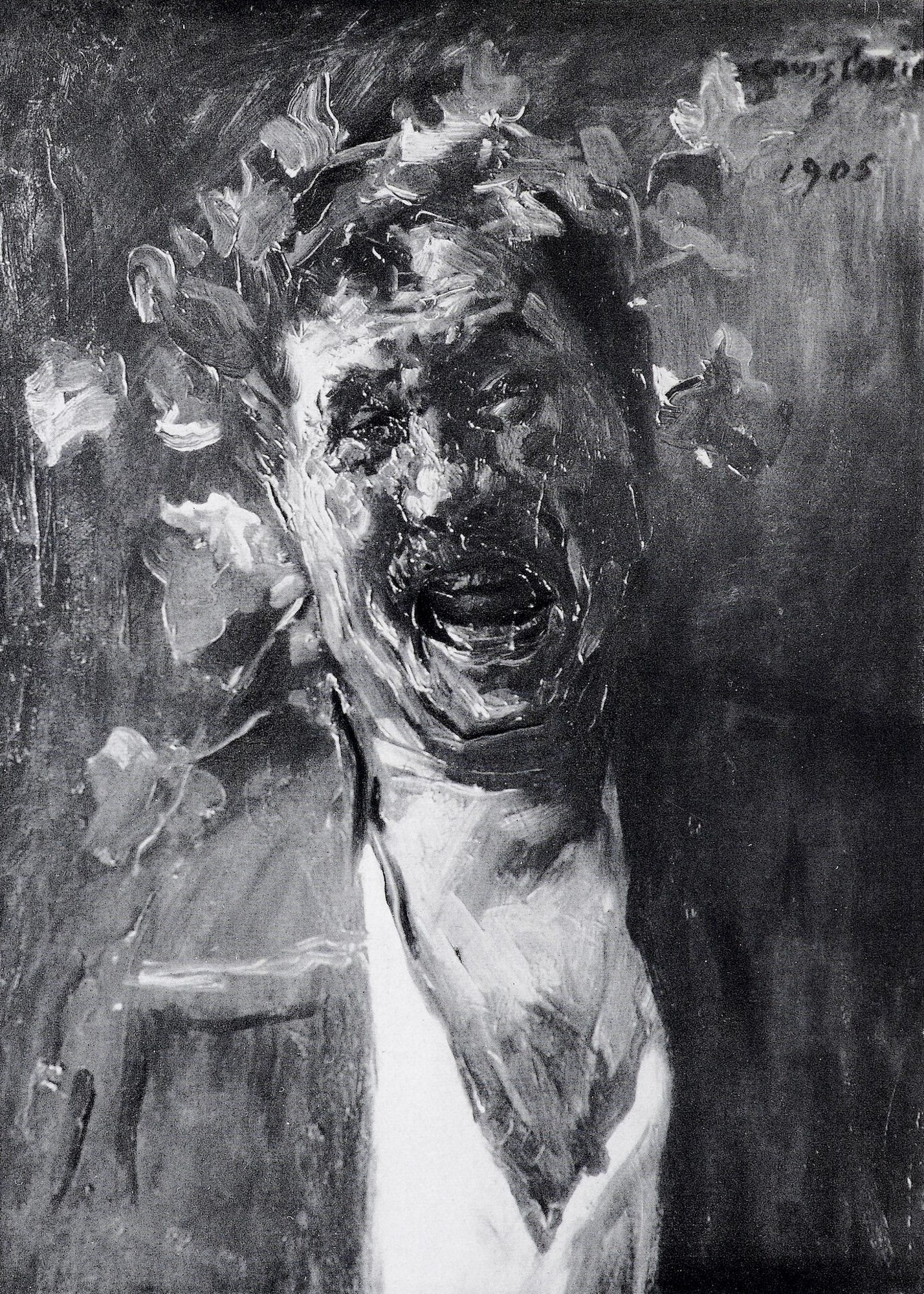
If Modersohn-Becker’s self-portrait is a declaration of creative life and Gerstl’s an admission of despair, Lovis Corinth’s sits somewhere stranger. Painted in 1905, when Corinth was forty-seven and already one of Germany’s most established painters, the Self-Portrait as a Roaring Bacchant shows the artist as a mythological figure: half-naked, crowned with vine leaves, mouth open in a howl, eyes wild.
There is something almost embarrassing about it. A middle-aged man playing at being Dionysus. But that embarrassment is the point. Corinth refuses to let the ageing male body retreat into dignity. He roars. He sweats. The paint is thick and physical, laid on in slabs that make the body feel dense and present. This is not the idealized nude of academic tradition — the smooth, depilated, timeless body that populates salon paintings — but a body that leaks and bellows and will not apologize.
Corinth had suffered a severe stroke in 1911 that partially paralyzed his left side, and his later work grew freer and more Expressionist. The Bacchant self-portrait, painted before the stroke, already anticipates that liberation. The body is not something to be perfected on canvas. It is something to be used — a vehicle for paint, for feeling, for noise.
Why the Nude Self-Portrait Matters
The nude self-portrait does what almost no other genre can: it makes the artist simultaneously subject and object, viewer and viewed, maker and made. There is no model to hide behind, no mythological alibi, no comfortable distance between the person holding the brush and the body on the canvas. The mirror tells no lies.
When Modersohn-Becker painted herself pregnant with art, she was claiming a territory that had belonged exclusively to men: the right to define what a woman’s body means. When Gerstl painted himself as a sack of bones clutching a palette, he was insisting that the artist’s body matters as much as the art it produces. When Corinth howled at his own reflection, vine-crowned and sweat-sheened, he was refusing to let age turn him invisible.
These three painters, all working in the German-speaking world between 1905 and 1908, were not a movement. They never met as a group. Modersohn-Becker was dead before Gerstl painted his masterpiece; Corinth would outlive both by decades. But together they mapped the territory of the nude self-portrait — a form that strips away everything except the one question that matters: What is a body, and whose is it to define?
The answer, in each case, is the same: Mine.