The Zoffany Painting That Says It All
In 1771, the German-born painter Johan Zoffany was commissioned to produce a group portrait of the Royal Academy of Arts in London. The result, The Academicians of the Royal Academy, shows thirty-four men gathered in the life room around two nude male models. It’s a document of institutional power: the men who defined British art, assembled in the room where they had the exclusive right to study the unclothed human body.
Two women are also present in the painting — but only as portraits hanging on the wall. Angelica Kauffman and Mary Moser were founding members of the Royal Academy. They were accomplished, respected, and voted in by their peers. But they could not be painted into the room itself. To show women in the presence of a nude male model would have been indecent. So Zoffany gave them a wall. It was a perfect visual metaphor for the next century of Western art.
For roughly three hundred years, across every major European art academy, women were banned from the life room. They could not draw from the nude model. They could not study anatomy from the living body. And because mastery of the nude was the foundation of history painting — the highest, most prestigious genre — they could not compete for the commissions, the prizes, the professorships, or the legacy that made artists immortal. The ban was not a footnote. It was a structural decision that shaped the entire Western art canon.
What the Life Room Meant
To understand why the ban mattered, you have to understand what the life room represented in the academic system. European art academies — the Accademia di San Luca in Rome (1593), the Académie Royale de Peinture et de Sculpture in Paris (1648), the Royal Academy in London (1768) — operated on a rigid hierarchy of genres. At the bottom: still life and flower painting. In the middle: portraiture and landscape. At the pinnacle: history painting, which depicted scenes from the Bible, classical mythology, and significant historical events. History painting required the human figure. And the human figure required the life room.
Students progressed through a tightly controlled sequence: first copying drawings, then plaster casts of antique sculpture, and finally — only after proving themselves — drawing from the living model. The life room was the capstone. It was where an artist learned to render flesh, proportion, foreshortening, the body in motion. Without it, you could not produce credible history paintings. Without history paintings, you could not join the Academy. And without Academy membership, you had no access to royal patronage, state commissions, teaching positions, or the exhibitions that built reputations. The system was a closed loop, and the lock was the nude.
The Exception That Haunted the Rule
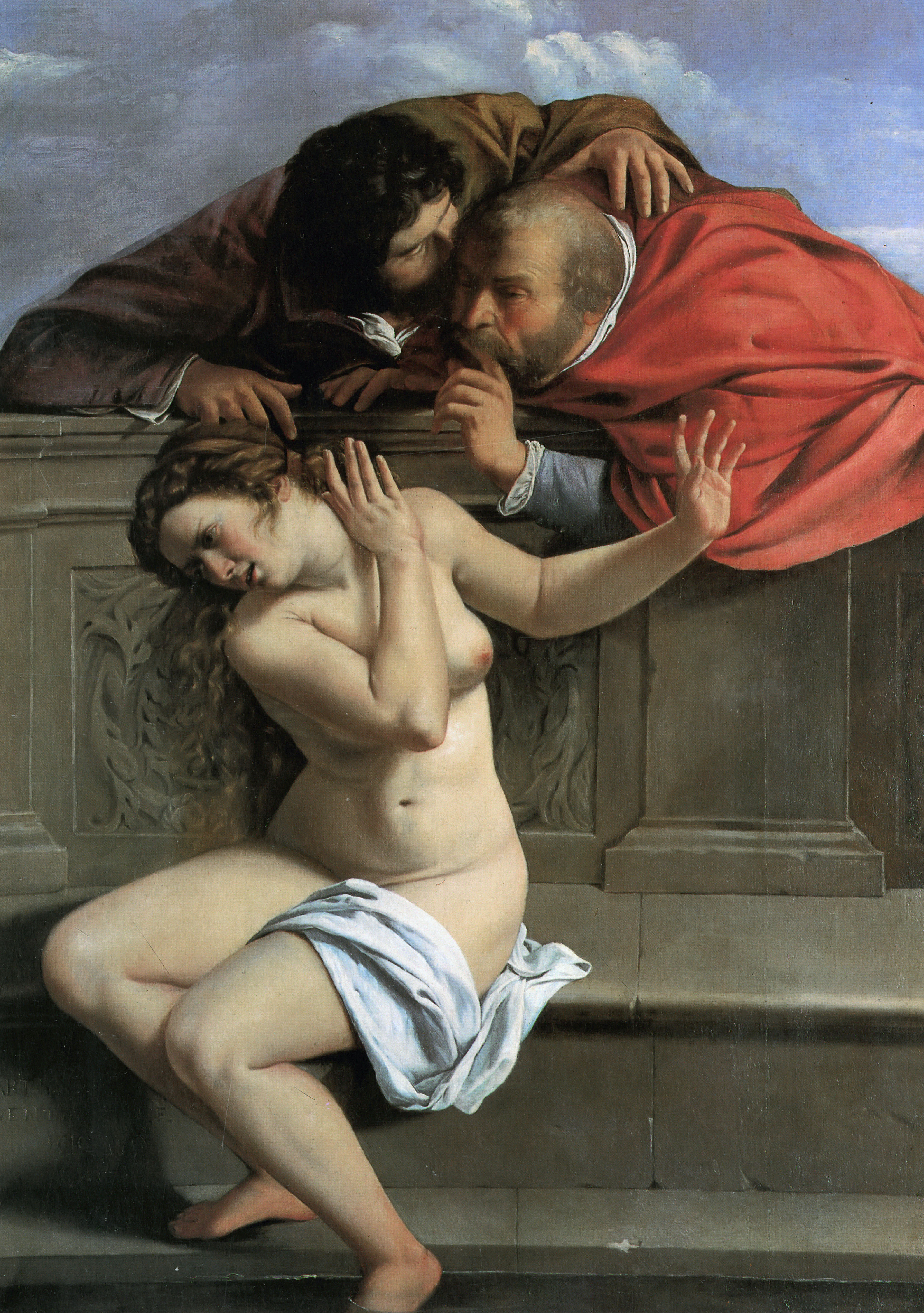
Artemisia Gentileschi never trained in a life room. She learned from her father, Orazio, a Caravaggist painter in Rome, and from private study. Yet she produced some of the most powerful nudes of the Baroque era. Her Susanna and the Elders, painted when she was seventeen, depicts the biblical story of a woman harassed by two lecherous elders while bathing. Male artists had painted this scene for centuries as an opportunity for voyeurism — Susanna as available, coy, ambiguously complicit. Gentileschi’s Susanna is none of those things. Her body twists away from the men. Her face registers distress, not invitation. The elders loom over her, physically invasive, and she recoils.
Gentileschi’s nudes — Susanna, Judith, Cleopatra — are fundamentally different from those of her male contemporaries. Not because women possess some essential way of seeing, but because Gentileschi’s relationship to the body was shaped by a different set of pressures. She painted nudes without the institutional license that male artists took for granted. She painted bodies that knew what it meant to be looked at without consent. The female nude, in her hands, is not an object for consumption. It is a subject with agency, even in extremis. She is the exception that proves the rule — the artist who achieved what the Academy said was impossible, and who proved, by her very existence, that the ban was never about capacity. It was about control.
The Taxonomy of Exclusion
The ban was not a single policy enacted in one place at one time. It was a distributed system of exclusions that varied by institution but produced the same result everywhere: women painted flowers, men painted bodies.
At the Royal Academy, women could exhibit but could not attend life classes until 1893. At the École des Beaux-Arts in Paris — the most powerful art school in the world — women were not admitted at all until 1897. Private academies like the Académie Julian offered women instruction, but at higher tuition, and often with the model partially draped or strategically positioned to preserve modesty. The Slade School of Fine Art in London, founded in 1871, was a rare exception: it admitted women from the start and gave them equal access to the life room. The result was a generation of women artists — Gwen John, Dora Carrington, Winifred Knights — who competed on equal footing and won the school’s top prizes.
But one school does not overturn three centuries of structural exclusion. The women funneled into still life and portraiture — Élisabeth Vigée Le Brun painting Marie Antoinette’s dresses, Rachel Ruysch painting elaborate floral arrangements, Clara Peeters painting breakfast tables — were working at the limits of what the system permitted. Their work was often brilliant. But it was never allowed to be important in the way that history painting was important. The hierarchy of genres was a hierarchy of access, and access was determined by anatomy.
The Woman Who Claimed Her Own Authority
Angelica Kauffman understood exactly what she was up against. Born in Switzerland in 1741, trained by her painter father, she was a child prodigy who spoke four languages and established herself as a portraitist and history painter before she turned twenty. When the Royal Academy was founded in 1768, Kauffman and Mary Moser were the only women among its thirty-four founding members. It was an extraordinary achievement — and a profoundly ambivalent one.
Kauffman could not attend life classes. She could not vote in Academy elections. She could not attend the annual dinner — she was invited once, seated separately, and never invited again. The Zoffany portrait captured the paradox exactly: she was an Academician, but she was not an academician in the room. She was a portrait on the wall.
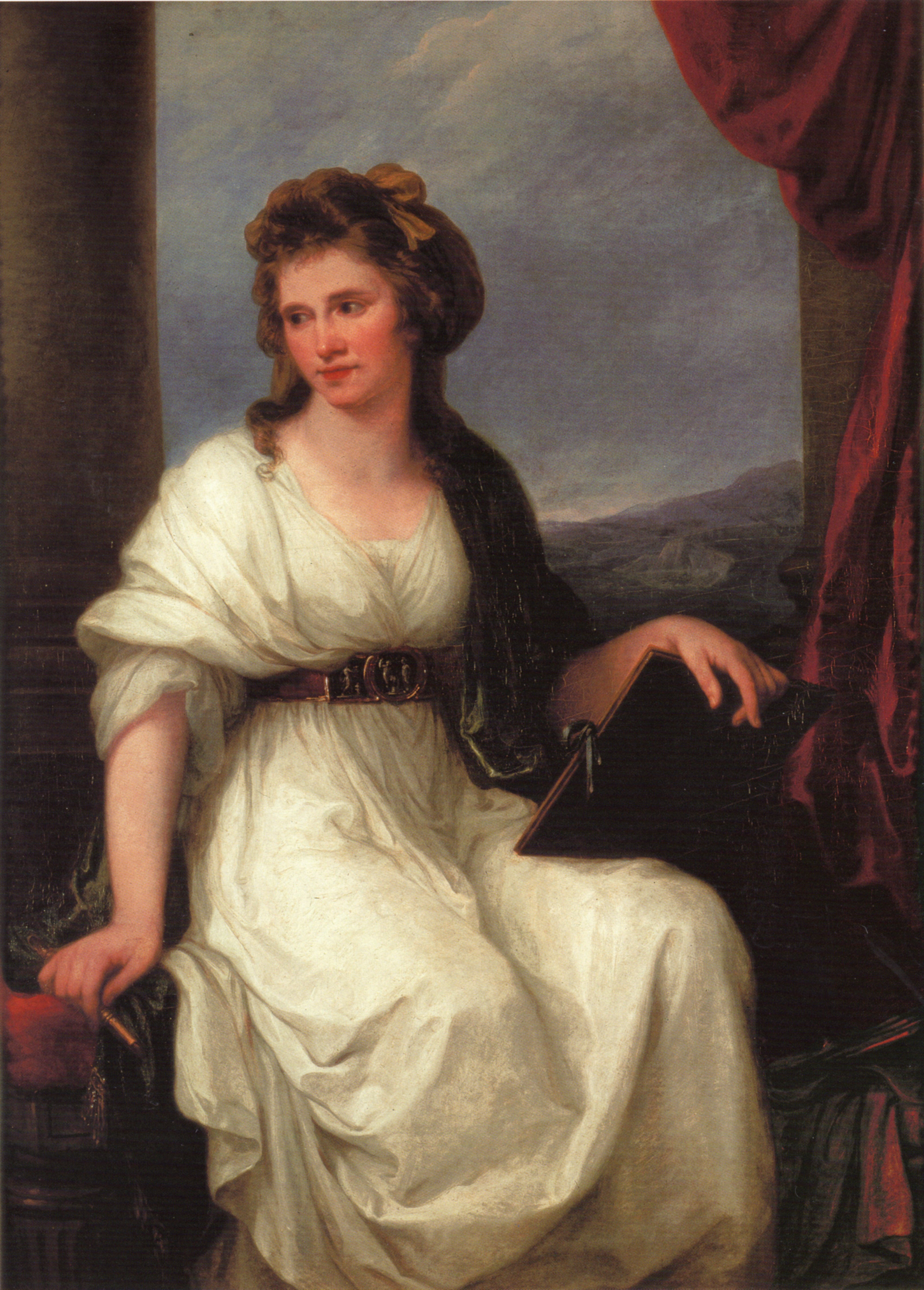
Her Self-Portrait as the Muse of Painting (1787) is a quiet act of defiance. She presents herself not as an allegorical figure — the traditional way to depict women in art — but as an active maker. She holds a portfolio and a brush. She looks directly at the viewer with calm, unapologetic authority. She is not a muse being painted. She is the painter, claiming the identity the Academy refused to fully grant her.
Why It Still Matters
The ban ended — officially — by the close of the nineteenth century. But its structural legacy endures in ways that are easy to miss if you do not know what you are looking for.
In 1989, the Guerrilla Girls published a poster that asked: “Do women have to be naked to get into the Met. Museum?” The answer, based on their count: less than 5 percent of the artists in the Modern Art sections were women, but 85 percent of the nudes were female. The poster became iconic, but the numbers it cited were not aberrations. They were the direct inheritance of the three-century ban. The imbalance in museum collections, in auction prices, in the artists included in survey textbooks — these are not accidents of taste or “quality.” They are the downstream effects of who was allowed in the room with the naked body.
When the life room was male-only, the perspective that emerged from it became the default. The male gaze was not one way of looking among many. It was the only way of looking that the institution recognized as legitimate. Generations of male artists internalized it, reproduced it, and passed it on. Generations of women artists were excluded from the conversation entirely. The result is a visual culture in which women’s bodies have been painted, sculpted, and photographed primarily by men — not because men are more interested in the nude, but because the system was designed that way.
The ban is history now. But the asymmetry it created is still with us. Every time a museum announces a retrospective and the artist is, yet again, a man. Every time an art history textbook devotes a chapter to the male nude and a paragraph to the women who painted it. Every time someone says “there just were not that many great women artists” without asking why. The answer starts in the life room, circa 1600, with a door that was locked — not by accident, but by design.