Anselm Feuerbach was born in Speyer on September 12, 1829, into a family that already carried the weight of German intellectual life. His father was the archaeologist Joseph Anselm Feuerbach; his uncle was the philosopher Ludwig Feuerbach, whose writing on religion shaped a generation. The nephew chose paint over thought, and he chose one subject above all: the human body as the classical world had imagined it.
Feuerbach spent his working life trying to resurrect the nude. He studied in Düsseldorf, Munich, Antwerp, and Paris, then in 1856 he did what so many German artists of his era did and left for Rome. There, surrounded by antiquity, he found the body he had been looking for. His 1870 masterpiece, The Judgement of Paris, now in the Hamburger Kunsthalle, gathers the three goddesses before the shepherd who must choose among them. It is one of the few monumental mythological nudes in all of nineteenth-century German painting, and Feuerbach meant it as a declaration: the classical nude belonged to Germany too.
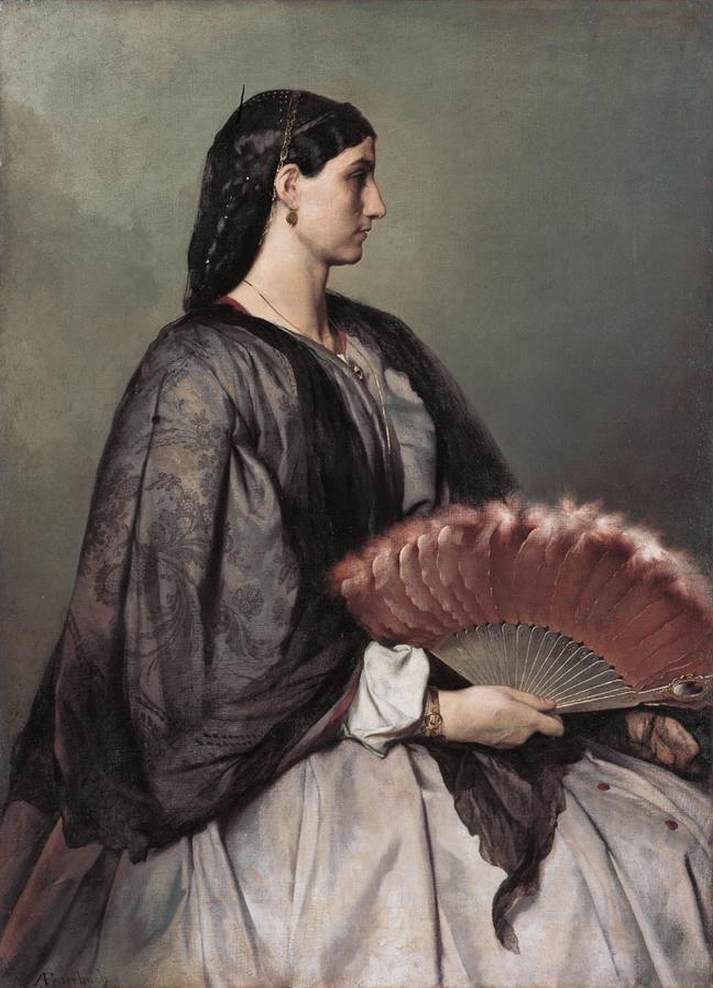
Behind every ideal stood a real woman. In 1860 Feuerbach met Anna Risi, a Roman model who became his lover and his obsession. He painted her again and again, most famously in the portrait he simply titled Nanna. Where The Judgement of Paris offered idealized goddesses, Nanna offered a living woman, her bare shoulders and steady gaze refusing the distance of myth. The tension between the two images is the whole of Feuerbach’s art: the body as pure form and the body as a specific person, impossible to separate.
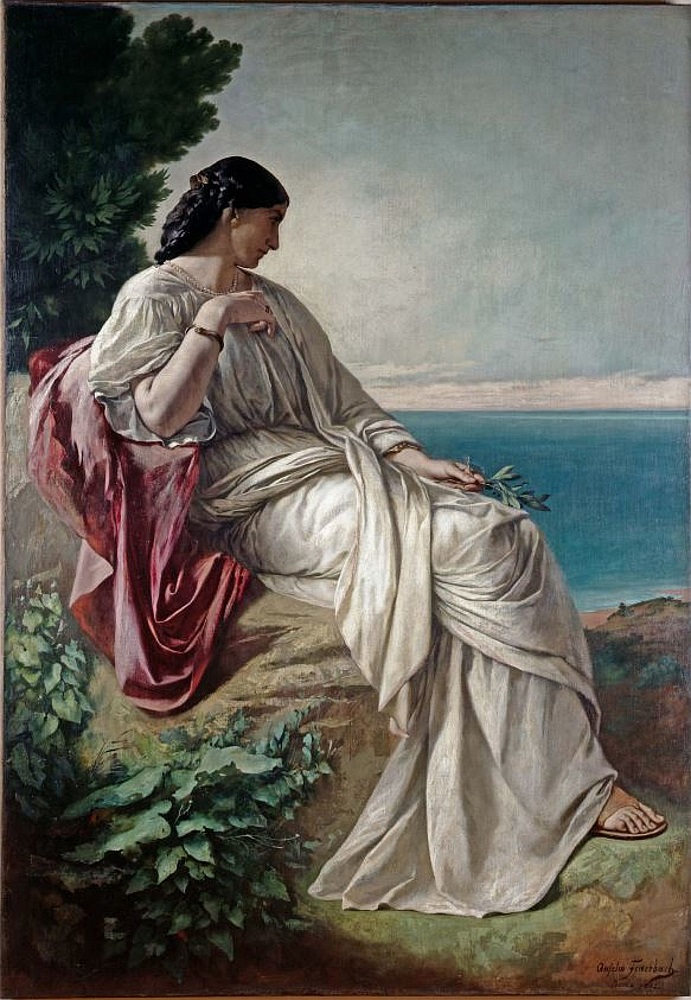
He painted the figure in solitude as well. His Iphigenia, begun in 1862, shows the Greek heroine seated by the shore, wrapped in thought rather than myth. The body turns inward here, melancholy and alone. It is the other half of Feuerbach’s project: the nude as argument and the figure as soul.
Feuerbach’s own life ran short. He returned to Vienna in 1873 to teach, found himself unhappy and under-appreciated, and died in Venice on January 4, 1880, at the age of fifty. His stepmother Henriette gathered his letters into a memoir that won him the posthumous recognition he never quite secured while alive. Today, on the 197th anniversary of his birth, he reads as a painter who made the classical nude into a cultural argument, a claim that the idealized body belonged to his nation, his century, and his own persistent longing.