When Alessandro Allori died in Florence on September 22, 1607, the nude in Western art stood at a crossroads. Caravaggio had already painted his brutally honest bodies, and the Baroque was gathering force. Allori, at seventy-two, belonged to an older world. He was the last major Florentine Mannerist, the adopted son and heir of Bronzino, and he spent his final decades defending a different idea of the naked body: refined, artificial, polished until it gleamed like enamel.
Allori never had to invent himself. He was born Alessandro di Cristofano di Lorenzo in Florence on May 31, 1535, and his father, a sword-maker, died when the boy was five. Bronzino, the Medici court painter, took the child in, trained him, adopted him, and passed on his own name. For years the young artist signed himself Alessandro Bronzino Allori in tribute to the master who raised him. From Bronzino he inherited the whole apparatus of Mannerist elegance: the enamel-smooth surfaces, the elongated limbs, the cool, detached eroticism that had defined the Florentine nude since Pontormo.
His subject, time and again, was the female nude, and he treated it as a jewel. In Venus and Cupid, painted after 1570 and now in Montpellier, the goddess stands full length, her body a continuous sweep of pearly skin, her pose too graceful to be natural. Allori’s nudes do not breathe. They glow.
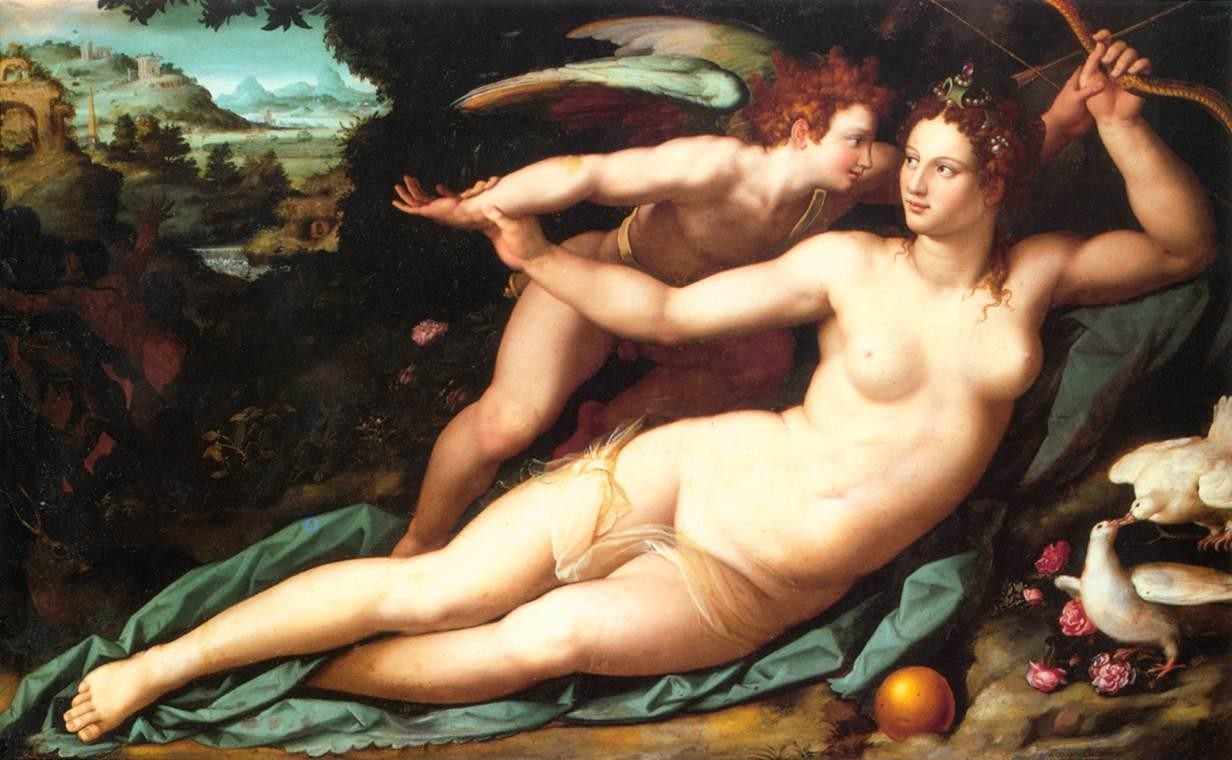
The distance was the point. Mannerism was a style for courts, and the nude Allori painted was a courtly artifact. In Venus Disarming Cupid, painted around 1570 and now in Los Angeles, he revisited a composition Michelangelo had designed and made famous among Florentine painters. Michelangelo’s nudes were massive and sculptural. Allori’s Venus is slender and self-possessed, taking the bow from her son with cool authority. Where Michelangelo built the body from stone, Allori gilded it.
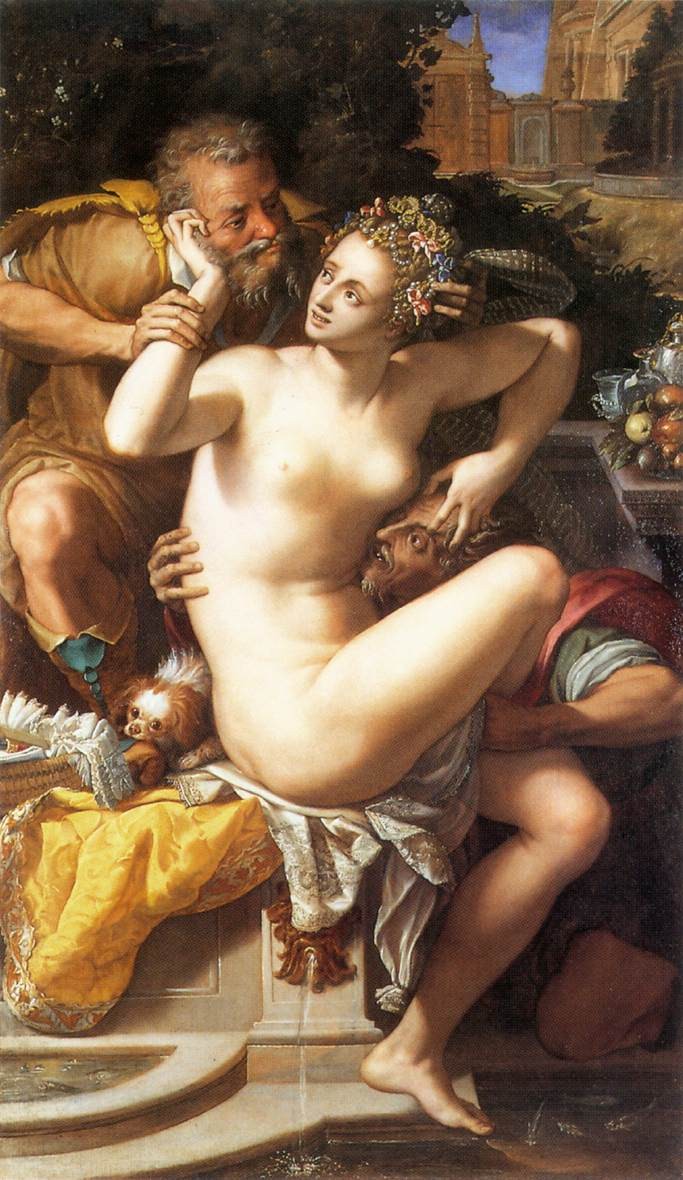
The irony is that Allori painted this polished perfection while the ground shifted beneath him. His early Susanna and the Elders, from 1561, stages the biblical nude through the Mannerist lens: Susanna bathes, two elders spy from the shadows, and the whole scene has the smooth, theatrical clarity of a Medici pageant. By the time Allori died, that visual language was fading. Caravaggio’s nudes had pores. The age of the enamel body was ending.
So why does Allori still matter? He marks the moment the nude stopped pretending to be nature and admitted it was artifice. The academic nudes of the next three centuries, the polished Venuses of Bouguereau and Cabanel, the airbrushed bodies of a later age, all descend from the Mannerist gamble that the body could be a jewel rather than a fact. Allori made that gamble with total conviction. His nudes feel cool and flawless, and perfection was the only thing he was chasing.
He also left a living legacy. His son Cristofano Allori became a brilliant painter in his own right, remembered above all for the Judith with the Head of Holofernes that hangs in the Pitti Palace. The father’s obsession with the refined body did not die with him. It changed hands.
On the 419th anniversary of his death, Alessandro Allori deserves to be remembered as more than Bronzino’s student or a footnote between Michelangelo and Caravaggio. He was the artist who held the nude to a standard of flawless, courtly elegance at the very moment history was demanding something rawer. The polished body he perfected may have been an illusion, but it is an illusion we are still looking at.