Before Suzanne Valadon painted the nude, she was the nude. She arrived in Montmartre as a teenager, the illegitimate daughter of a laundress, and went to work modeling for the men who were about to define Impressionism. Renoir posed her. Puvis de Chavannes posed her. Toulouse-Lautrec sketched her. For years her body appeared on their canvases while she watched them work, memorizing every stroke of the brush.
Then she took the brush herself. Valadon was born on September 23, 1865, in a small village in the Limousin. By the time she died in 1938, she had become one of the only women of her generation to earn a living as a painter, and she had done it by painting the female nude the way the men never quite could: from the inside, without a pedestal, without an apology.
The body she learned to see
She had no formal training and no permission. Women were barred from the life room and from the École des Beaux-Arts, so Valadon learned the way a spy learns, by watching the painters she sat for. Edgar Degas saw her drawings in the early 1890s and bought them on the spot, hanging them on his own walls beside works by Ingres and Delacroix. He championed her at the Société Nationale des Beaux-Arts in 1894, making her the first woman painter to exhibit there.
A nude that does not perform
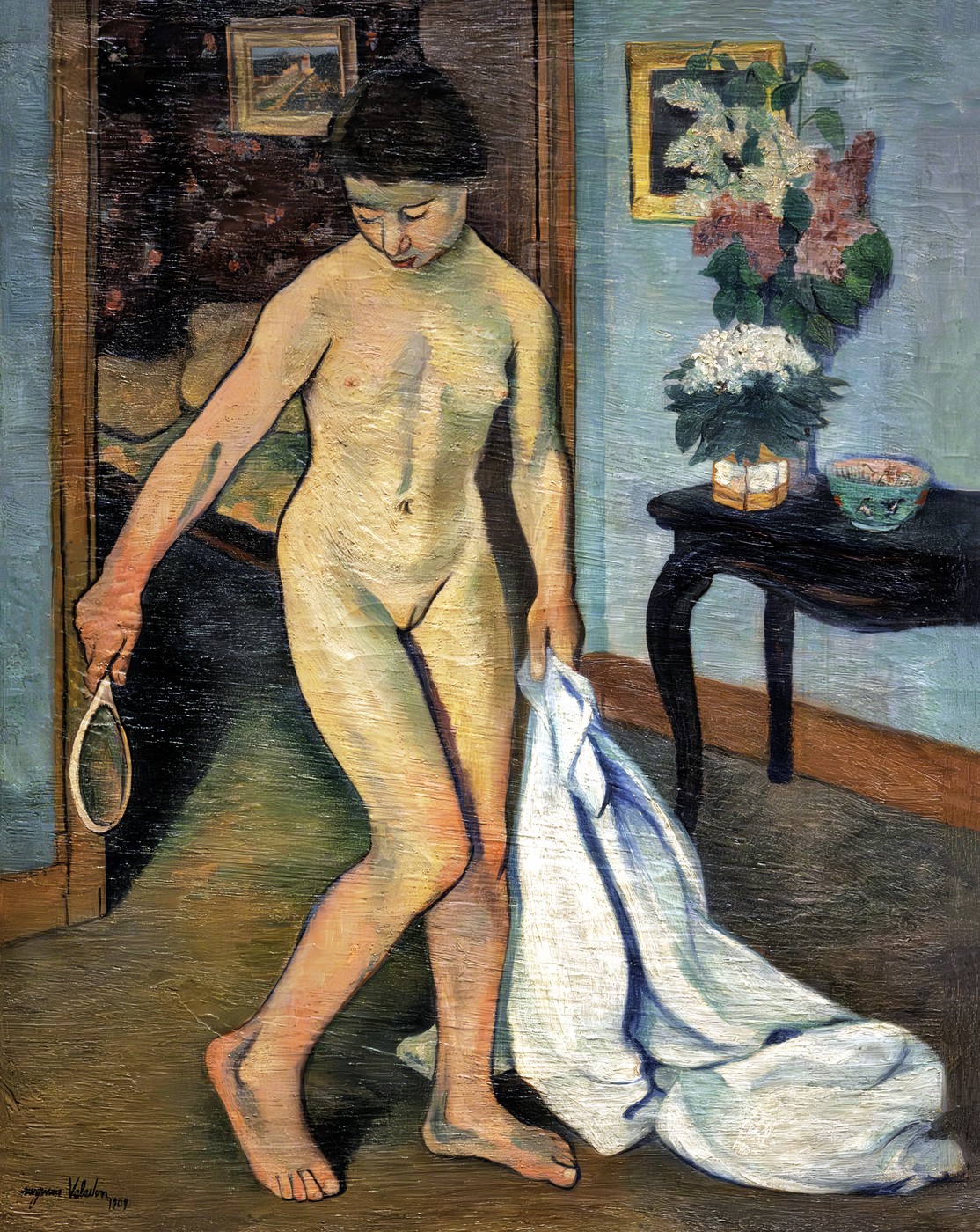
The academic nude was a performance. The Venus and the odalisque turned their bodies toward a viewer who owned the gaze. Valadon’s women do something else. In Nude on a Red Sofa (1920), her model lies back with the ease of someone alone in a room. In Nude at the Mirror (1909), the body is caught mid-movement, absorbed in its own reflection. These are bodies at rest in their own presence, not arranged for someone else to admire.
The difference is the painter’s position. Valadon had spent her youth as the object of that gaze, and she knew exactly what it did to a woman. When she crossed to the other side of the canvas, she refused to reproduce it. Her nudes are unidealized and heavy with real life: thick limbs, strong hands, faces that do not flatter the viewer.
Her own body, at sixty-six
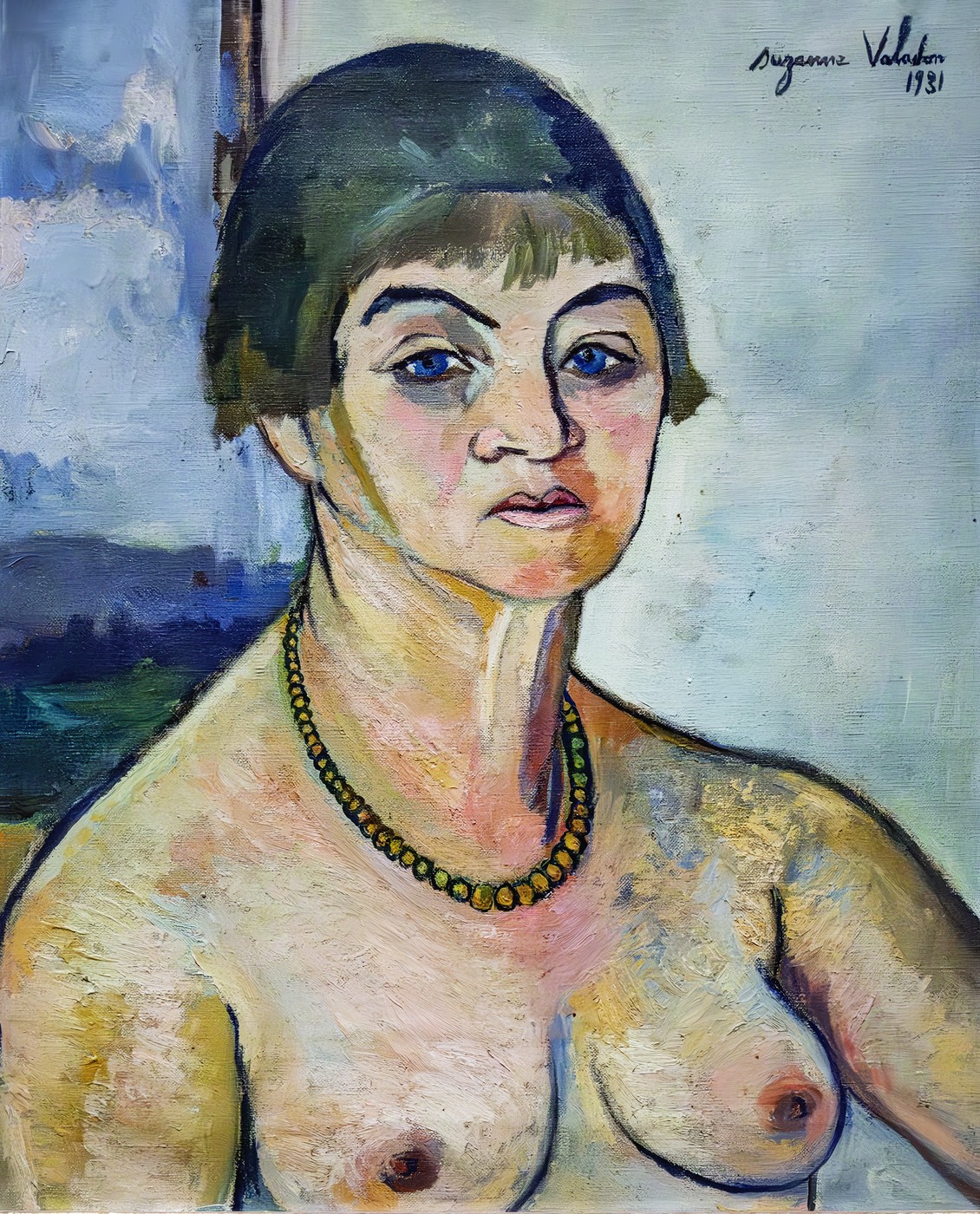
Her most radical nude may be her last. Self-Portrait with Bare Breasts (1931) shows Valadon at sixty-six, torso bared, painted without mercy and without shame. The Western canon is crowded with young Venuses and almost empty of aging bodies. An older woman’s nakedness, painted by her own hand, was a quiet act of defiance. She did not flatter herself, and she did not ask permission.
The gaze she handed to the next century
Valadon died in 1938, a few years after her son, the painter Maurice Utrillo, whose early canvases she guided and whose fragile career she protected for decades. She left behind a body of work that anticipated the female gaze years before the term existed. The women she painted are not waiting to be admired. They are simply present, and that is what makes them radical.
The model had become the author of the image, and the nude was finally allowed to stop performing. Join us as we keep telling the stories the canon forgot.