Marcel Duchamp died on October 2, 1968, at his home in Neuilly-sur-Seine, just outside Paris. His admirers assumed they had heard his final word. They were wrong. For the last twenty years of his life, Duchamp had been building one more nude, in secret, behind a locked studio door. He told almost no one. He left instructions for it to be assembled only after he was gone.
The door with two holes
In the summer of 1969, visitors to the Philadelphia Museum of Art came upon a strange sight: a weathered wooden door set into a wall of bricks. Two small holes sat at eye level. Through them, in dim light, a naked woman lay on a bed of twigs, her legs spread, her face hidden, her left hand holding a small gas lamp. Behind her stretched a landscape with a waterfall and a faint moving glow.
The work was Étant donnés: 1° la chute d’eau, 2° le gaz d’éclairage. Given: 1. The Waterfall, 2. The Illuminating Gas. Duchamp built it in secret between 1946 and 1966. It is the most radical nude of the twentieth century, and he showed it to no one while he lived.
The reclining nude, from Giorgione to Duchamp
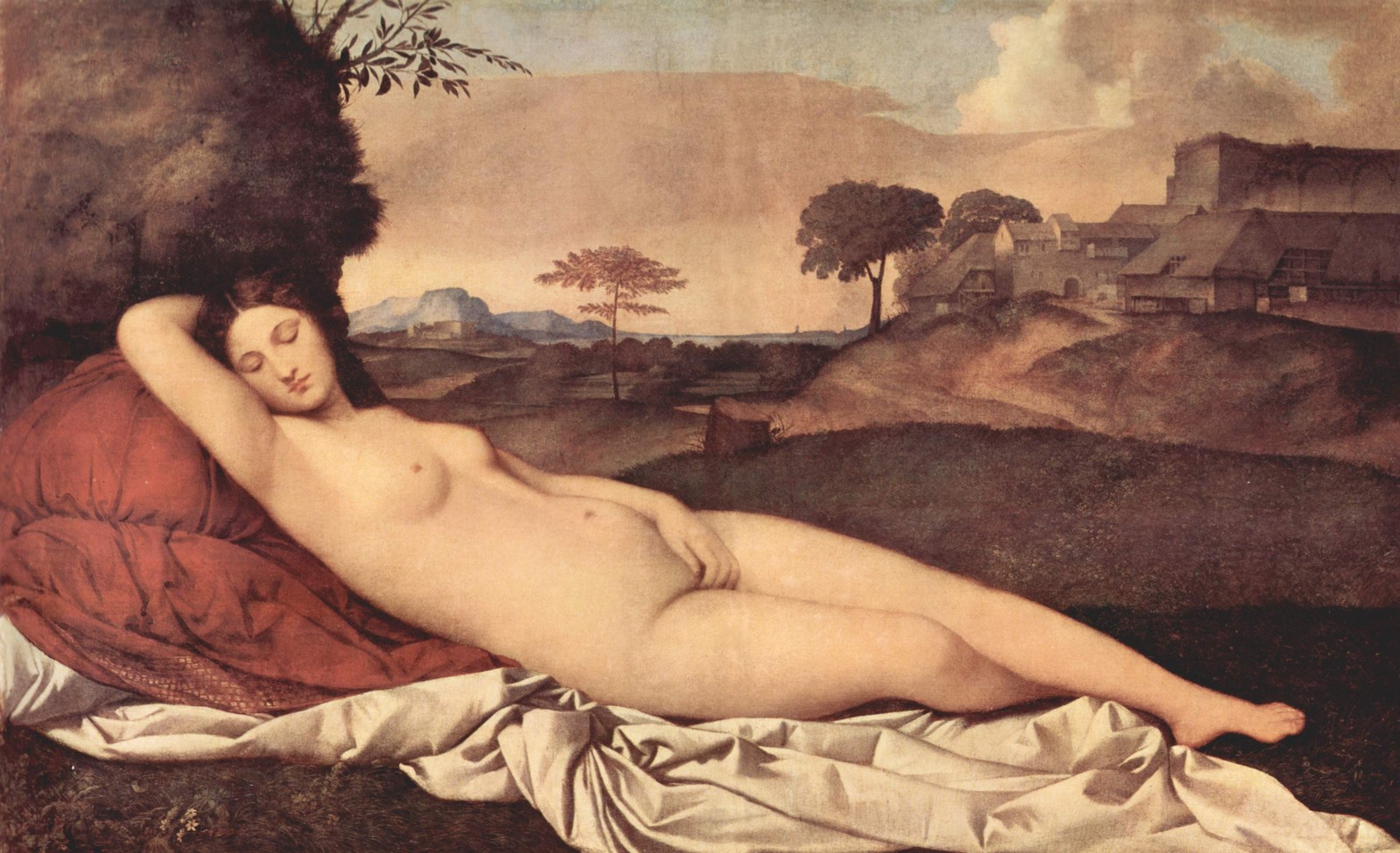
The reclining nude is among the oldest subjects in Western art. Giorgione began it around 1510 with Sleeping Venus, a woman asleep in a landscape, unaware of any viewer. Titian took the same pose and made it look back: Venus of Urbino meets the spectator’s eye. Ingres stretched the body, Courbet stripped away its allegory, and Manet made it stare back and ask questions.
Duchamp spent his early career dismantling that whole tradition. Nude Descending a Staircase, the 1912 scandal, turned the body into motion and machinery. For years he insisted painting was finished. Then, in his sixties, he returned to a studio and rebuilt the reclining nude, piece by piece, in total secrecy.
The gaze turned into a peephole
Every reclining nude before Étant donnés was painted to be looked at. The artist set the body in full display and hung the canvas to face the room. Duchamp reversed the arrangement. No one can stand before Étant donnés. A viewer presses one eye to a hole in a door. The body stays hidden except through that narrow opening. The face never appears. The spectator becomes a voyeur, and the nude stays out of reach.
For Duchamp, beauty was beside the point. The real subject was control: who looks, and who is seen.
The artist controls the reveal, even from the grave
Duchamp left a binder of photographs and instructions showing how to assemble Étant donnés after his death. Only his wife, Alexina, knew the work existed. He had spent two decades building it, then took it apart and shipped it in pieces. The Philadelphia museum put it back together in 1969.
The gesture reads as a final joke and a final seriousness at once. The artist who had declared the end of art spent his last years making a work so private it could not be seen until he was dead. The nude, the oldest subject in the tradition, became his last secret.
Why it still matters
Étant donnés closes the history of the reclining nude and opens the art that followed it: installation, the viewer as participant, the body as a controlled encounter instead of a shared image. In an era when nearly every body gets photographed and posted, Duchamp’s final nude refuses the crowd. Only one person at a time can see it, through a hole, in the dark.
That is what a nude can still do when an artist trusts its power. It can make you look, and it can make you feel, in the same instant, that you were never meant to see it.
For more on the artists who shaped the nude in art, explore the nudeartla.com collection or get involved with our community.