
Pierre Bonnard was born on October 3, 1867, in Fontenay-aux-Roses, a suburb of Paris. He died in 1947, having spent roughly forty of his eighty years painting the same woman in the same room, lowering herself into the same bath. Those canvases changed what the nude could mean.
The Nabi who stayed home
Bonnard trained for the law, then walked away from the bar to help found Les Nabis, the “prophets,” a band of young painters who wanted to free color and line from the duty of describing objects. Gauguin’s flat fields of color and Hokusai’s woodblock prints taught him that a picture was a surface before it was a window. But while his Nabi friends chased symbol and mysticism, Bonnard turned inward, toward the apartment, the garden, the table after a meal, and the woman at her bath.
Marthe
In 1893 he met Maria Boursin, a young woman from the provinces who called herself Marthe de Méligny and trimmed years off her age. She became his model, then his companion, then his wife. For the rest of his life Bonnard guarded her identity as a secret, and for decades he painted her: reading, sleeping, and above all bathing. Marthe bathed constantly, a compulsion some biographers trace to fragile health, and Bonnard turned that private ritual into a lifelong subject.
The bath as the modern nude
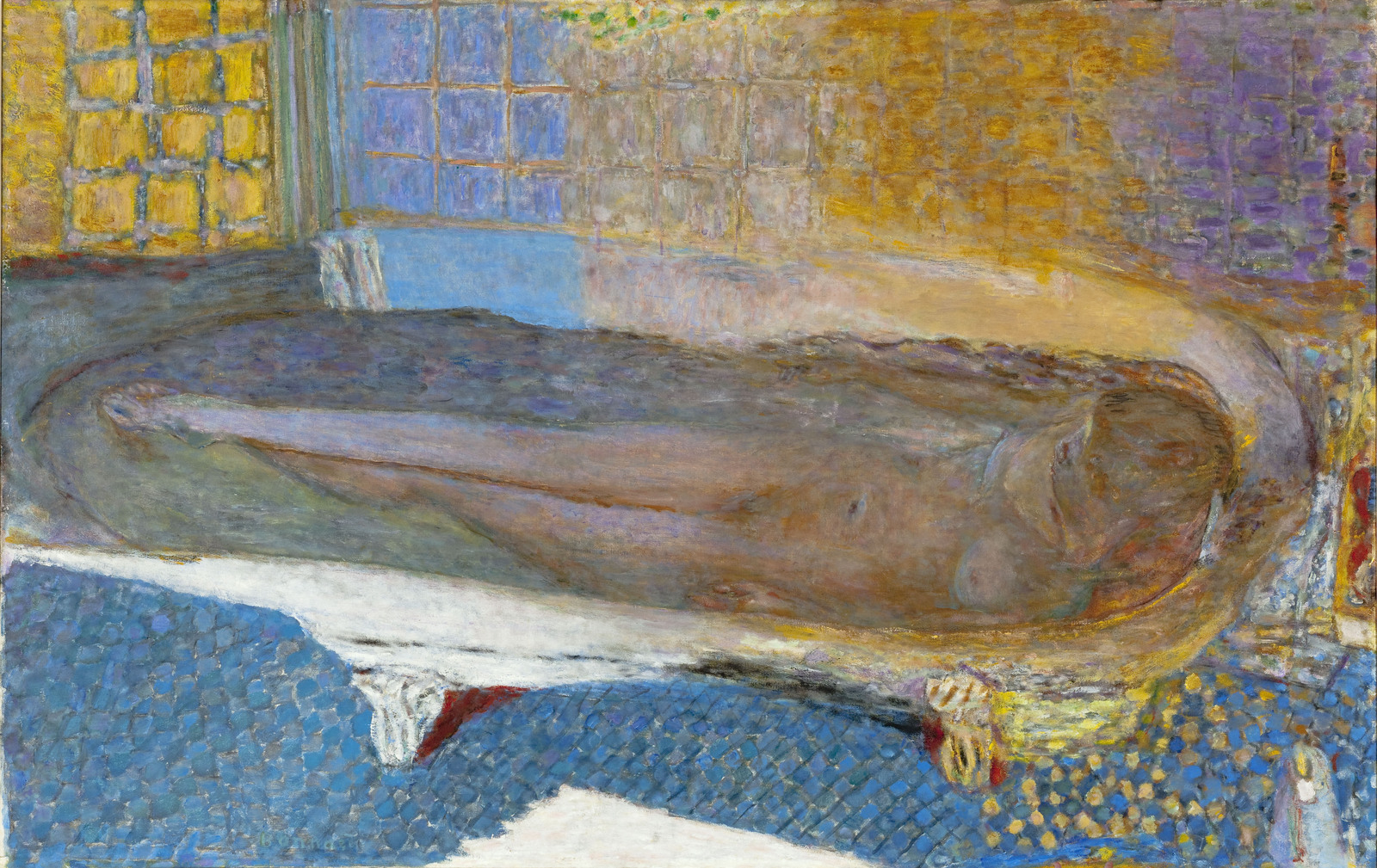
The bath series is the core of Bonnard’s art. A woman stands in a tub or lies back in water that Bonnard renders as a shifting field of color: turquoise, lilac, rose, gold. The body is present but never anatomized. Flesh, water, and light merge until the nude reads less as a figure than as a patch of luminous color that happens to be a person.
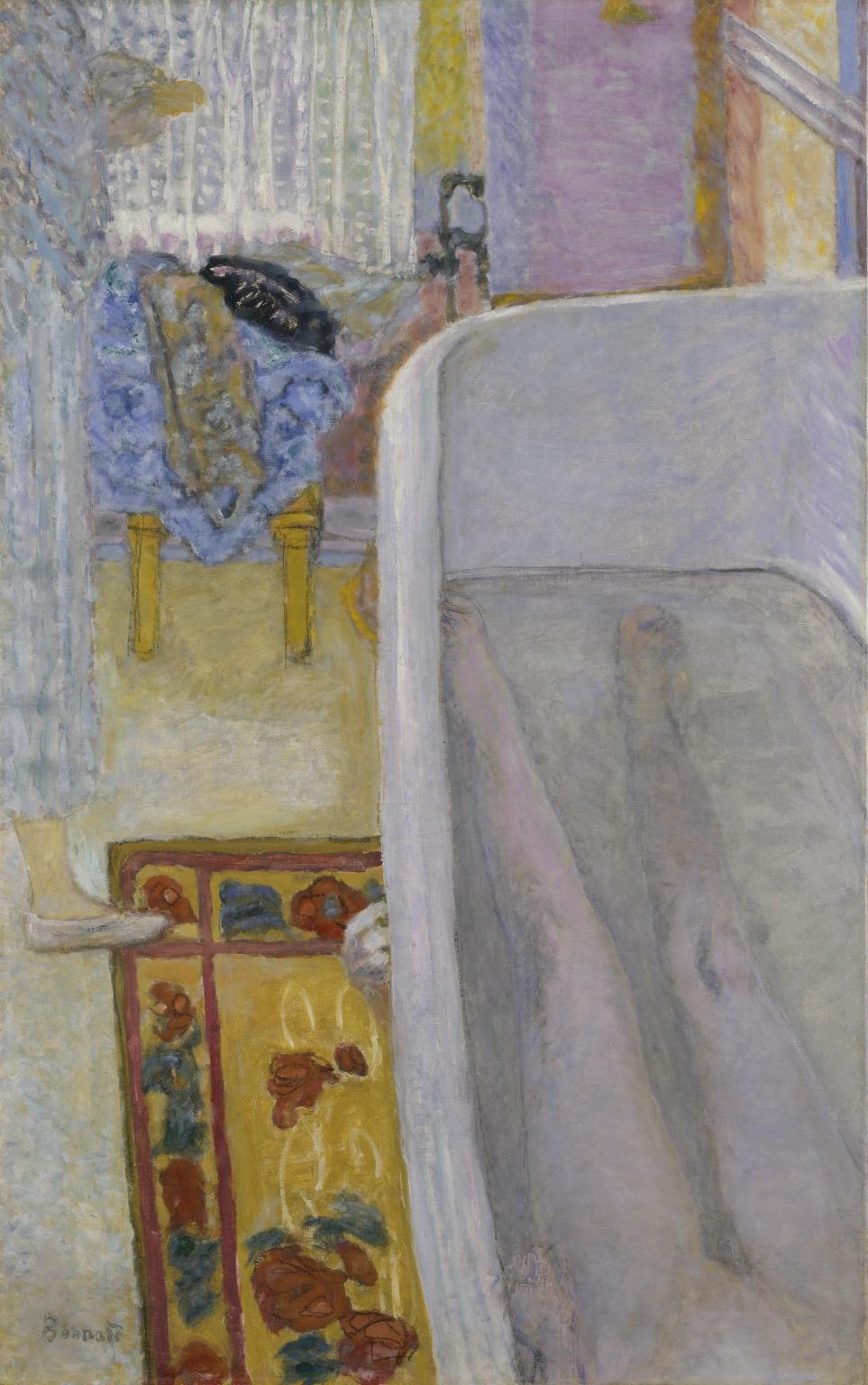
Bonnard painted from memory. He pinned his canvases to the wall and worked on them for months, layering color, never in front of the live model. The academic nude depends on the observed body held still in the life room. Bonnard’s nudes are remembered bodies: the nude as presence, as afterimage, as the feeling of a person rather than the measurement of one.
Dissolving into light
What makes these bathers radical is how completely Bonnard demotes anatomy in favor of atmosphere. In the 1925 Nude in the Bath, the body is a pale shape dissolving against a wall of blue and gold. By the 1936 canvas now in the Musée d’Art moderne de Paris, the boundary between skin, water, tile, and light has nearly collapsed. The figure emerges as a memory of color rather than a rendering of flesh. This is the nude pushed toward abstraction, decades before abstraction claimed it.
The painter of happiness, corrected
Critics long called Bonnard “the painter of happiness,” and the label sticks the wrong way. His rooms are warm and his gardens bright, but the bath nudes are watchful, solitary, a little obsessive: one woman, one room, the same water, year after year. Bonnard’s happiness is the happiness of absorption, the happiness of a man who looked at one thing for so long that he began to see it as pure color.
He watched his contemporaries build form out of harder, stranger geometries. Matisse flattened the figure into decorative line. Picasso broke it into facets. Bonnard did the reverse: he let the body dissolve, allowing skin to borrow the colors of the water and the tile until the distinction no longer held. In a century that kept asking what a body could be reduced to, Bonnard kept answering: light.
Bonnard’s bathers sit in a long lineage. Titian’s Venus reclined to be admired. Degas watched his bathers as if through a keyhole. Bonnard’s bather performs for no one. She is absorbed in the water, unaware of the painter, and the painter is absorbed in the color she becomes. This is the nude with the audience removed, the body that has forgotten it is on display. That forgetting is the quiet revolution at the center of Bonnard’s art.
Henri Matisse called him “the greatest among us.” The claim holds. Bonnard took the most public, most idealized genre in Western art, the female nude, and made it private, daily, and strange. He traded the Venus for the wife and the myth for the morning bath, and in doing so he gave the twentieth century its most tender account of what it means to live inside a body and to look at one you love.