In 1908 an American in his late twenties finished eighteen large carved figures for the façade of the British Medical Association building on the Strand in London. The city answered with a moral panic. The National Vigilance Association, whose offices stood directly across the street, called the figures sexually explicit and an insult to Edwardian decency. Newspapers ran editorials. Three decades later the figures would be declared unsafe and hacked from the wall. Jacob Epstein, born on this day in 1880 on New York’s Lower East Side, learned the lesson that governed his career in his first years in London: the monumental nude was still the most dangerous thing an artist could place in public.
Epstein arrived in London in 1905 with a head full of what he had studied in the British Museum: African and Polynesian carvings, Egyptian sculpture, the archaic Greek kouroi. His figures are frontal, blocky, totemic. They stand like kouroi and stare like pharaohs. They carry the mass of carved stone rather than the smooth finish of the academic nude. While his contemporaries polished the salon Venus or prepared to shatter the body into Cubist planes, Epstein looked toward sources older than Athens to make something new.
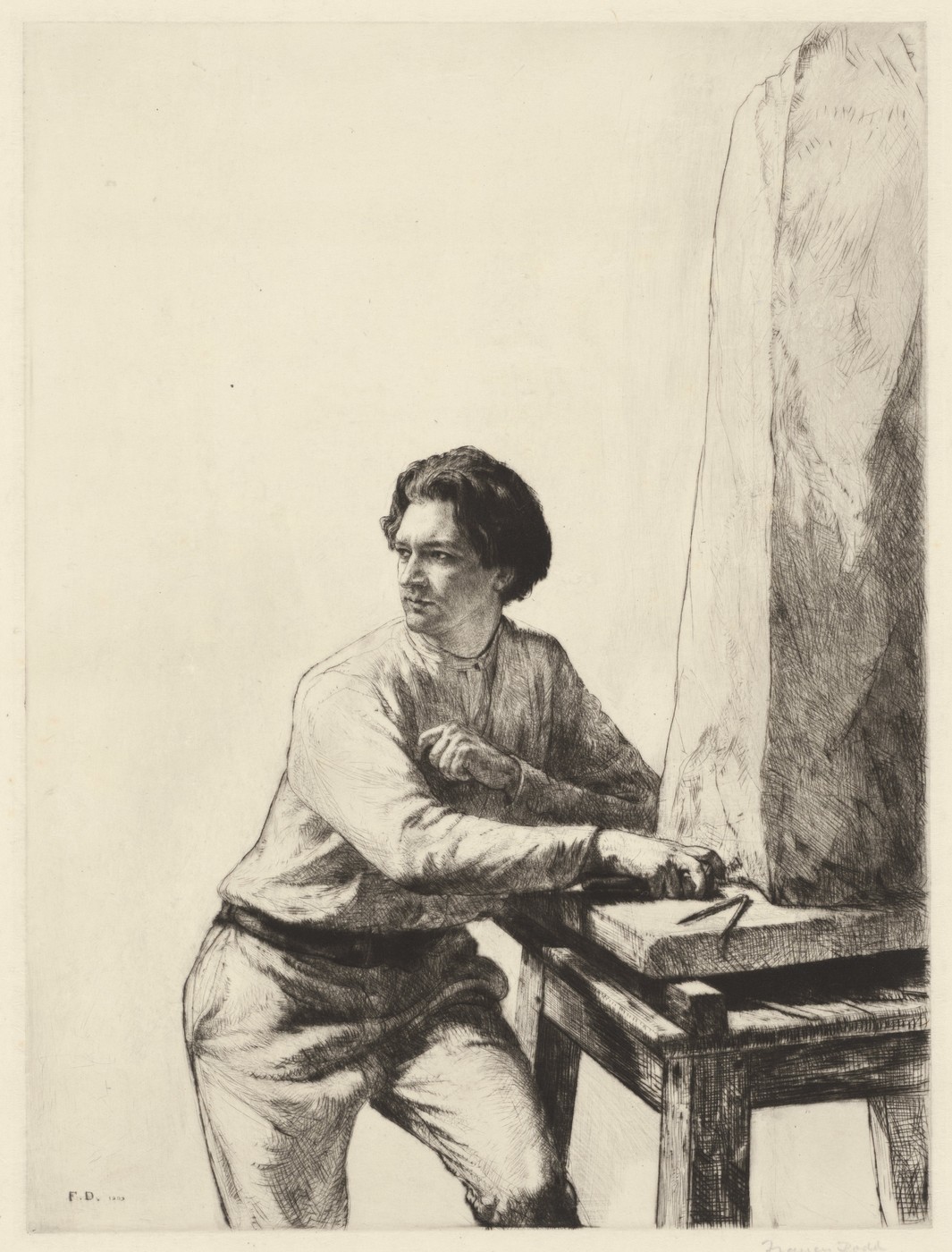
The Strand controversy was about place and power. A reclining academic Venus in a gilt frame flattered the buyer who owned it. A row of naked figures raised nine feet above a public street addressed the whole city, and the city’s guardians judged that an offense. When Epstein carved Adam in 1938, a seven-foot male nude hewn from a three-ton block of alabaster, he was still answering the same charge. Made monumental, the body refuses to be decorative.
The body grew heavier as he aged. Genesis (1929) turned pregnancy into a three-ton marble monolith with a face drawn from an African mask. Rock Drill, which he later dismantled and kept only as a truncated torso, fused the human body with the machine age. Jacob and the Angel (1942) wrestled two figures, one winged, into a single four-ton embrace. Through all of it ran one conviction: the human figure, stripped of its classical veneer and returned to its archaic source, could still carry a modern idea.
Epstein was knighted in 1954 and died in 1959, long enough to watch the nude he championed pass from scandal into the museum. Henry Moore wrote after his death that Epstein had taken the brickbats and the insults so that later sculptors would not have to. The kouros he admired in the British Museum and the giants he carved in his studio are one creature, separated by twenty-six centuries. What Epstein understood is that the nude’s power lives in its scale. Make the body big enough, and it stops being a body. It becomes an argument.