Alberto Giacometti was born on October 10, 1901, in Borgonovo, a Swiss mountain village near the Italian border. Across the next sixty-four years he took the oldest subject in Western art, the bare human body, and whittled it down until it almost vanished. What survived was a thin, upright figure that walked into an empty space and refused to disappear.
The nudes Giacometti made in the 1940s and 1950s stand against everything the academy taught. The academy enlarged and polished the body. He reduced it. The academy posed a perfect Venus in marble. He modeled a woman in plaster and clay until she stood barely a finger wide, rough and scarred from his knife. The more he stripped away, the more the figure insisted on being seen.
Critics called these works thin men and walking men, and for decades they read them as a complaint about the war, the camps, the anxious century. Giacometti was asking a quieter question: what survives when you remove the costume, the allegory, the flattery, the mythology. His answer was a figure still standing in space, still walking, still upright. The nude became a survivor, and it carried more meaning in its reduction than it ever did dressed in classical ideals.
He borrowed the walk directly from Auguste Rodin. Rodin’s Walking Man, a headless, armless torso on legs, appeared around 1900 and scandalized the academy by treating the fragment as a finished work. Giacometti saw it and spent the rest of his life pursuing that walk.
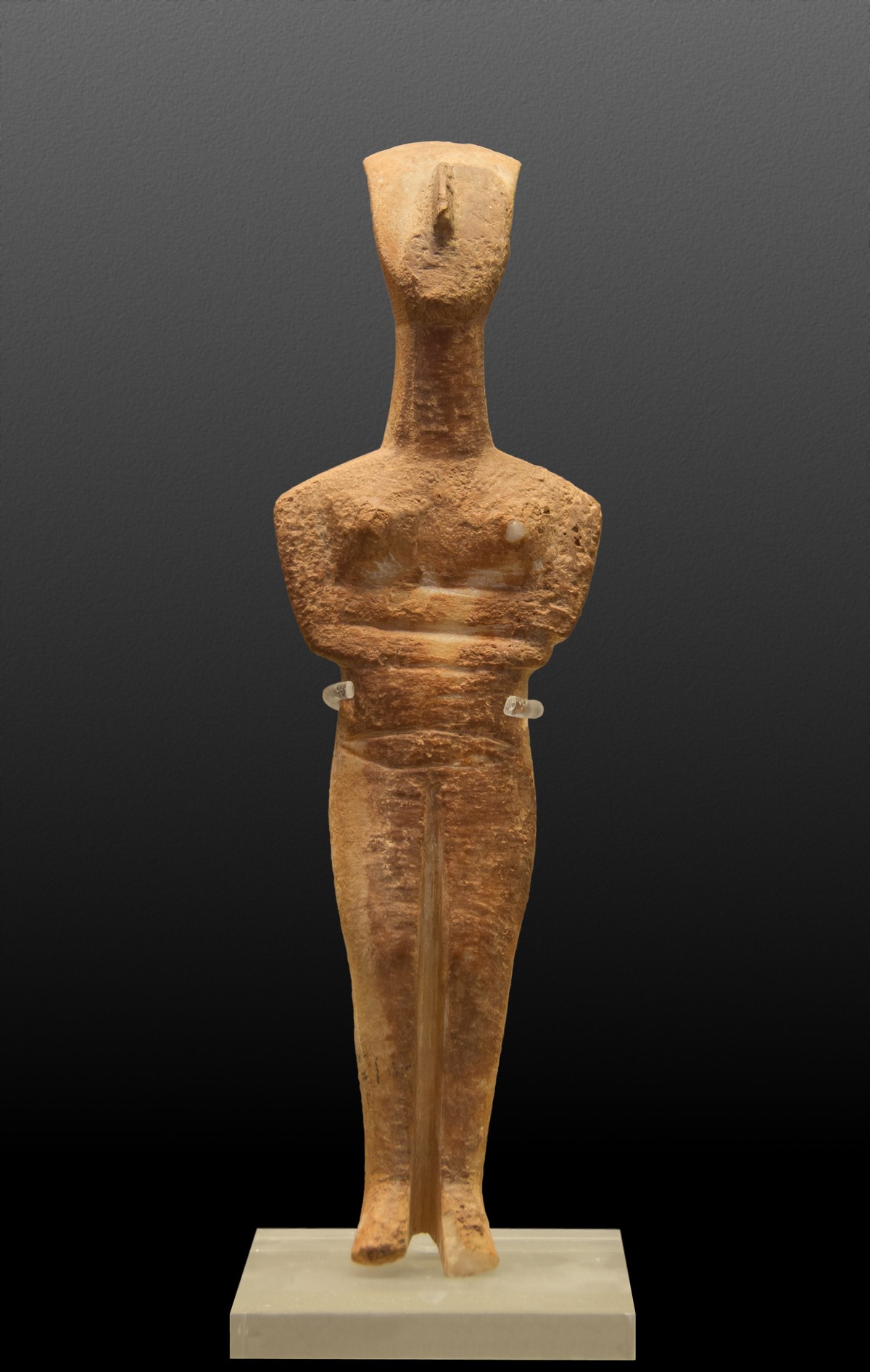
He reached further back too, to the Cycladic figures and archaic Greek kouroi whose makers had reduced the human body to a geometric fact thousands of years before. In his hands those two lineages met: Rodin’s restless modern energy set inside the stillness of an ancient idol.
The result turns the nude’s purpose inside out. A classical nude offers abundance. Giacometti’s offers scarcity, and the scarcity is the point. His standing woman is a presence you can almost see through. His walking man moves forward, which after the middle of the twentieth century felt like the only honest posture left.
What he teaches a contemporary audience is that the body earns its urgency by telling the truth about itself. He spent a lifetime erasing until only the essential remained, and what remained walked.