On this day in 1860, in the small Moravian town of Ivančice, a boy was born who would grow up to make the female nude inescapable. Alphonse Mucha didn’t just paint the body — he ornamented it, dissolved it into line and curve, and put it on the walls of every Parisian café, shop window, and boulevard kiosk. His radical move: the nude body wasn’t just a subject for the gallery. It was a public good.
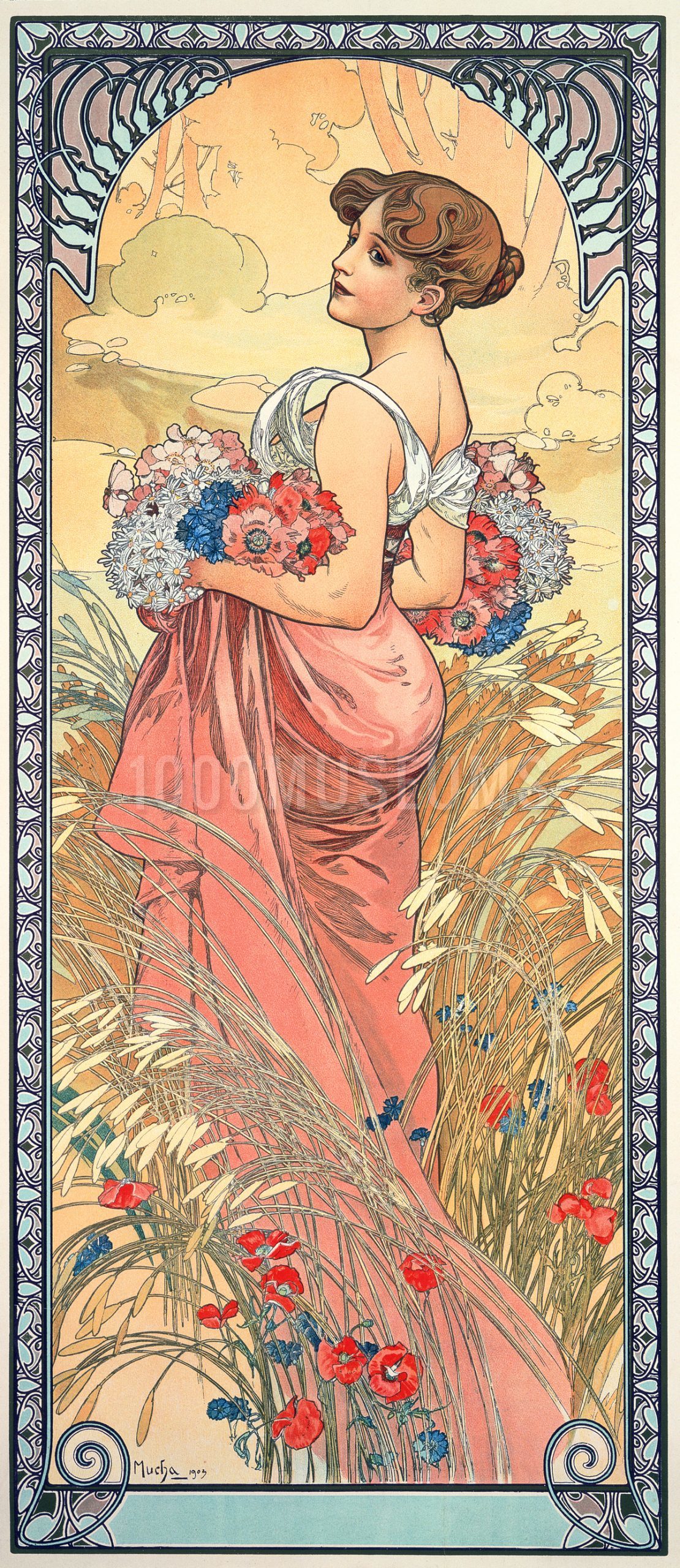
Mucha’s nudes are impossible to miss. They’re unmistakably his — idealized women whose flowing hair becomes arabesque, whose limbs spiral into decorative borders, whose skin merges with flower petals and mosaic backgrounds. In Mucha’s hands, the female form isn’t flesh so much as it is design. The body becomes a line. The line becomes an idea. And the idea was everywhere.
The Nude as Decoration: A Scandal in Disguise
In the 1890s, Paris was the capital of the nude. But the nude had rules. The Academic nude — posed, mythological, safely distanced by allegory — belonged in the Salon. The real nude — the one in Manet’s Olympia staring back at you, or Degas’s bathers caught mid-wipe — belonged to the avant-garde, and it was still fighting for legitimacy.
Mucha sidestepped the entire argument. He put his nudes on posters for Sarah Bernhardt, on biscuit tins, on champagne labels, on the covers of mass-market magazines. His women weren’t Venus or Olympia — they were everywhere, and they were beautiful in a way that didn’t ask permission. This was the nude as popular culture, and it was as disruptive as any Salon scandal, just quieter.
The art establishment sniffed. Decoration wasn’t art. Commercial work wasn’t serious. A lithograph for Job cigarette papers wasn’t a painting. But Mucha understood something the critics didn’t: the decorative nude reached more eyes in a single afternoon on a Paris boulevard than a Salon painting reached in a month. He democratized the nude body — not through politics, but through poster paper.
The Body as Line: Mucha’s Visual Grammar
If you strip a Mucha nude down to its skeleton, you don’t find anatomy — you find geometry. His figures are built from the whiplash curve, the spiraling tendril, the sinuous S-line that became the signature of Art Nouveau. The body isn’t modeled with shadow and volume the way an Academic painter would; it’s drawn as a continuous ornamental gesture. The hair doesn’t fall — it flows, it coils, it becomes architectural.
This was a fundamental reimagining of what a nude could do. Since the Renaissance, the nude body in Western art had been about mass, weight, presence. Michelangelo’s figures strain with internal pressure. Rubens’s nudes occupy space with physical insistence. Even the Impressionists, for all their rebellion, kept the body as a thing of light falling on flesh.
Mucha’s nudes reverse the equation. They’re not bodies that happen to be beautiful — they’re beauty that happens to take the shape of bodies. Weightless, stylized, symbolic rather than specific. They are what the body looks like when it stops being anatomy and starts being rhythm.
Documents Décoratifs: The Nude as a Tool
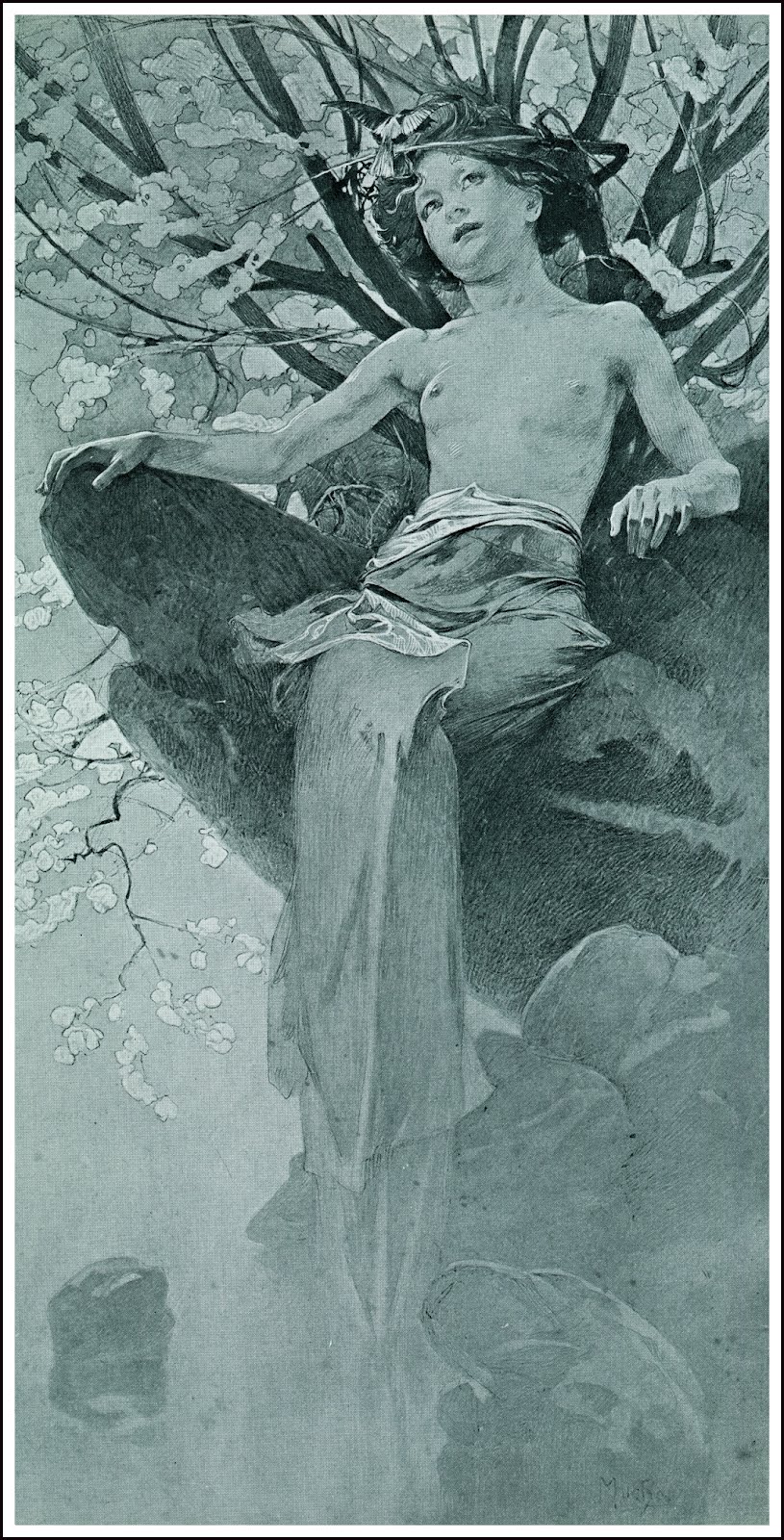
In 1901, Mucha published Documents Décoratifs — a portfolio of 72 plates intended as a reference for artists, designers, and craftsmen. It contains floral patterns, jewelry designs, furniture studies, and, running through everything, the nude female figure treated as a design element. A woman’s profile becomes the frame for a brooch. A nude torso spirals into wallpaper. A reclining figure dissolves into botanical ornament.
This was unprecedented. The nude wasn’t the subject of the design — it was the design’s raw material, interchangeable with leaves, vines, and geometric motifs. Art historians sometimes wince at this: wasn’t Mucha reducing women to mere decoration? But the question cuts both ways. By making the female body the fundamental unit of visual language, Mucha was also insisting that beauty — and specifically female beauty — was the essential ingredient of a well-designed world.
The Tension Mucha Never Resolved
Here’s what makes Mucha genuinely interesting as a figure in the history of the nude: he was torn. Deeply, publicly torn. On one side, the decorative commercial artist who made a fortune turning the female form into posters and packaging. On the other, the serious Czech nationalist who spent the last 18 years of his life painting The Slav Epic — twenty monumental canvases depicting the history of the Slavic people, a project he considered his life’s real work.
The Art Nouveau nudes that made him famous? He called them “mere decorative work.” He resented being known for them. Yet without them — without the Paris posters, the champagne labels, the Documents Décoratifs — there is no Slav Epic. The commercial nudes funded the serious art. Mucha spent his whole career trying to escape the decorative body, and his whole career was made possible by it.
This tension — between the nude as ornament and the nude as meaning, between beauty and substance, between popular success and artistic seriousness — is the tension at the heart of Mucha’s legacy. It’s also, not coincidentally, the tension at the heart of how we’ve always talked about the nude in art. Is a beautiful body enough? Or does it have to mean something?
166 Years Later: The Body Still Decorates Our World
Mucha died in 1939, shortly after being interrogated by the Gestapo. Art Nouveau had already been out of fashion for two decades. But his influence never really faded. You see it in the psychedelic concert posters of the 1960s. In manga and anime’s flowing hair and decorative framing. In every lifestyle brand that uses a stylized female silhouette as shorthand for elegance.
The decorative nude is everywhere, and we barely notice it anymore. That’s Mucha’s real victory — not that he changed how artists painted the body, but that he changed how ordinary people encountered it. A nude on a gallery wall is a statement. A nude on a poster, a label, a package — that’s just the world. Mucha made the body ambient. He made it ordinary. He made it unavoidable.
One hundred and sixty-six years after his birth, the body as ornament is so naturalized we don’t even see it as a choice. Every fashion illustration owes him a debt. Every album cover with a flowing-haired figure is unwitting homage. The line he drew — the one that turned flesh into design, anatomy into rhythm, the body into the world — still runs through everything we make.