The Nudes That Got Modigliani Arrested
\n\nOn December 3, 1917, the Berthe Weill Gallery in Paris opened a solo exhibition of paintings by Amedeo Modigliani. The police arrived before the wine was poured. A crowd had gathered outside, drawn by a painting visible through the window \u2014 a reclining nude woman, her body unapologetically present, her pubic hair rendered with the same painterly attention Modigliani gave to her face. The police demanded the painting be removed. When Weill refused, they shut the exhibition down entirely.
\n\nThe charge was obscenity. The evidence was Modigliani’s refusal to pretend the women he painted were goddesses. The nude body \u2014 that ancient, sanctioned subject of Western art \u2014 became illegal the moment it stopped hiding behind mythology and admitted it was human.
\n\n\n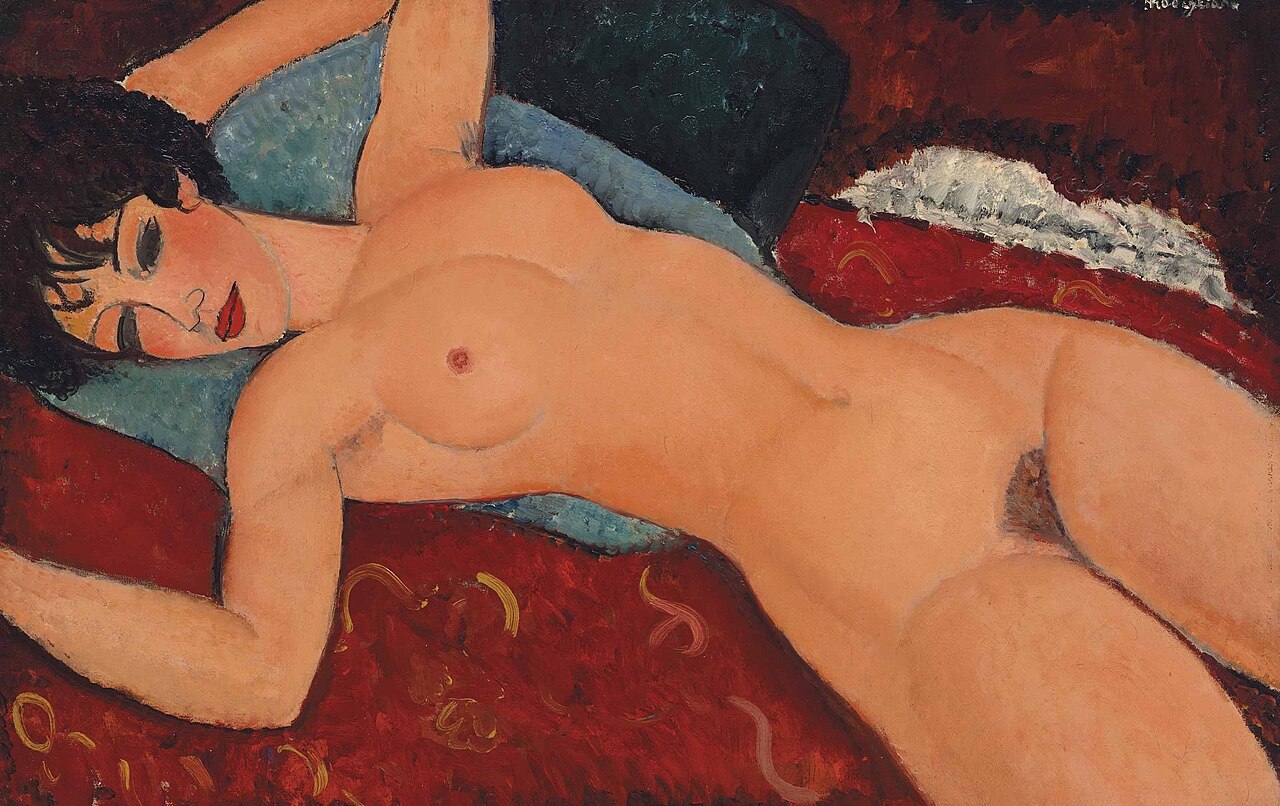
Modigliani was born on this day, July 12, in 1884 \u2014 142 years ago \u2014 in Livorno, Italy, to a Sephardic Jewish family that had fallen from prosperity into poverty. He arrived in Paris in 1906, twenty-two years old, beautiful, tubercular, and burning with ambition. He drank. He drew obsessively. He absorbed the lessons of Cézanne’s geometry, Brancusi’s simplification, and the African and Cycladic masks he studied at the Musée de l’Homme. But what he made from these influences was entirely his own: a visual language in which the human figure became both monument and intimate confession.
\n\nBy 1916, Modigliani was thirty-two and had almost nothing to show for a decade in Paris \u2014 no money, no critical reputation, a body slowly being consumed by the tuberculosis he refused to acknowledge. Then his dealer, Léopold Zborowski, made him an offer: a daily stipend, models, materials, and wine, in exchange for paintings. Zborowski believed in the nudes. He paid the models five francs apiece and cleared his own apartment so Modigliani could work.
\n\nWhat followed was a feverish outpouring \u2014 roughly two dozen canvases over the next three years that constitute the most radical reinvention of the female nude since Manet’s Olympia. These women are not Venuses. They are not allegories of Beauty or Truth or Spring. They are bodies \u2014 specific, present, unperformed. They recline on dark couches and look at the viewer without invitation or apology. Their faces carry Modigliani’s signature elongation \u2014 almond eyes without pupils, swan necks, simplified noses \u2014 but their bodies are rendered with a sensuality that is neither demure nor pornographic. It is factual.
\n\n\n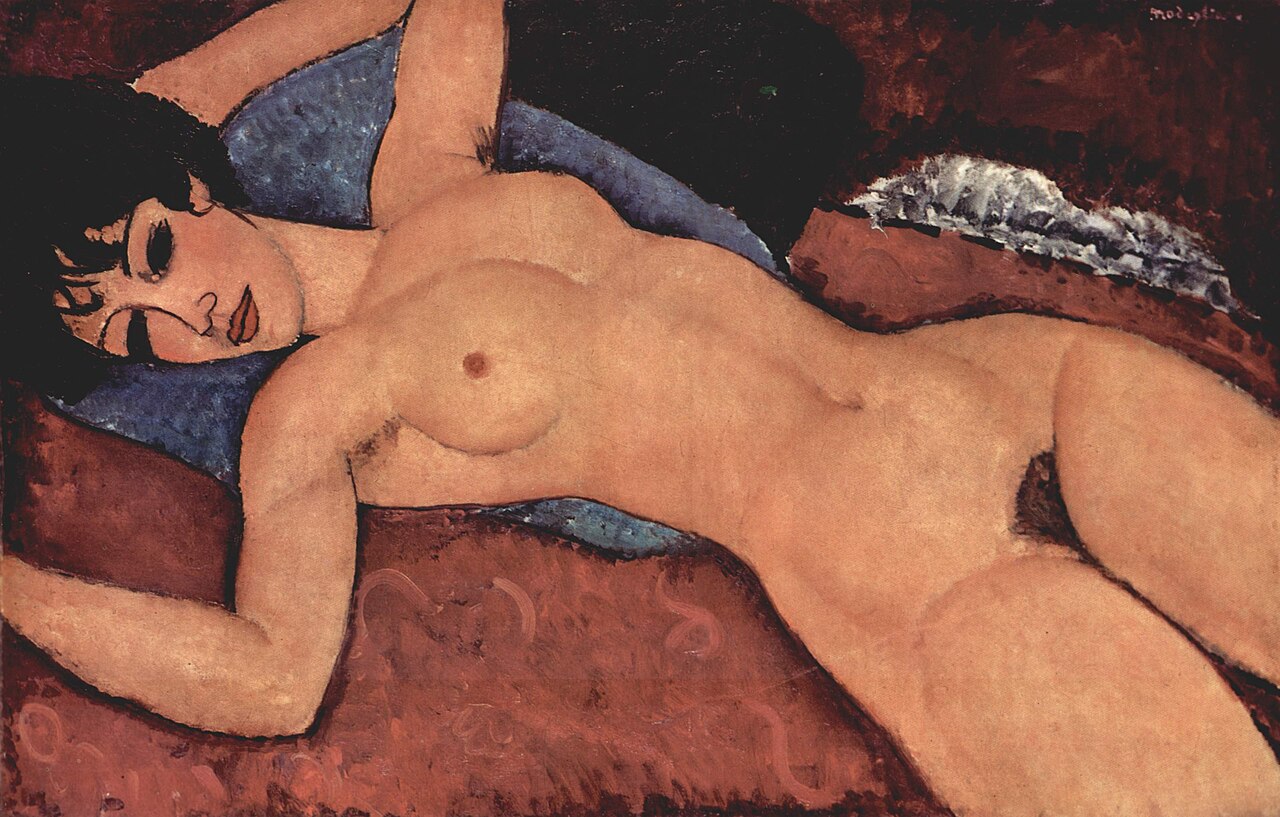
The 1917 police raid is a turning point in the history of the nude \u2014 not because it was the first time art was censored, but because it exposed the unspoken contract that had governed the nude body in Western painting for four centuries. The nude was permissible as long as it maintained a polite distance from actual human sexuality. You could paint Venus, because she was a goddess. You could paint Bathsheba, because she was a Bible story. You could paint Susanna and the Elders, because the male voyeurism was safely displaced onto a moral lesson. Modigliani painted a woman on a couch who looked back at you. That was the crime.
\n\nThe irony is that Modigliani’s nudes are far less explicit than the academic nudes of Gérôme or Cabanel, which wrapped sexuality in the alibi of Orientalist fantasy or classical myth. What made Modigliani dangerous wasn’t more flesh \u2014 it was less disguise. His nudes refused to pretend they were anything other than what they were: women, painted by a man, in a room, looking. The body hair that so offended the Paris police was the sign that this was a real body, not a marble fantasy.
\n\nModigliani died on January 24, 1920, at thirty-five, of tubercular meningitis. His partner Jeanne Hébuterne, pregnant with their second child, threw herself from a window the following day. He had sold few paintings in his lifetime. Zborowski, who had believed in him when nobody else did, died penniless in 1932.
\n\nIn 2015, Modigliani’s Nu couché sold at Christie’s for 70.4 million \u2014 at the time, the second-highest price ever paid for a painting at auction. The buyer was a Chinese billionaire. The same painting that had been pulled from a gallery wall by police in 1917 now hung in a private museum in Shanghai, proof that the line between obscenity and masterpiece is drawn not by the work itself but by the century looking at it.
\n\nModigliani’s nudes endure because they solved a problem most artists never even name: how do you paint a naked body without turning it into either a sermon or a seduction? His answer was to give the body the same dignity he gave the face \u2014 not by idealizing it, but by seeing it. The women in his paintings are not offering themselves. They are simply there, inhabiting their own skin, looking back at a world that has never quite decided whether that’s allowed.
\n\nHappy 142nd birthday to the painter who proved that the most radical thing a nude can do is refuse to apologize for being a person.
\n\n\n\n
Image credits: All works by Amedeo Modigliani (1884–1920). Public domain.
\n