On July 4, 1776, a group of men in Philadelphia signed a document declaring that all men are created equal and endowed with certain unalienable rights. What that document did not specify, and what the next 250 years would make painfully clear, is that Americans have never quite known what to do with the bodies those rights belong to \u2014 especially when those bodies are unclothed.
\n\n
The nude has been the central subject of Western art since the Greeks carved the first kouros. But for a nation founded by Puritans and shaped by a Protestant suspicion of the flesh, the nude body in art was a problem from the start. Not a subject to be explored \u2014 a temptation to be managed. And the history of American art is, in no small part, the history of that management.
\n\n
The Missing Century
\n\n
For roughly the first hundred years of the republic, there is almost no American nude to speak of. The great early American painters \u2014 Copley, Stuart, Peale, West \u2014 were portraitists. Their subjects were clothed, powdered, and respectable. The American art establishment simply did not produce nudes. There was no market for them, no tradition that supported them, and no institutional apparatus \u2014 no academies, no life rooms, no sculpture courts \u2014 to teach artists how to make them.
\n\n
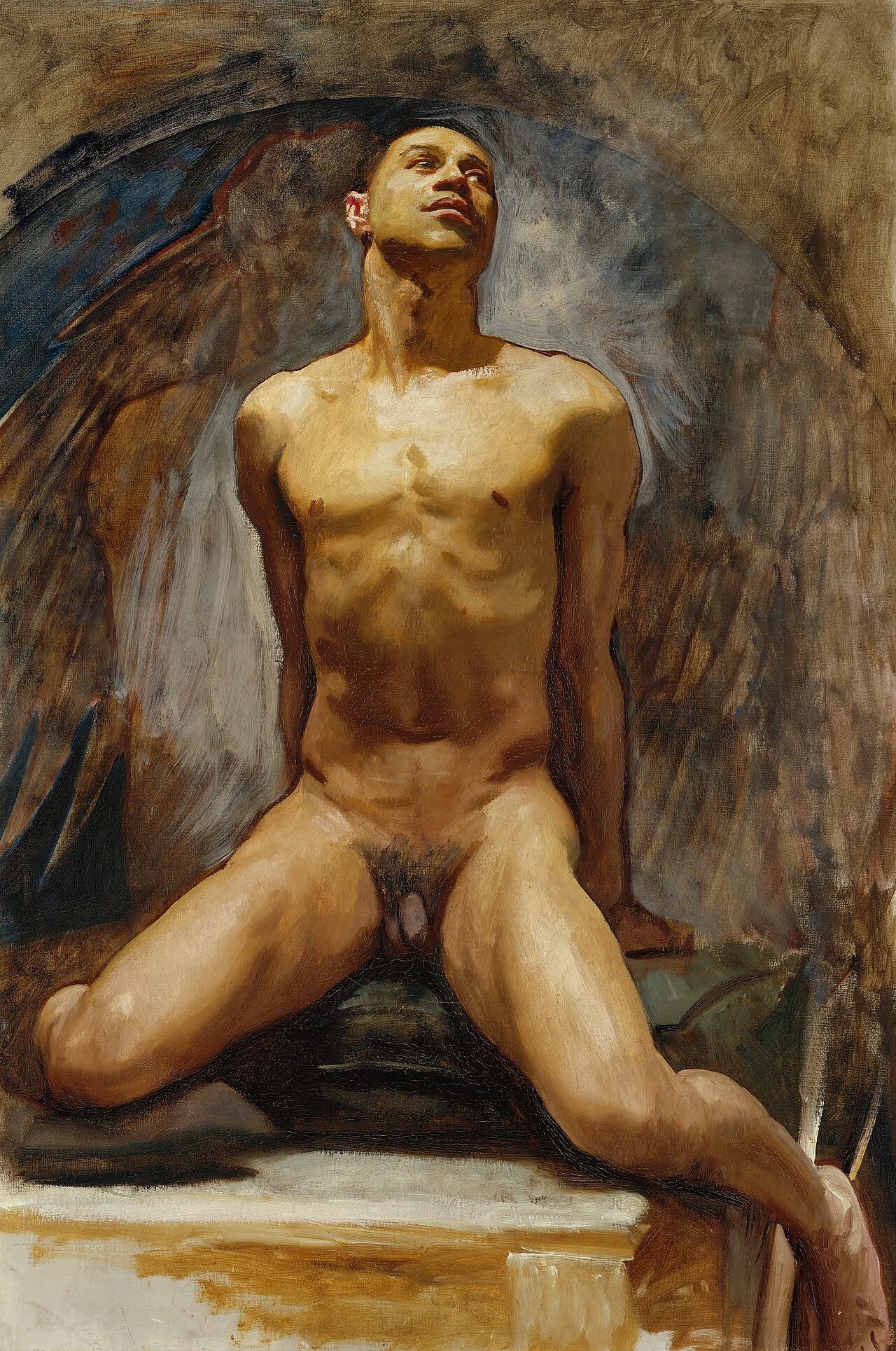
When American painters wanted to engage with the nude, they went to Europe. John Singleton Copley left Boston for London. Benjamin West became president of the Royal Academy. John Singer Sargent spent his entire career in Paris and London, painting the European aristocracy by day and, by night, producing the kind of work he could never exhibit in America: luminous, unapologetic male nude studies \u2014 dozens of them \u2014 that remained in his studio until his death.
\n\n
\n\n
Sargent’s nude studies of Thomas E. McKeller, his Black model and collaborator, are among the most powerful figure paintings an American has ever produced. They were seen by almost no one during Sargent’s lifetime. A hundred years later, they hang in the Museum of Fine Arts, Boston \u2014 proof that even the most private American nude eventually finds its way into the light.
\n\n
The Eakins Problem
\n\n
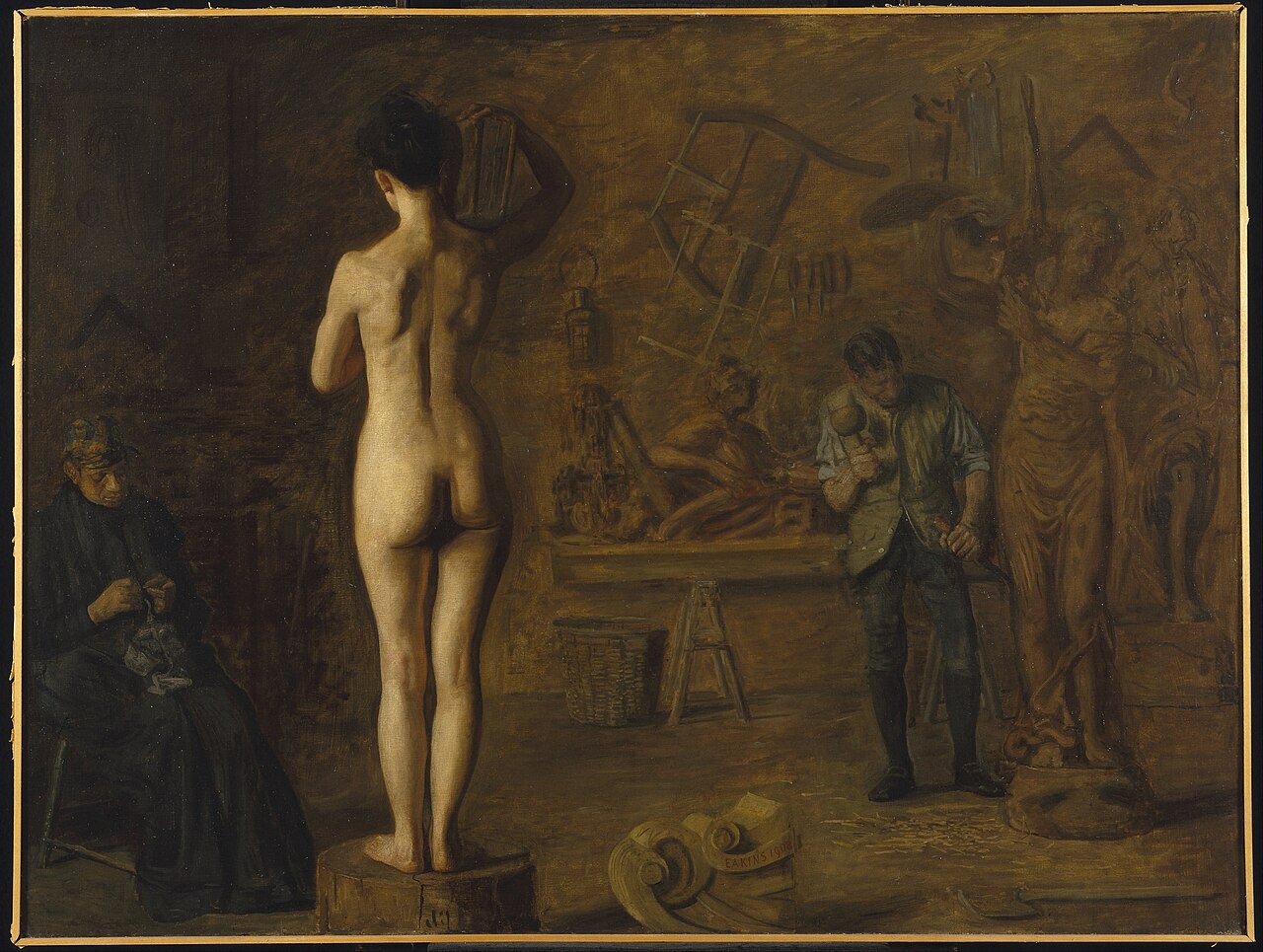
No American artist paid a higher price for the nude than Thomas Eakins. In 1876, the year of the Centennial, Eakins painted William Rush Carving His Allegorical Figure of the Schuylkill River \u2014 a work that placed a nude female model at the center of the American studio, visible, unembarrassed, and entirely matter-of-fact. The painting was a provocation: it asserted that the nude belonged in American art not as allegory or distant myth, but as a living person in a Philadelphia workshop.
\n\n
\n\n
Eakins, who had studied in Paris and brought European rigor back to the Pennsylvania Academy of the Fine Arts, insisted that his students \u2014 male and female \u2014 draw from nude models. In 1886, he removed the loincloth from a male model during a class that included women. He was fired. The charge was “conduct unbecoming.” The real offense was treating the nude body as a fact rather than a scandal.
\n\n
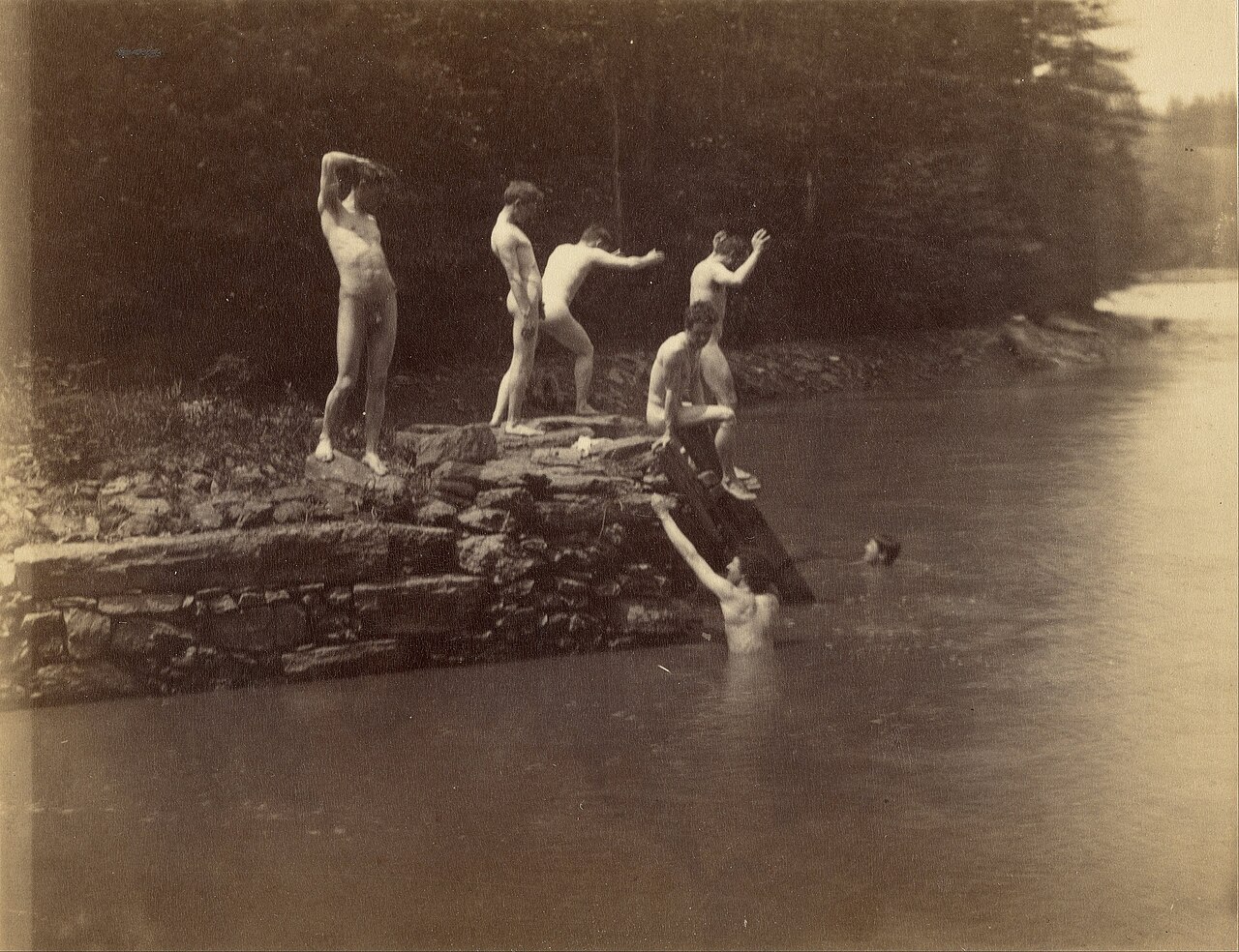
Eakins kept painting nudes anyway. The Swimming Hole (1884-85), his most famous work, shows a group of young men \u2014 his students \u2014 bathing in a creek outside Philadelphia. There is no allegorical frame, no classical reference, no apology. It is simply American bodies in American light. The painting is now considered a masterpiece. In its time, it was unrepeatable.
\n\n
\n\n
The Century of Contradiction
\n\n
What followed Eakins was a century of American contradiction. The Ashcan School painted the urban body \u2014 clothed, mostly, but undeniably physical. Georgia O’Keeffe turned flowers into bodies and bodies into landscapes. Edward Weston photographed the nude with a precision that made it impossible to dismiss as prurient. By mid-century, the American nude had become a legitimate subject \u2014 in the studio, in the gallery, in the museum.
\n\n
And then came the 1990s. Robert Mapplethorpe’s X Portfolio. Andres Serrano’s Immersion (Piss Christ). The National Endowment for the Arts funding battles. The Culture Wars were, at their core, a fight about the nude \u2014 specifically, about which nude bodies were permitted in public and which must be hidden. The Puritan inheritance had not disappeared. It had gone underground, waiting for the right moment to reassert itself.
\n\n
What America Still Can’t Look At
\n\n
Two hundred and fifty years after the Declaration, the American relationship with the nude body remains unresolved. The country that produces more pornography than any other nation on earth still panics when a classical statue appears in a public square. The culture that streams graphic content into every phone still debates whether a high school art class should be allowed to show Michelangelo’s David. The contradiction is not a bug. It is the operating system.
\n\n
The nude in American art has always been a test \u2014 of freedom, of maturity, of the willingness to encounter a body without immediately needing to consume or condemn it. Eakins failed that test in his lifetime and passed it in history. Sargent hid his nudes and time revealed them. The question, on this July Fourth, is whether the third American century will finally produce a culture that can look at its own body without flinching.
\n\n
Not yet. But the art is waiting.
\n