On October 30, 1861, Antoine Bourdelle was born in Montauban, a town in southwest France. He would become Auguste Rodin’s most trusted pupil and assistant, and the sculptor who taught the heroic male nude to stand like architecture.
Bourdelle spent fifteen years in Rodin’s studio, modeling for the master, carving for him, learning a language of melting, expressive flesh. Then he did the harder thing and left it behind. Where Rodin let bronze ripple and dissolve, Bourdelle pulled the body tight. He wanted muscle to read like masonry, tendon like rigging.
The result was Hercules the Archer, modeled in 1909. A patron asked for a figure of Hercules, and Bourdelle chose the instant before the release: the sixth labor, the Stymphalian birds, frozen at full draw. The giant kneels, leans back, and pulls the bow. Every muscle works as a load-bearing element. This is a body built, a structure under tension that is also the archer holding it.
That was Bourdelle’s gift to the nude. The classical nude had been an ideal; Rodin’s nude had been a living body caught mid-breath; Bourdelle’s nude was an engine. He looked back past Rodin to archaic Greece, to the severe faces and blocky limbs of the earliest sculpture, and found a body he could construct. He taught his students to think as builders think.
The male nude mattered to him because it carried weight. Hercules the Archer stands over eight feet tall and reads as a civic monument, which is why its casts spread from the Metropolitan Museum of Art to the garden of the Musée Bourdelle, the Montparnasse studio he left to Paris and which now bears his name.
He taught generously. Alberto Giacometti passed through his studio, along with Germaine Richier, and Henri Matisse worked there briefly. The line that runs from Bourdelle to Giacometti is a line of sculptors who refused to let the human figure die, who kept the body at the center of modern art while abstraction rose around it.
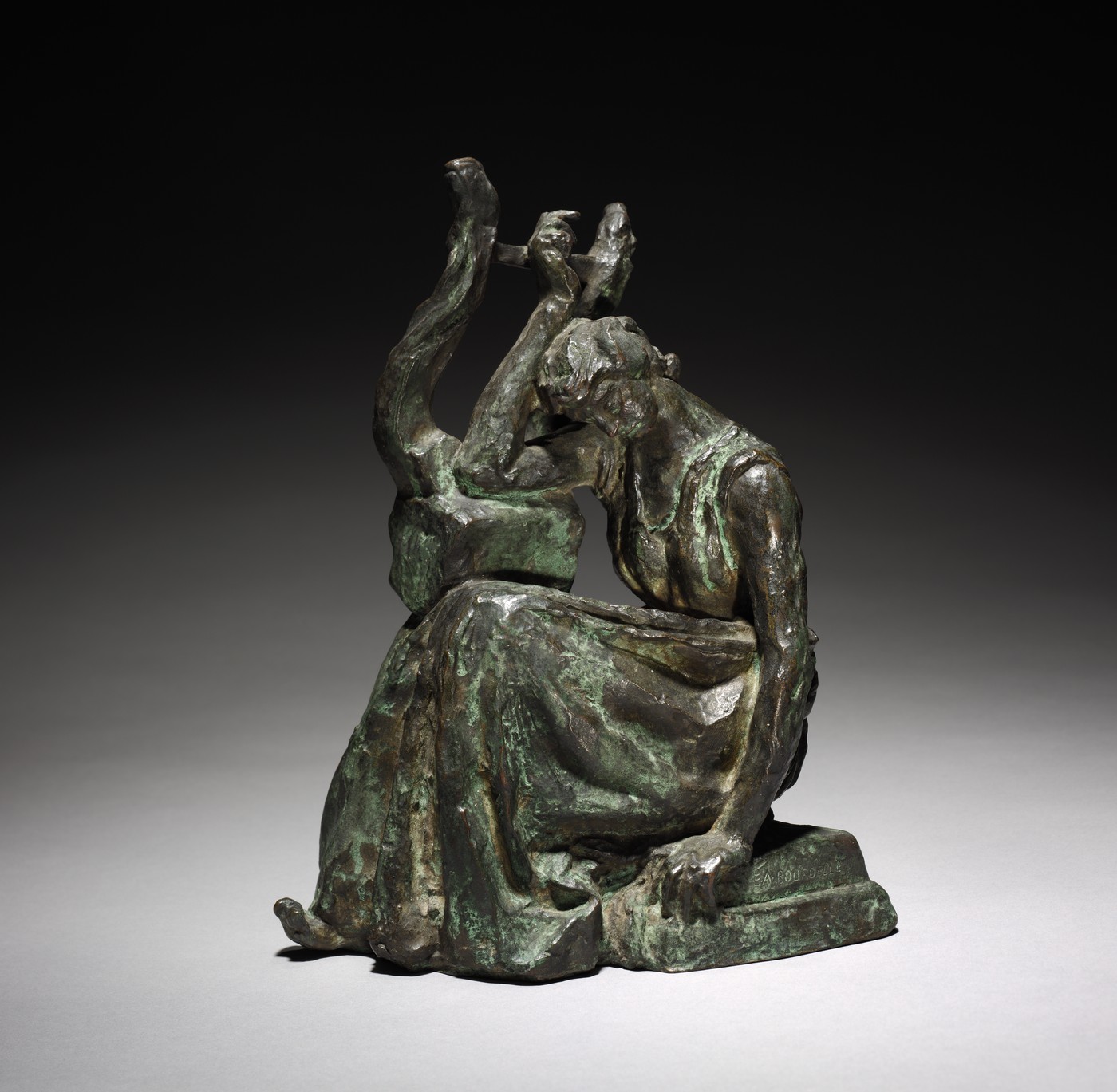
Bourdelle also knew the figure’s gentler register. His Sappho, modeled in 1925, shows the Greek poet seated and leaning, a woman’s body held in a curve of thought. Beside the strung tension of Hercules, Sappho is the nude at rest, the body as a private, lyrical fact.
He died on October 1, 1929, at sixty-seven, a month short of his sixty-eighth birthday, having carried the heroic nude from the nineteenth century into the twentieth. On what would have been his 165th birthday, the bow is still drawn.