There is a quiet conspiracy in Western art history, and it has been running for half a millennium. If you want to paint a naked body — not a goddess, not an allegory, not a martyr — you need an excuse. You need a reason for the clothing to be absent that does not immediately read as pornography. And for five hundred years, the most reliable excuse has been water.
The bather is art history’s great alibi. She is not nude because she is performing; she is nude because she is bathing. The act is private, quotidian, innocent. She is not looking at you. She does not know you are there. And that plausible deniability — that fiction of the unobserved moment — has given artists license to paint the naked body with an intimacy and candor that no mythological scene could ever justify.
The Bath as Permission
Before there were bathers, there were goddesses. Botticelli’s Venus arrived on a scallop shell, her nudity sanctified by myth. Titian’s Venuses reclined on velvet, their bodies offered up as Neoplatonic ideals. The nude was acceptable as long as it wore the costume of classical antiquity. But the bath — the bath was different. The bath was domestic. It happened indoors, to real women, in real water. And that made it radical.
The bathing motif allowed artists to do something the mythological nude could not: it let them show the body as it actually was — imperfect, unposed, unaware. No goddess stands in a zinc tub with a sponge in her hand. No Venus crouches awkwardly, vertebrae visible, focused entirely on the task of washing herself. The bather was not for you. And that was the point.
The Orientalist Fantasy: Ingres and the Turkish Bath
By the nineteenth century, the bath had acquired an exotic dimension. The hammam — the Ottoman bathhouse — became a subject of intense fascination for European painters, and no one exploited it more brilliantly than Jean-Auguste-Dominique Ingres. His Le Bain Turc (The Turkish Bath), completed in 1862 when the artist was 82, is the apotheosis of the Orientalist bathing nude: a circular composition packed with reclining, stretching, intertwined female bodies, all rendered with Ingres’s characteristic obsession with smooth, elastic flesh.
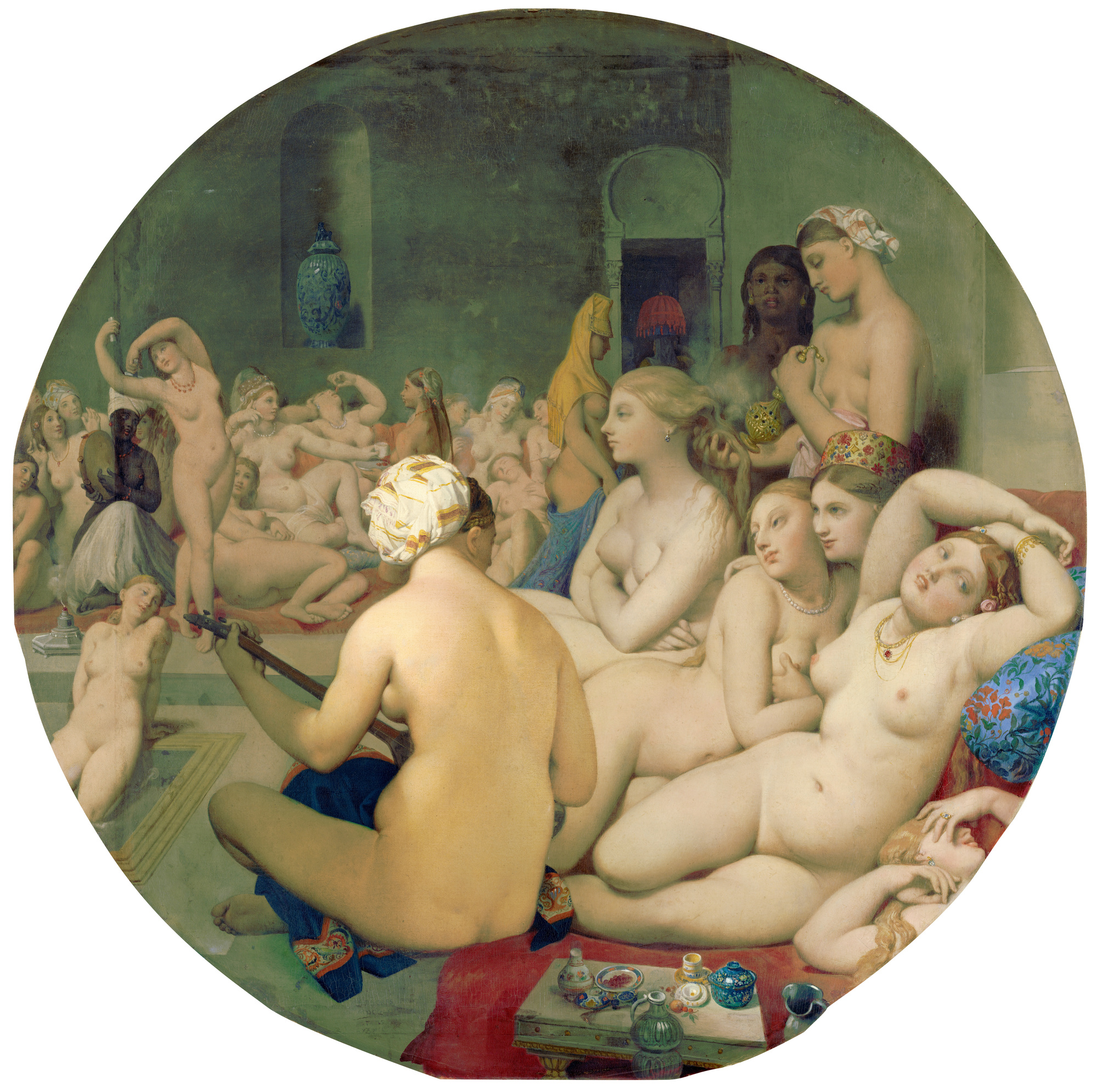
It is a painting that perfectly encapsulates the problem of the bathing nude. On one hand, it is a technical marvel — the circular format, the rhythmic arrangement of bodies, the extraordinary draftsmanship. On the other, it is a colonialist fantasy dressed as reportage. Ingres never visited a hammam. He never saw a Turkish bath. What he painted was an imagined Orient, a space where the Western male gaze could consume the female body without accountability because, after all, these women were simply bathing — it was their culture, their custom. The bath provided the permission structure.
Yet even within that problematic frame, Ingres did something genuinely radical with the nude. He rejected the single-figure compositional tradition. His bathers exist only in relation to one another. They touch, recline, overlap. The body here is not a solitary ideal — it is social, communal, embedded. The bath becomes a world.
The Modernist Pivot: Cézanne and the Monumental Bather
If Ingres made the bath a fantasy, Paul Cézanne made it a problem to be solved. His Les Grandes Baigneuses (The Large Bathers), worked on for the last decade of his life and left unfinished at his death in 1906, is arguably the most important painting of bathers in the Western canon — not despite its strangeness, but because of it.
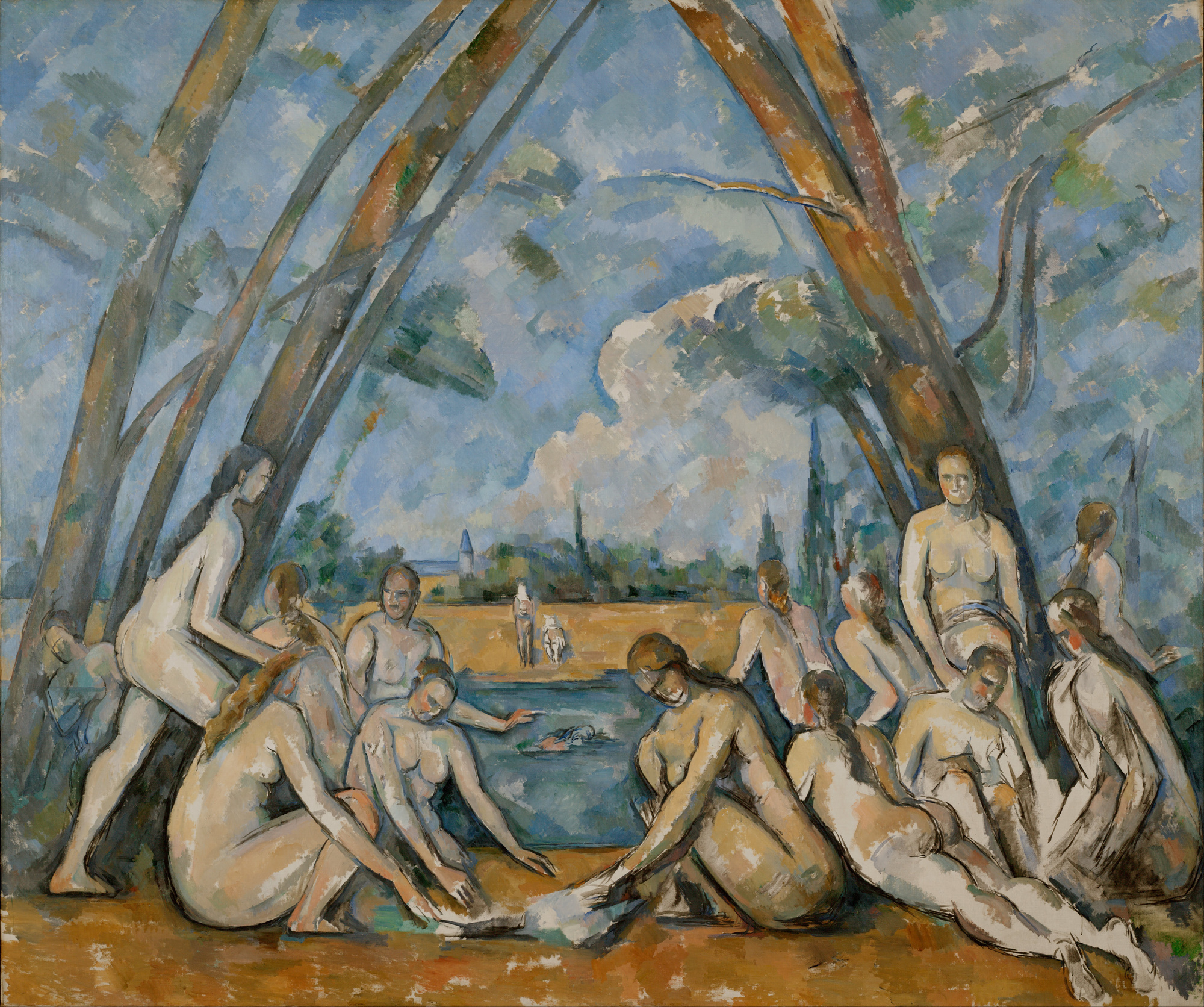
Look at these figures. They are not beautiful in any conventional sense. They are architectural. They tilt. They fuse with the landscape. Their bodies are built from the same planes of color as the trees and sky behind them. Cézanne is not interested in whether you find them attractive. He is interested in how form occupies space, how the body becomes geometry, how a group of figures can create a cathedral-like structure out of flesh and air.
This is the moment the bather becomes modern. The bodies in Cézanne’s painting are not performing for anyone — not the viewer, not each other, not even themselves. They are simply there, as elemental and impersonal as boulders. The bath is no longer an alibi. It is an occasion for pure formal investigation. The nude has been liberated from narrative entirely.
The Intimate Awkwardness: Degas and the Private Bath
While Cézanne was constructing his monumental bathers in the South of France, Edgar Degas was doing something radically different in Paris: he was painting women in actual bathtubs, performing actual ablutions, in actual apartments. Le Tub (1886), a pastel on card, shows a woman crouched in a shallow zinc tub, her back to the viewer, one arm reaching to sponge herself. There is nothing idealized about her. She is not graceful. She is working.
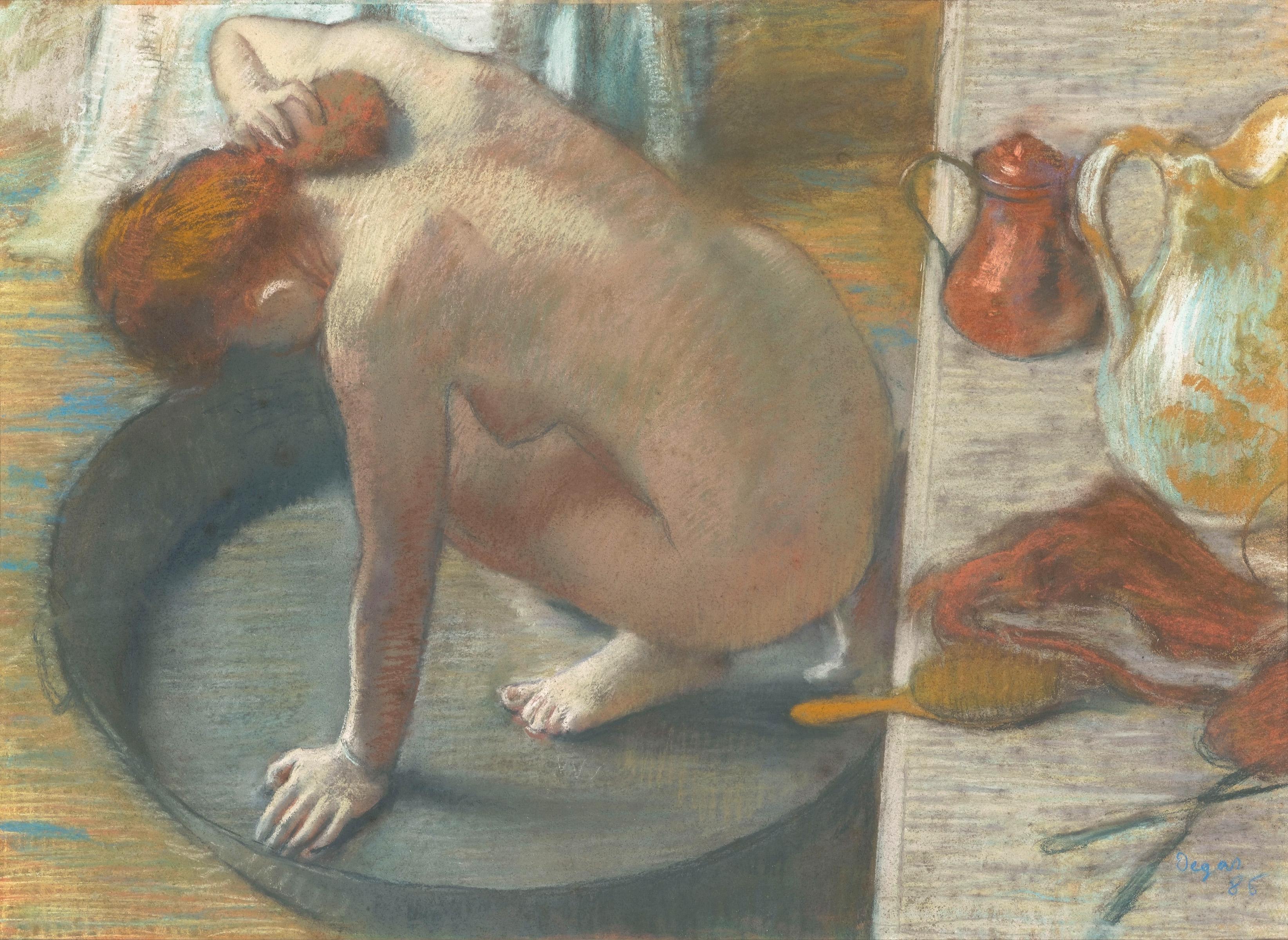
Degas’s bathers are the anti-Ingres. Where Ingres gives us smooth, elastic goddesses arranged for visual pleasure, Degas gives us women absorbed in the mechanics of washing — reaching, bending, drying, contorting. The poses are awkward because bathing is awkward. You do not look elegant while scrubbing your back. Degas understood this, and he made it the subject of his art.
He called his bathers his “human animals,” and the phrase is revealing — not in its cruelty but in its insistence on the unvarnished, instinctual nature of the body at its most private. These women are not being watched. They do not know we are here. Degas has positioned the viewer as a voyeur, and he knows it. The awkwardness we feel looking at Le Tub is not the woman’s. It is ours.
What the Bath Reveals
The bathing motif endures because it does something no other artistic convention can do: it makes the nude ordinary. Not sacred, not scandalous, not symbolic — just a body, doing what bodies do, in water. And in that ordinariness, something profound happens. The viewer is forced to confront the body on its own terms, without the protective distance of mythology or eroticism or allegory.
When you look at Ingres’s harem, you are looking at a fantasy — a fiction constructed for your pleasure. When you look at Cézanne’s bathers, you are looking at architecture — bodies as formal problems. But when you look at Degas’s crouching woman with her sponge, you are looking at something closer to the truth: a person, unobserved, in a private moment, existing entirely for herself.
That is the real power of the bathing motif. It is not that it justifies nudity. It is that, at its best, it makes nudity irrelevant. The body in the bath is not a body on display. It is a body at work, at rest, at home in its own skin. And that — not the allegory, not the myth, not the pose — is what makes it art.
The bather has been painted for five hundred years and will be painted for five hundred more because water is the one setting in which the naked body is allowed to stop performing. And when the performance ends, the truth begins.
At NALA, we believe the nude body is one of art’s most powerful subjects — not because it is transgressive, but because it is true. Explore more at nudeartla.com.