Camille Claudel spent her life giving stone the tenderness of flesh. She died on October 19, 1943, in an asylum outside Avignon, aged seventy-eight, thirty years after her family had her committed. For three decades she had touched neither clay nor marble. The woman who carved one of the most intimate embraces in French sculpture died with her hands empty.
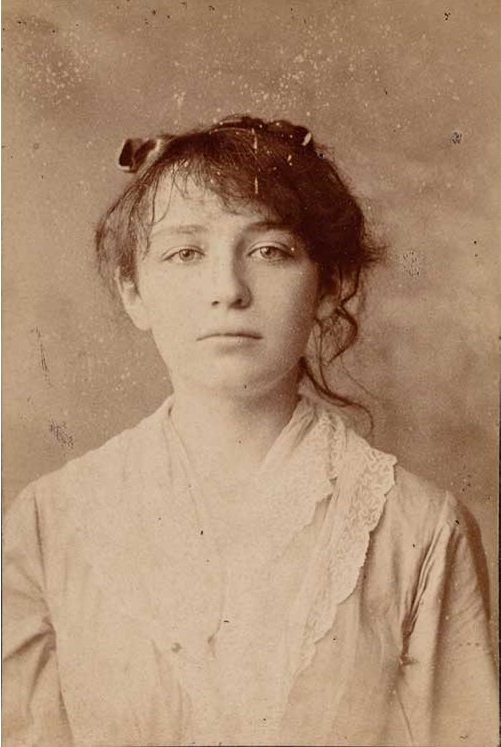
She was born in 1864 in Fère-en-Tardenois, in northern France, and came to Paris determined to be a sculptor at a moment when the École des Beaux-Arts still barred women from its studios and its life-drawing rooms. She enrolled at the Académie Colarossi, one of the few that admitted women, and by her early twenties she had entered the workshop of Auguste Rodin. She became his student, then his assistant, his model, and his lover. From the first, she insisted on being his rival.
The difference between them shows in what each chose to carve. Rodin made the body heroic, muscular, and straining. Claudel made the body tender. Her Sakuntala, reworked in marble in 1905 as Vertumnus and Pomona, shows a couple locked in a reunion embrace, two figures melting into one. Her Waltz, first modeled in the late 1880s, spins a pair of lovers through a dance. These are nudes built around feeling.
Her most autobiographical work reads as prophecy. The Age of Maturity, from 1899, shows an aging man pulled forward by an older woman while a young woman kneels behind him, arms reaching, imploring. Everyone who knew her life read the group as Rodin, torn between his longtime companion Rose Beuret and Claudel herself. She had turned private grief into a public monument.
Then the story hardens. Rodin refused to leave Beuret. Claudel’s commissions dried up, her fears deepened, and in 1913, weeks after her father’s death, her brother, the poet Paul Claudel, had her committed. She never sculpted again. The woman who spent her life giving the nude its emotional truth lost her studio, her materials, and at last the freedom of her own body. She spent thirty years refusing visitors and refusing the art that had made her.
For most of the twentieth century, art history filed Claudel under Rodin: the muse, the mistress, the madwoman. That filing was a second confinement. The Musée Rodin now gives her a room of her own, and in 2017 the town of Nogent-sur-Seine opened a museum in her name. The nude she sculpted outlasted the men who decided she was too fragile to hold a chisel. On the anniversary of her death, the embrace in Vertumnus and Pomona still holds.