Egon Schiele: The Artist Who Made Discomfort the Point
Some artists make you feel something. Egon Schiele made sure you couldn’t look away.
The Austrian Expressionist died at 28 — younger than Van Gogh, younger than Basquiat, younger than anyone with as much influence on how we see the human body. In his furious decade of work, he produced over 3,000 drawings and paintings. Most of them were nudes. And most of those made people furious.
Schiele wasn’t interested in beauty as the world defined it. He was interested in truth — raw, awkward, sexual, uncomfortable truth — and he painted it in bodies that seemed to twist under their own psychological weight.
The Apprentice Who Outran the Master
Schiele studied under Gustav Klimt at the Vienna School of Arts and Crafts. Klimt, the reigning prince of Viennese Secessionism, painted nudes wrapped in gold leaf and allegory — society women transformed into Judith, Salome, the Danaë of myth. His bodies were decorative, seductive, safe in their mythologizing.
Schiele rejected every layer of that safety.
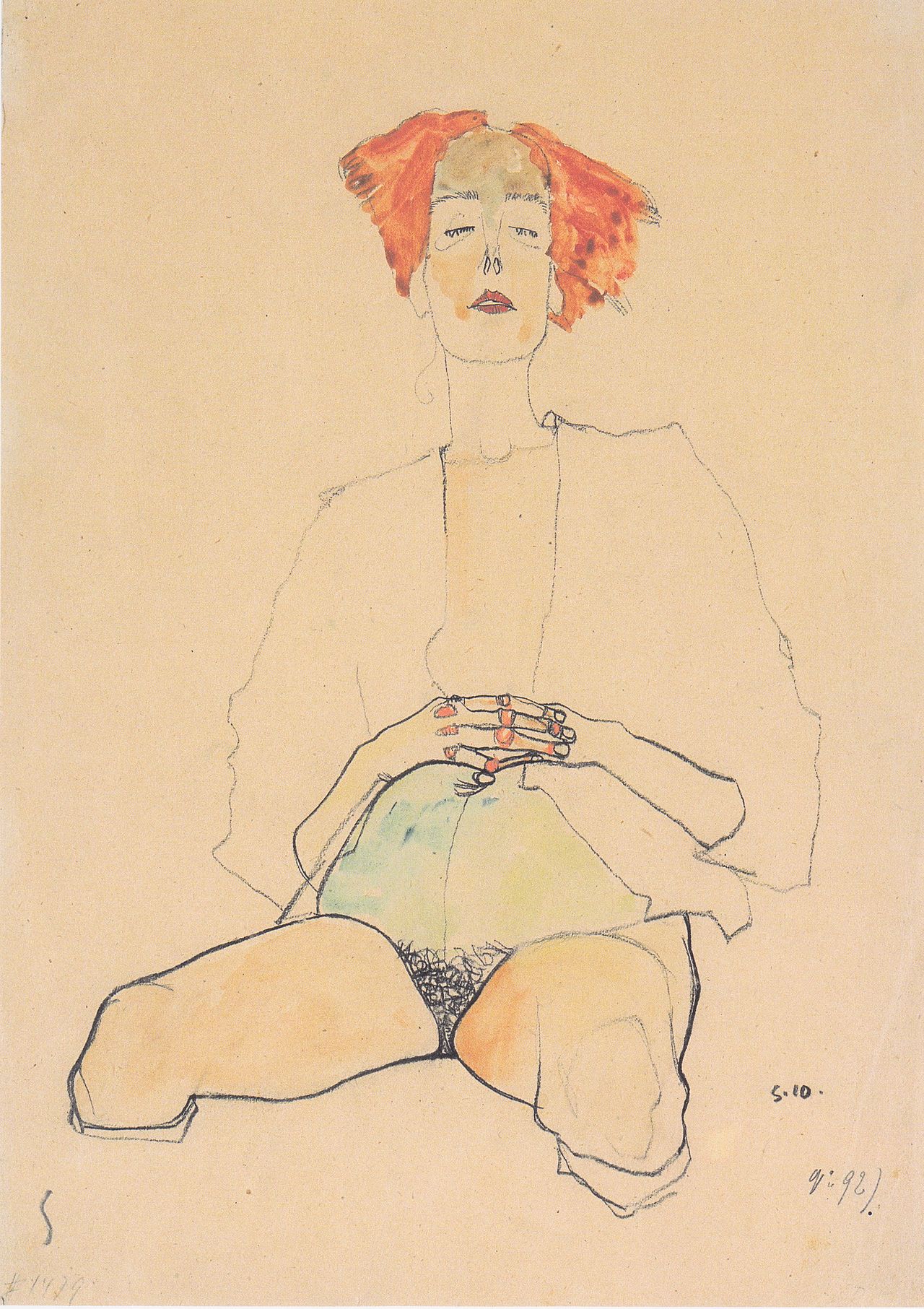
By 1910, at age 20, he had developed his signature style: figures drawn with brittle, nervous lines, limbs too long, ribs visible, skin mottled with raw washes of orange, red, and green. His subjects stared directly at the viewer — not coyly, not invitingly, but with an unsettling awareness. They knew you were looking. They looked back.
While Klimt dressed his nudes in ornament, Schiele stripped everything away. No allegory. No mythology. No gold leaf to justify the naked body. Just the body itself — exposed, imperfect, alive.

The Arrest: When Art Becomes a Crime
In April 1912, Schiele was arrested. The charge: seducing a minor (dismissed) and exhibiting “obscene drawings” (not dismissed).
The specifics matter. Police seized over 100 of Schiele’s drawings from his studio in Neulengbach. During the trial, the judge burned one of his works in court over a candle flame — a piece of evidence deemed too corrupting to even be shown.
Schiele spent 24 days in prison. The experience shattered him. While incarcerated, he created a series of drawings — Die Gefangenen (The Prisoners) — documenting his cell, his cot, the guards, his own emaciated body in a gray prison shirt. These are not protest art. They are something stranger: an artist using imprisonment as another studio, another angle on the body in extremity.
He was convicted only of “exhibiting obscene drawings in a place accessible to children.” The sentence — three days — had already been served by his pretrial detention. But the message was clear: the state considered his vision of the nude body criminal.
What Made Schiele’s Nudes So Dangerous
To understand why Schiele’s nudes provoked this reaction, look at what was hanging in respectable galleries at the time. Academic nudes — smooth, idealized, allegorically justified — were everywhere. A naked woman in a painting was acceptable if she was Venus, if she was Diana, if she was a nymph in a classical landscape. The nudity had to mean something else.
Schiele’s nudes didn’t mean anything else. They meant exactly what they were: a naked person, seen honestly, without justification.
His female subjects are not passive objects of the male gaze. They are active, confrontational, often masturbatory — posed not for a viewer’s pleasure but for their own. His male nudes — especially his self-portraits — are gaunt, anxious, sometimes erotically charged. The bodies don’t perform beauty. They perform being bodies: awkward, sexual, mortal, alive.
This was not an aesthetic choice. It was a philosophical position. Schiele was part of the Viennese Modernist movement that included Freud, Schnitzler, and Klimt — all asking what lay beneath the polished surface of Austro-Hungarian respectability. Schiele’s answer was drawn in charcoal and watercolor: underneath the corsets and stiff collars, human beings are animal, fragile, and desperately real.
The Late Work: Maturity Cut Short
By 1915, Schiele had married Edith Harms, a middle-class woman from a respectable family. His work softened — not in technical skill but in emotional register. The bodies became less angular, the gazes less confrontational. Paintings like Embrace (1917) and The Family (1918) show a tenderness that his earlier work refused.
Then the Spanish flu arrived.
Edith died of influenza in October 1918 while pregnant. Schiele died three days later. He was 28 years old.
In those final months, he produced some of his most accomplished work: The Family, a portrait of himself with Edith and their unborn child, rendered with a gravity that suggests he knew what was coming. It is the only Schiele painting that looks like a monument — because that is exactly what it became.
Schiele’s Legacy: Why He Still Makes Us Uncomfortable
A century after his death, Schiele’s nudes still have the power to shock — not because they are graphically sexual (by contemporary standards, they are restrained), but because they refuse to perform the fiction that art is somehow separate from the body it depicts.
Museums that show Schiele still face calls to censor his work. In 2023, a London gallery’s Schiele exhibition was flagged on social media as “pornographic content.” The same conversation the judge had in 1912 — over a candle flame in an Austrian courtroom — is happening on Instagram in 2026.
That continuity is the point. Schiele’s work hasn’t changed. The culture around it hasn’t changed as much as we’d like to believe. We still want our nudes allegorized, justified, made safe by distance. Schiele refuses to give us that distance. A century dead, he’s still making us look — and still daring us to look away.
Egon Schiele (1890–1918) was an Austrian Expressionist painter. His complete body of work — over 3,000 works on paper — entered the public domain in 1989. Major collections of his work are held by the Leopold Museum (Vienna), the Albertina (Vienna), and the Museum of Modern Art (New York).
NALA: Los Angeles’s premier nude art exhibition. Get involved.