\u00c9mile Bernard Was Born 168 Years Ago Today. The Forgotten Prodigy Who Invented Modernist Nudes at Pont-Aven.
\n\n
Every art history textbook tells you C\u00e9zanne invented modernism. Cubism was Picasso and Braque. The flat, bold nudes of Gauguin’s Tahiti changed everything.
\n\n
Almost nobody mentions that a teenager expelled from art school was producing the same radical experiments before any of them \u2014 and that his nudes from 1888, painted in a tiny Breton village, are where the modern body in art actually begins.
\n\n
\u00c9mile Bernard was born June 26, 1858, in Lille, France. He died in 1941, an embittered traditionalist who had long since disowned the revolution he started. But between 1886 and 1890, this forgotten prodigy reinvented the nude figure from scratch \u2014 and the entire 20th century followed.
\n\n
The Prodigy Who Said No
\n\n
Bernard entered the \u00c9cole des Beaux-Arts at 17. He was expelled within a year. The reason, depending on who tells it, was either insubordination to his teacher Cormon or a fundamental refusal to paint the way he was told. What matters is what came next: he walked out of the Academy and into the countryside \u2014 first Brittany, later the South of France \u2014 determined to find a new visual language entirely outside the classical tradition.
\n\n
In 1886, at age 28, he met Vincent van Gogh in Paris. Van Gogh, seven years older and still completely unknown, immediately recognized Bernard as a kindred spirit. They began exchanging paintings, drawings, and long letters about color, faith, and the future of art. Bernard introduced van Gogh to the Pointillist experiments of Seurat. Van Gogh, in turn, encouraged Bernard to push further into the radical simplification they both sensed was coming.
\n\n
Pont-Aven: The Summer That Changed Everything
\n\n
In the summer of 1888, Bernard settled in Pont-Aven, a fishing village in Brittany that had become a magnet for artists fleeing Paris. He was 30 years old and working feverishly. And there, in direct response to the stained-glass windows of Breton churches \u2014 flat, black lines containing fields of pure, luminous color \u2014 he invented what art history would later call Cloisonnism.
\n\n
His Adam et Eve (1888) is a landmark of this style. Rendered in the Mus\u00e9e d’Orsay collection, Bernard’s rendition of the first couple is unrecognizable compared to the classical tradition. Gone is the naturalism of D\u00fcrer, the muscular idealism of Michelangelo. Bernard’s Eve is a flat, decorative figure outlined in black, her body reduced to pure pattern. She belongs less to Eden and more to stained glass \u2014 and that was exactly the point. Bernard was arguing that the nude did not need to be illusionistic to be powerful. It could be schematic, symbolic, and still carry every ounce of its theological weight.
\n\n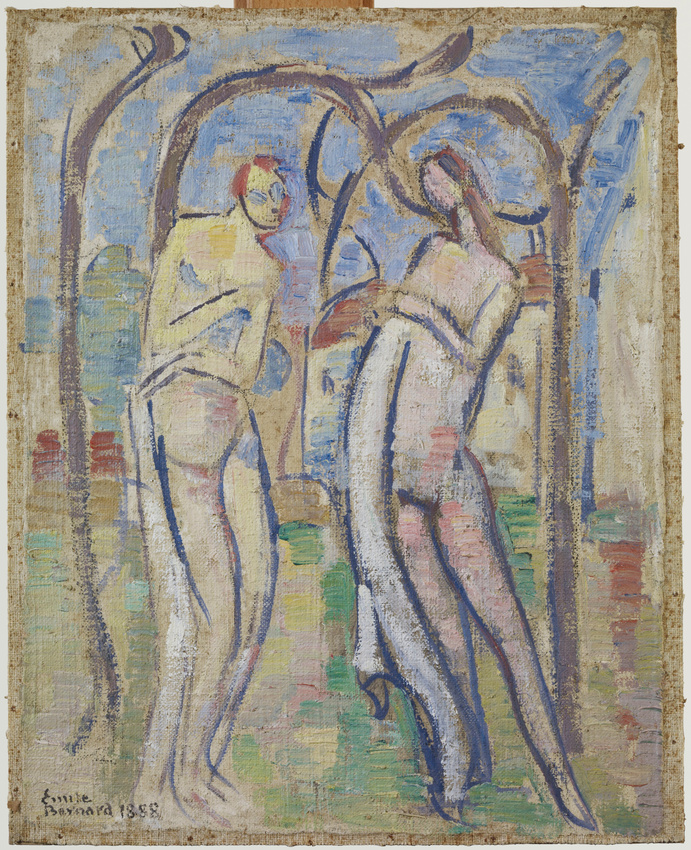 \n\n
\n\n
Emile Bernard, Adam et Eve (1888), Musee d’Orsay \u2014 Public Domain
\n\n
When Paul Gauguin arrived in Pont-Aven later that same summer, he saw Bernard’s Cloisonnist works and immediately understood their importance. Gauguin adopted Bernard’s technique of bold outlines and flat color fields, applied it to his own vision of the primitive, and \u2014 being the more ambitious self-mythologist \u2014 took most of the historical credit. The Vision After the Sermon, Gauguin’s breakthrough painting from that same year, owes its entire visual logic to what Bernard had already been doing.
\n\n
Madeleine and the Modern Nude
\n\n
Also in 1888, Bernard painted Portrait of My Sister Madeleine (now at the Mus\u00e9e Toulouse-Lautrec in Albi). Madeleine Bernard, then in her early twenties, is shown with her blouse slipped from one shoulder \u2014 a subtle, intimate nude that carries none of the theatricality of Academic nudes or the allegorical cover of mythological painting. She looks directly at the viewer with an expression that is neither inviting nor ashamed. She simply is.
\n\n
In that directness, Bernard anticipated something the 20th century would spend decades trying to articulate: the nude as a psychological encounter rather than a physical spectacle. There is nothing of the odalisque here, nothing of the goddess. Madeleine is just a young woman, half-unclothed, looking her brother \u2014 and through him, us \u2014 in the eye. It is, in its quiet way, as radical as Manet’s Olympia.
\n\n
The Three Graces: Tradition Through a Modern Lens
\n\n
Later in his career, as Bernard retreated from his own radicalism and attempted to reconcile with the classical tradition, he produced Les Trois Graces (1912). The subject is ancient \u2014 the three daughters of Zeus, personifications of beauty, charm, and creativity, a staple of Western art from Botticelli to Canova. But Bernard’s version retains the flat, decorative sensibility he developed at Pont-Aven. The bodies are stylized, the outlines are emphatic, and the composition flattens the traditional pyramidal grouping into something closer to medieval illumination than Renaissance sculpture.
\n\n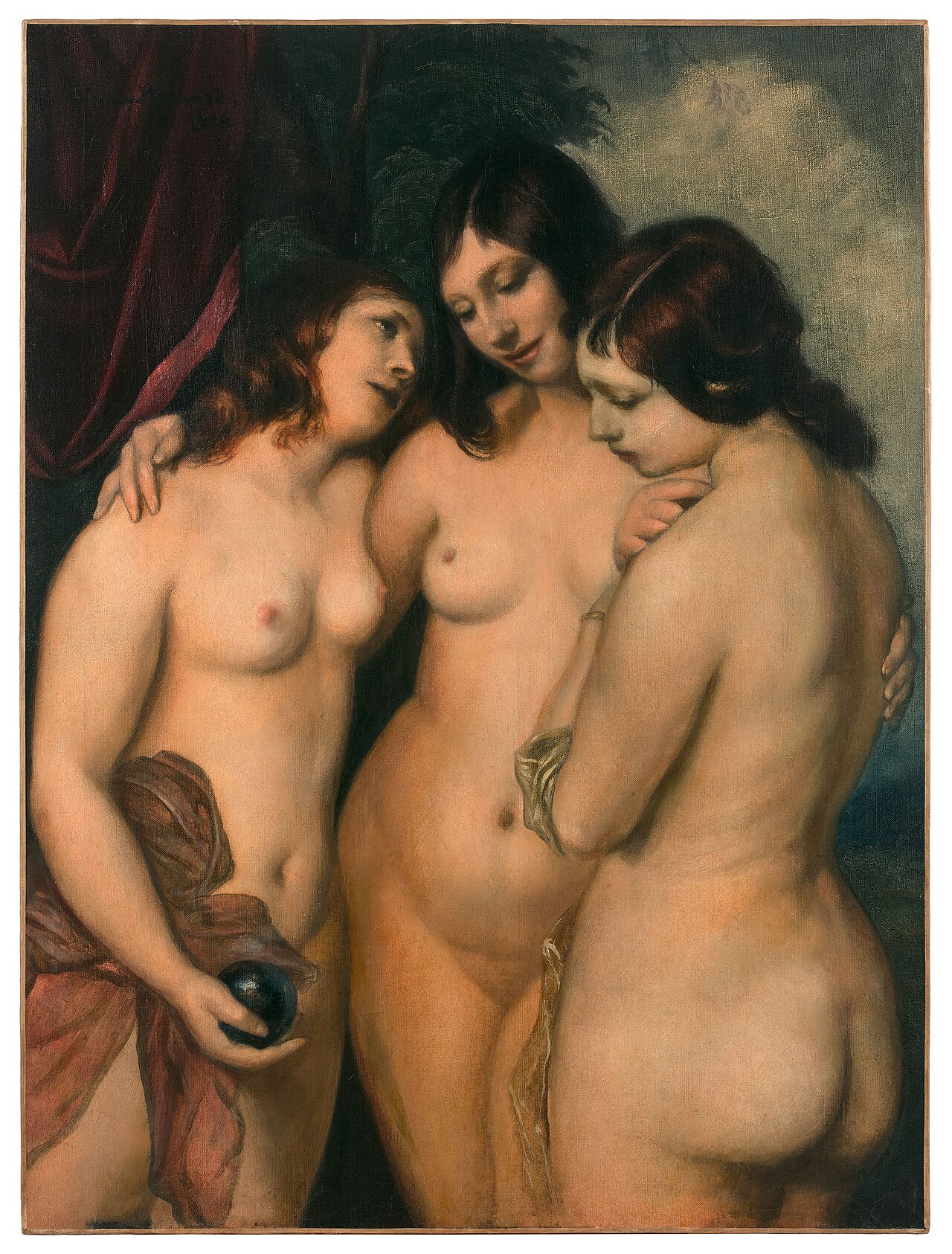 \n\n
\n\n
Emile Bernard, Les Trois Graces (1912), Wikimedia Commons \u2014 Public Domain
\n\n
By 1912, Bernard had publicly rejected modernism \u2014 he wrote essays attacking C\u00e9zanne, described Cubism as a dead end, and insisted that only the classical tradition could produce great art. But Les Trois Graces betrays him. However much he insisted on returning to tradition, the painting still looks like the invention he could not un-invent. The Cloisonnist skeleton is still there under the classical skin.
\n\n
The Nude Body as Pure Surface
\n\n
Bernard’s later nudes \u2014 like Nu \u00e0 la rivi\u00e8re (1932), painted when he was 74 \u2014 show the mature phase of his thinking about the body. The nude reclines by a riverbank in a pose that echoes Giorgione’s Sleeping Venus, the foundational image of the European reclining nude. But Bernard flattens her into the landscape. She is not in the landscape, a separate figure occupying pictorial space; she is part of the landscape, constructed from the same decorative strokes and muted harmonies as the water and trees around her.
\n\n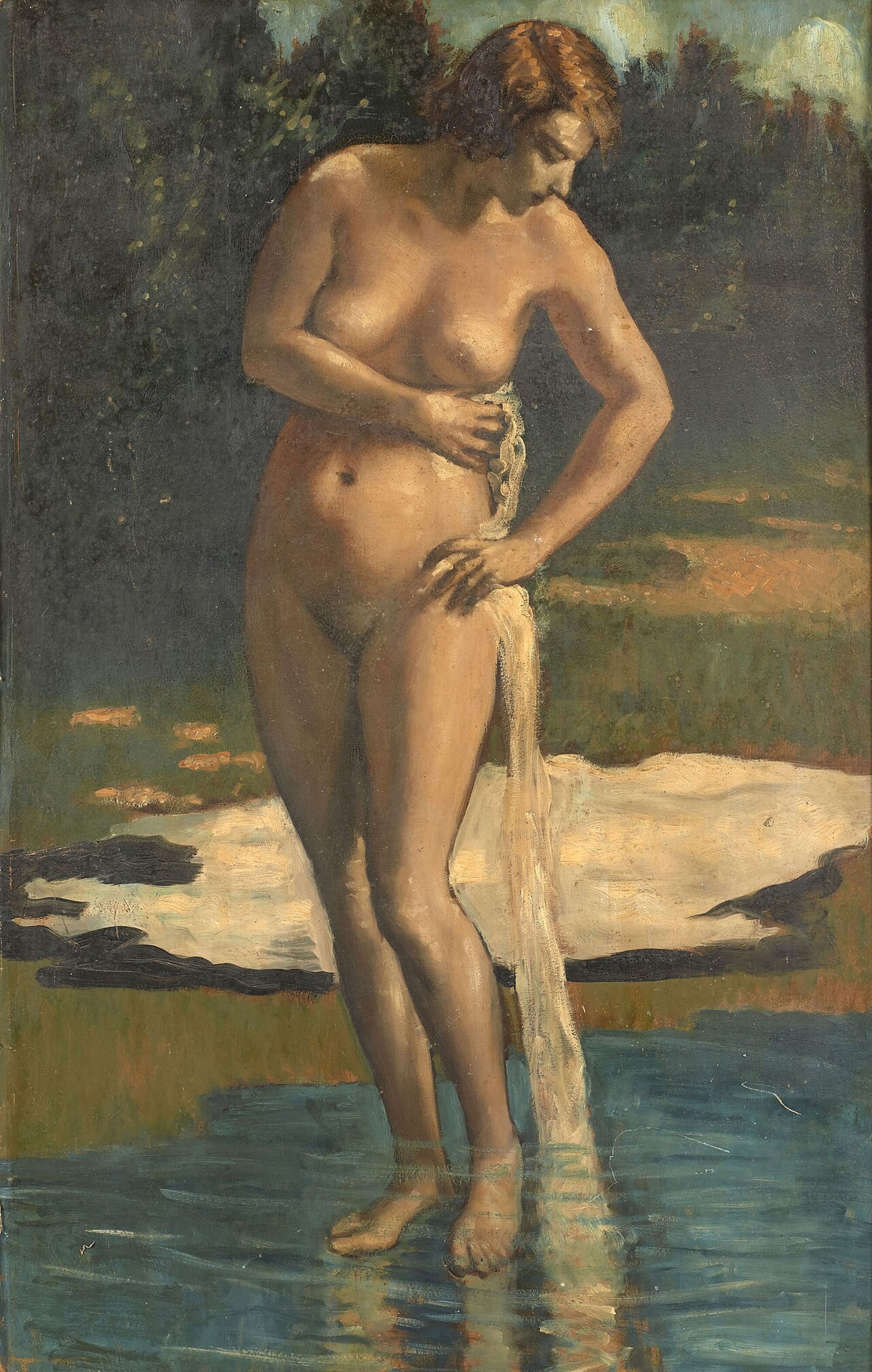 \n\n
\n\n
Emile Bernard, Nu a la riviere (Nude by the River, 1932), Wikimedia Commons \u2014 Public Domain
\n\n
This is the mature Bernard thesis on the nude body: it is not more important than anything else in the picture. It has no privileged place. It is surface \u2014 as much pattern as flesh, as much decoration as humanity. In this, Bernard’s nudes from the 1930s feel closer to Matisse than to the Renaissance he spent his late career defending.
\n\n
The Forgotten Inventor
\n\n
\u00c9mile Bernard died in Paris on April 16, 1941, at age 73, largely forgotten by the art world. The modernists he had rejected had won, and the traditionalists to whom he had pledged allegiance had no use for a painter who had once been too radical for the Academy.
\n\n
History, however, has been quietly revising that verdict. Major retrospectives \u2014 at the Mus\u00e9e d’Orsay (2010), the Van Gogh Museum (2014), and the Mus\u00e9e de l’Orangerie (2018) \u2014 have reestablished Bernard as a key transitional figure whose work at Pont-Aven in 1888-1889 fundamentally changed the direction of European painting. The flat, decorative nudes he invented at 30, working in a cramped studio above a Breton bakery, turned out to be the template for everything from Art Nouveau to Matisse’s Blue Nudes.
\n\n
Bernard did not just paint nudes. He reimagined what a painted body could look like after the collapse of the classical tradition. And very few artists \u2014 not even Gauguin \u2014 can claim to have done it first.
\n\n
\n\n
The nudes of \u00c9mile Bernard are in the public domain. Prints of his works are available through the Mus\u00e9e d’Orsay, the Van Gogh Museum, and the Mus\u00e9e Toulouse-Lautrec in Albi. To support NALA’s mission of keeping art-history education free from censorship, consider getting involved.
\n