Francis Bacon was born in Dublin on 28 October 1909, and no painter since has looked at the human body with less comfort or more honesty. The nude, for most of its long life, has been a promise: that the body can be made smooth, whole, and permanent, that flesh can be coaxed into marble or made to glow as if it will never age. Bacon declined the promise. He painted bodies that knew they were going to die.
His figures are recognizably human and yet barely holding together. Faces smear. Limbs blur as if caught mid-motion or mid-collapse. Mouths open into a scream that has no sound in a picture and no end outside it. Bacon worked this way from the start, from the 1944 triptych Three Studies for Figures at the Base of a Crucifixion, which announced him, to the popes he painted after Velázquez, to the late portraits of friends and lovers that read as elegies painted before the loss.
He made the point without ceremony. Bacon told the critic David Sylvester that he wanted to paint the human figure the way Rembrandt painted a carcass, the flayed ox hanging in a butcher’s shop. A body, in this view, is meat. The tradition he inherited had spent centuries denying that fact, and Bacon made it the whole subject. He kept a photograph of a butcher’s shop in his studio and described the Crucifixion and the slaughterhouse as a single subject: the body given over to its own material truth.
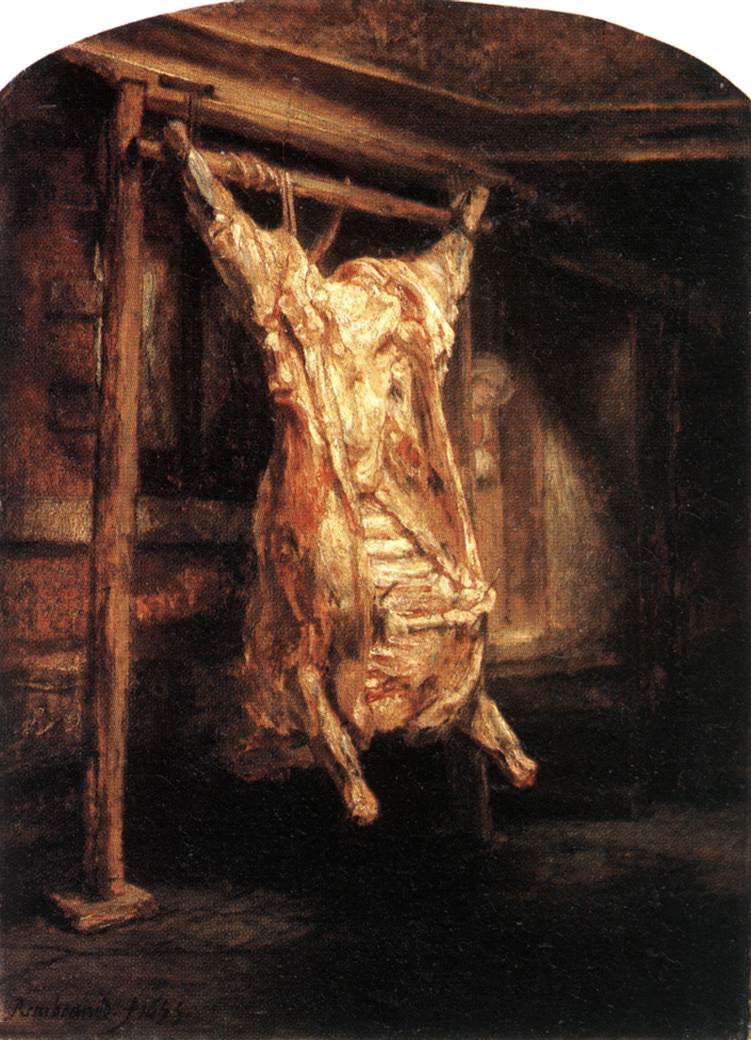
He was never the first to see the body this way, and he knew it. El Greco’s Laocoön, painted around 1610, already distorts the human figure toward agony rather than repose: the priest and his sons writhe, elongated and undone, in the coils of the serpents. Titian, near the end of his life, painted Marsyas being flayed alive and let the brushwork grow raw and unfinished. Rembrandt refused to idealize his nudes and gave the carcass the same tenderness he gave a face. Bacon inherited this minority line, the one that treats the figure as mortal matter rather than a monument.
His contribution was to strip the setting down to almost nothing and leave the body exposed inside it. His figures stand alone in bare rooms, often enclosed in thin cage-like lines or set on a rail under a naked bulb. There is no myth to excuse the nakedness, no landscape to soften it, no god to explain it. The classical nude needed its alibi, a Venus, a bath, a biblical story. Bacon removed the alibi and kept the body, which is why his pictures still unsettle.
His nudes are among the most unsparing in modern art. The reclining figures owe a debt to the odalisque, but they refuse its calm. The wrestling lovers he painted after photographs by Eadweard Muybridge turn two bodies into a single struggling shape. The male figure, which the classical tradition dressed in heroic armor, appears in Bacon as something open and defenseless. He treated every body, male and female, with the same unblinking attention, which is its own kind of tenderness.
That is the real argument of his work. The nude, at its most ambitious, is a body with death removed. Bacon put the death back. He painted the figure as something fragile, transient, and animal, and in doing so he extended the honest side of the Western tradition: the line that runs from Rembrandt’s unidealized Bathsheba through the late Titian to the modern painters who refused to flatter. A Bacon figure is not beautiful in the old sense, and it never asks to be. It asks to be looked at as what it is.
A hundred and seventeen years after his birth, Bacon’s body remains one of the most demanding in art. It will not sit still for flattery. It insists that the human figure, the thing every artist since antiquity has drawn and carved and desired, is also the thing that ages, hurts, and ends. The figure still matters because it is ours, and it is mortal.