Georges Braque was born on May 13, 1882 — 144 years ago today. Though history remembers him as the co-inventor of Cubism alongside Picasso, Braque’s journey to that revolution began with a single, radical confrontation: the painted female nude.
The Nude That Started a Revolution
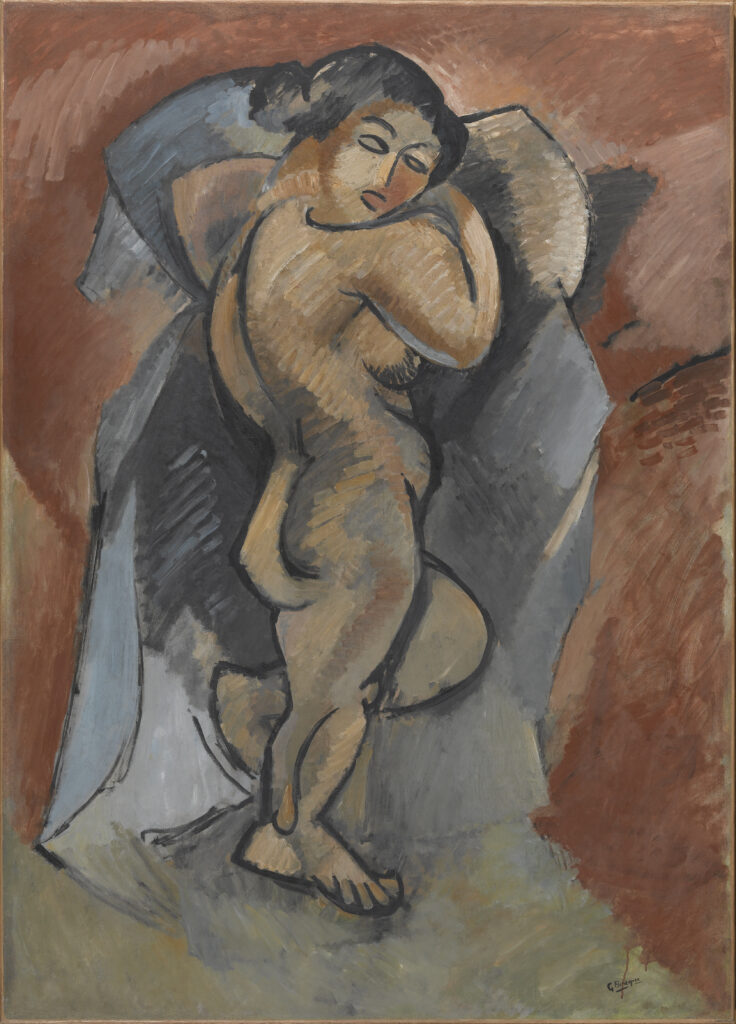
In the winter of 1907, Georges Braque visited Pablo Picasso’s studio and saw Les Demoiselles d’Avignon for the first time. The encounter changed everything. Braque returned to his own canvas and began work on what would become Grand Nu (Large Nude) — a monumental, 140 × 100 cm oil painting that marked the turning point between Fauvism and Cubism.
Completed in June 1908, Grand Nu depicts a standing female figure with deliberately distorted anatomy — a mask-like face, angular limbs, and a body that seems to twist in multiple directions at once. The American writer Gelett Burgess, visiting Braque’s studio on April 27, 1908, described it as “a horrendous painting of a woman exhibiting her leg muscles, a belly like a collapsing balloon, a breast shaped like a jug, square shoulders.” The description was meant as mockery. Today, we recognize it as a description of the birth pangs of modern art.
Braque himself called it “a new kind of beauty.” He was right. The painting rejected every convention of the idealized nude that had dominated Western art since the ancient Greeks. Gone was the smooth, flawless marble goddess. In her place stood a figure built from faceted planes, compressed space, and willful crudity of brushwork — a nude that was as much about the act of seeing as the body being seen.
From Flesh to Facet: Braque’s Path to Cubism
Before Grand Nu, Braque had been a Fauvist — painting brightly colored landscapes in the mode of Matisse. But the nude proved to be his bridge to something entirely new. Between 1907 and 1908, Braque absorbed influences from three sources that would define the next phase of Western painting: Paul Cézanne’s Bathers, with its geometric simplification of the human form; Henri Matisse’s Blue Nude (1907), which had scandalized Paris at the Salon des Indépendants; and Picasso’s Demoiselles d’Avignon, with its shattered, African-mask-derived faces.
What Braque did with these influences was unique. While Picasso’s Demoiselles was aggressive and confrontational, Braque’s Grand Nu is more ambiguous. The figure could be standing or reclining — the spatial relationships are deliberately unresolved. The background and foreground bleed into one another. The body is no longer a figure in space; it has become part of the space itself. This was the insight that would become the foundation of Cubism: that painting could represent multiple viewpoints simultaneously, and that the relationship between figure and ground was not fixed but fluid.
The Figure Dissolved and Rebuilt
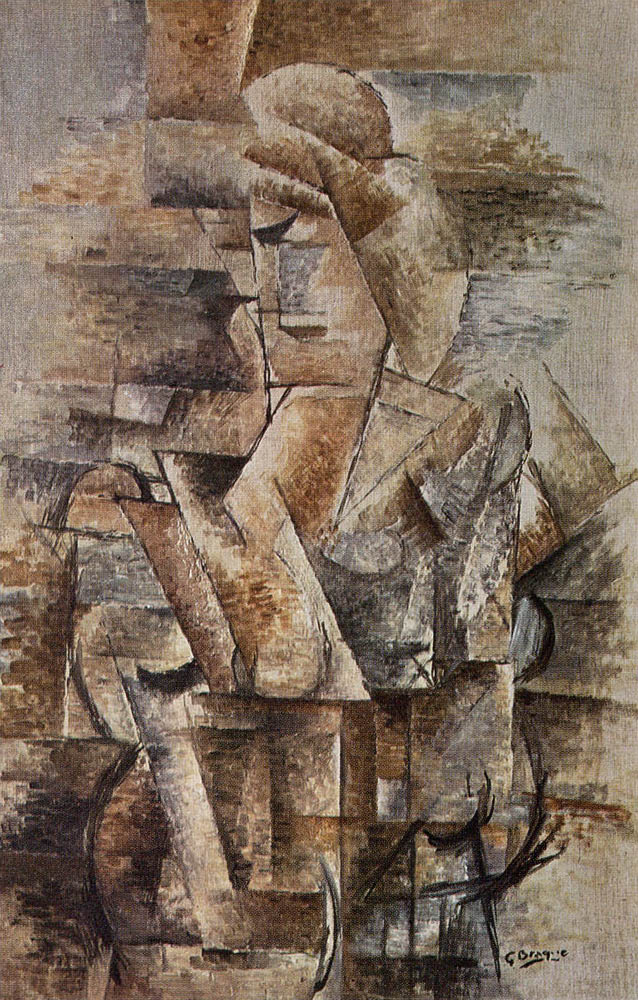
After Grand Nu, Braque did not abandon the human figure. Rather, he subjected it to ever more radical transformation. In 1910’s Female Figure (Torso), the body has been almost entirely broken into angular planes — a shoulder here, a curve of the hip there — held together by a new kind of pictorial logic. The viewer no longer looks at a body; they assemble it from fragments.
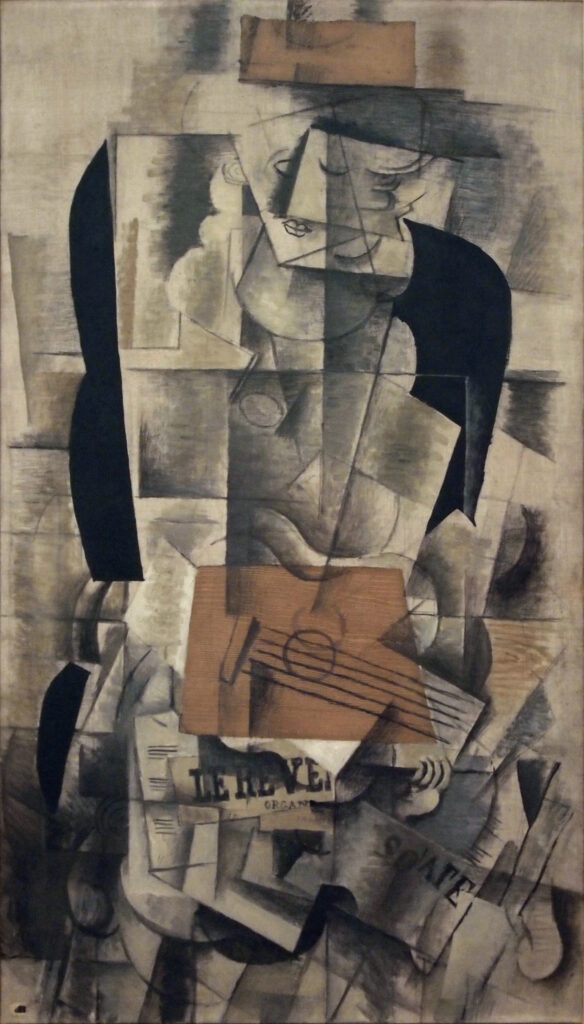
By 1913, in works like Femme à la guitare (Woman with Guitar), the figure has become almost indistinguishable from the space around it. The guitar, the body, the table, the wall — all are rendered in the same analytical language of interlocking facets and muted browns and grays. This is the mature phase of Cubism: the nude and the still life, the figure and the object, existing on equal terms in a world where every boundary has been questioned.
Braque’s approach to the figure was fundamentally different from Picasso’s. Where Picasso attacked the nude with violent energy, Braque dismantled it with deliberation — analyzing, reconstructing, testing what a painting could do. As the critic Clement Greenberg later observed, Braque’s Cubism was “the most disciplined, the most patient, and the most conclusive” of the two.
The Legacy: A Body Without Boundaries
Braque’s Grand Nu stands at a crossroads. Behind it lies the thousand-year tradition of the idealized nude — from Praxiteles to Michelangelo to Ingres — in which the naked body was a vehicle for beauty, myth, or morality. Ahead lies the modern body: fragmented, ambiguous, seen from every angle at once, and answerable to no single standard of perfection.
In this sense, Braque’s radical nude was not a rejection of the tradition but a transformation of it. He didn’t stop painting the figure because it was no longer beautiful. He painted it differently because the world had changed, and art needed a new language to describe what it meant to be embodied in the 20th century.
Every artist who has since approached the nude as a question rather than an answer — from Willem de Kooning’s Women to Jenny Saville’s flesh landscapes — owes something to that moment in 1908 when Braque declared that the nude could be more than a beautiful surface. It could be a way of thinking about space, perception, and what it means to see.
Georges Braque (May 13, 1882 – August 31, 1963) was born in Argenteuil, France. Over a career spanning six decades, he produced over 1,000 paintings, sculptures, and prints. His work is held in every major museum of modern art in the world. Grand Nu resides at the Centre Pompidou in Paris.
Interested in the future of the nude in art? Nude Art LA champions body-positive, artist-driven representation of the human figure. Get involved.