Georgia O’Keeffe was born 139 years ago today, on November 15, 1887, in Sun Prairie, Wisconsin. She died in 1986, famous for flowers and bones and for an almost mythical independence. The story most people know is that she painted the desert and refused every label. The story underneath is about a body. Hers.
In 1917 the photographer Alfred Stieglitz began photographing O’Keeffe. Over the next twenty years he built a “composite portrait” of her, hundreds of prints that mapped her hands, her neck, her torso, her hips. A large share of them are nudes. He photographed her body the way he photographed clouds and skyscrapers, as a formal problem to be solved over and over. When he exhibited the photographs in 1921, the New York art world reacted as if a private act had been committed in public. The nude woman in those prints was a working painter who had asked, again and again, to be judged by the canvases she made.
That tension is what makes O’Keeffe matter. She spent her career insisting the body she happened to inhabit was beside the point. When critics read her flowers as sexual anatomy, she pushed back for the rest of her life. She told anyone who would listen that there was no such thing as a woman painter, only painters. Yet the defining visual record of her early years was made by a man pointing a camera at her bare body. The art world wanted a female body to organize itself around, and hers became the landmark.
Her own work ran the other way. In 1915, a year before she met Stieglitz, she made a set of abstract charcoal drawings. They came, she said, from the feeling of her own body, from music and motion rather than any landscape or figure. They are nudes in the sense that they are body without flesh. She distilled herself into line and rhythm, which was exactly what the lens, in Stieglitz’s hands, refused to do. The camera stayed on the surface.
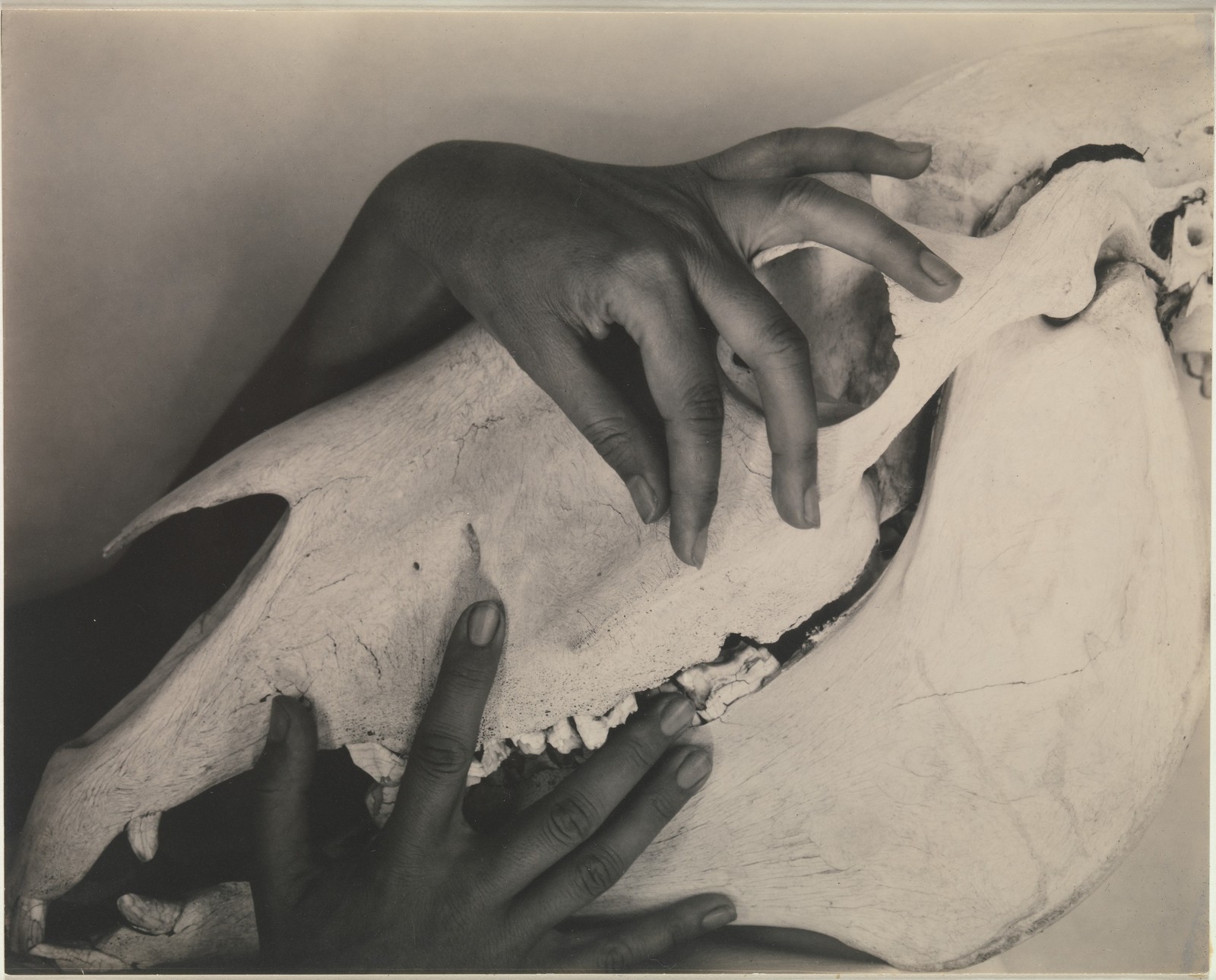
Read side by side, the two bodies of work are a study in control. O’Keeffe controlled what left her easel. Stieglitz controlled what entered the frame. She made the body abstract and universal. He made it specific and hers. The artist who fought hardest against being seen as a body became, through no choice of her own, one of the most photographed nudes of the twentieth century.
Her escape was the desert. In 1929 she went to New Mexico and found a place where the body receded, replaced by bone and adobe and red earth. She kept going back until she stayed for good. The flowers she painted there, enlarged until they filled the canvas, were read by a generation of male critics as vulval and vaginal, which infuriated her. She insisted they were flowers. She was right, and she was fighting a fight she could not win, because the public mind had already fixed her as a body first and a painter second.
What O’Keeffe left behind is a warning and a triumph. The warning is that authorship and the body are never fully separable for a woman artist, no matter how loudly she refuses the frame. The triumph is that the refusal itself became a body of work. She painted on her own terms for seven decades, and when she died at ninety-eight she had outlived every reading of her. The photographs remain. So do the canvases. They tell two stories about the same woman, and both are true.