On July 30, 1898, a boy was born in a cramped miner’s cottage in Castleford, Yorkshire, who would spend the next 88 years chipping away at a single question: what is the irreducible truth of the human body? Henry Moore didn’t just sculpt nudes. He excavated them. He treated the figure the way a geologist treats a landscape — finding bones in bedrock, valleys in thighs, tributaries in collarbones. Today, on what would be his 128th birthday, his answer still matters more than any anatomical diagram ever could.
The Miner’s Son Who Refused to Draw Bones Correctly
Moore’s origin story has become so familiar it risks sounding like myth: the seventh of eight children, a father who insisted on education, a war that nearly killed him at Cambrai, a scholarship to the Royal College of Art. But the detail that actually explains everything happened in a classroom. As a young art student, Moore refused to draw from plaster casts the approved academic way — flattening forms into shaded outlines. He wanted to feel volume. He wanted to draw through the figure, as if his pencil were a blade slicing cross-sections of flesh. His teachers told him to stop. He did not stop.
That refusal contains the whole Moore project. The classical nude had been a surface — polished marble, smooth contour, the body as a beautiful object to be admired from a respectful distance. Moore wanted the body as a territory. Something you could walk around. Something with interior pressure. Something that didn’t just sit there looking pretty but occupied space with the same geological inevitability as a boulder.
The Reclining Figure: One Pose, an Entire Career
Moore discovered the reclining figure in the 1920s and never let go. For sixty years, he returned to the same posture — a body horizontal, weight surrendered to the earth — and found something new in it every time. This wasn’t repetition; it was obsession as methodology. The reclining pose solved a formal problem Moore couldn’t stop thinking about: how do you make a static object feel like it’s still breathing?
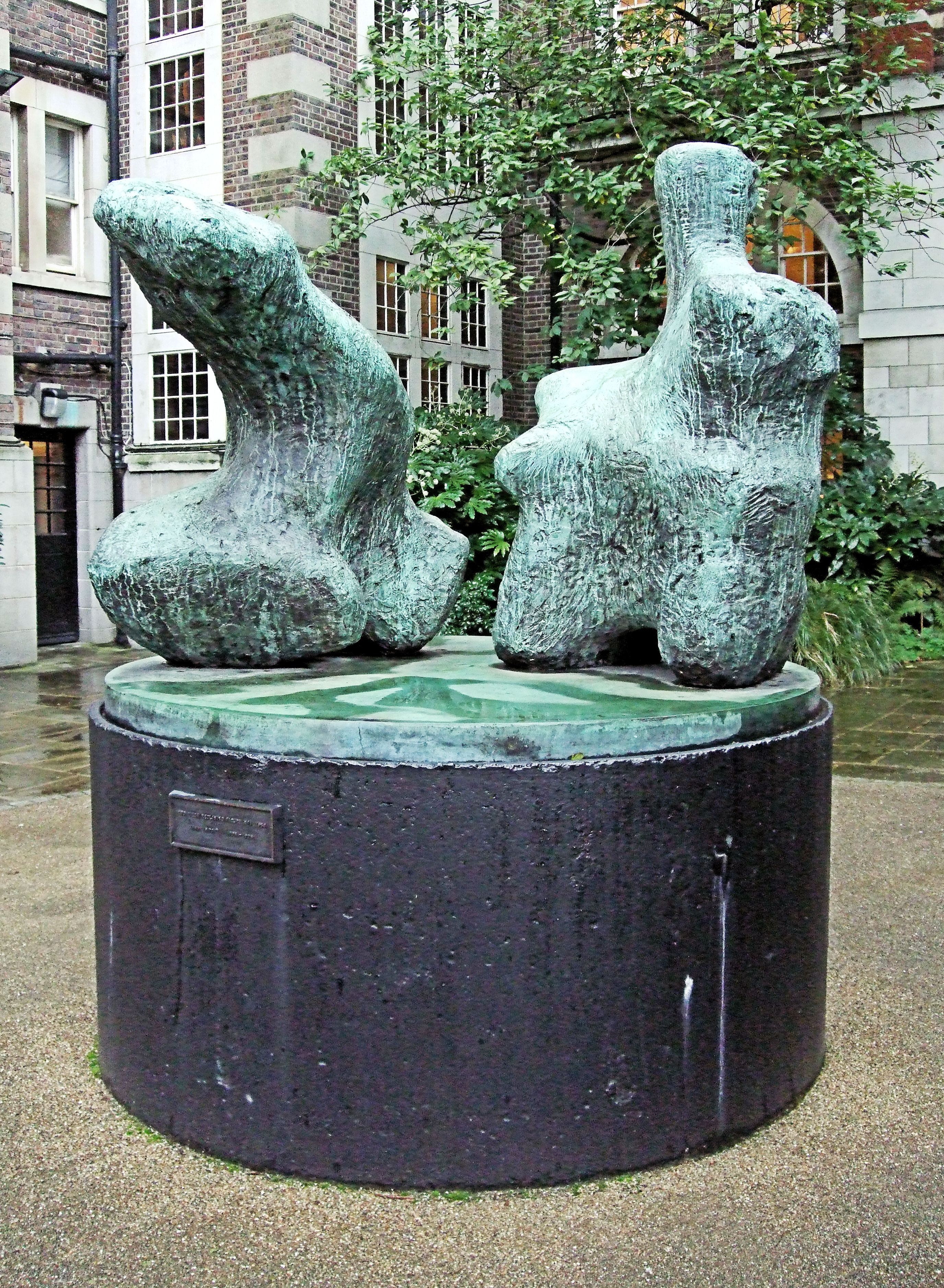
The answer was in the relationship between mass and void. Moore’s great innovation was to pierce the body — to let light and air flow through it. A Moore reclining figure has holes where a stomach should be. Limbs merge into torso, then separate again. The head becomes a knob, a protrusion, a suggestion. This wasn’t abstraction for abstraction’s sake. Moore was after something older and deeper: the way a hillside suggests a hip, the way a riverbed echoes a spine. His nudes were bodies that had made peace with being landscape.
Body as Landscape, Landscape as Body
The easy reading of Moore — and it’s not wrong — is that his reclining figures look like hills. The Yorkshire boy who grew up among slag heaps and rolling dales carried the shape of the land into every sculpture. But there’s a harder, stranger reading that gets closer to what Moore actually achieved. His figures don’t just resemble landscape. They are landscape — and landscape is them. The boundary dissolves. You look at a Moore sculpture and you’re not sure whether you’re seeing a body becoming earth or earth remembering it was once a body.
This is where Moore parts company with every other modernist. Picasso fragmented the body. Brancusi refined it to pure essence. Giacometti stretched it until it nearly disappeared. Moore did something odder: he let the body merge with the non-human world and somehow emerge more human for it. His nudes were never cold formal exercises because they never forgot their origin in flesh. A Moore sculpture carries weight the way a sleeping body carries weight — completely surrendered, completely present.
The Draped Figure and the Paradox of Clothing
Moore’s draped figures, beginning in the early 1950s, seem at first like a retreat. After decades of pure abstraction — the stringed figures, the internal/external forms, the multi-piece compositions — here were bodies covered in cloth. But Moore understood something counterintuitive about drapery: it doesn’t hide the body. It reveals it. Fabric falling over a knee describes the knee more precisely than bare skin ever could. The tension of cloth over a shoulder is a diagram of the shoulder’s structure. In Moore’s hands, drapery became a second skin that told the truth about the first.
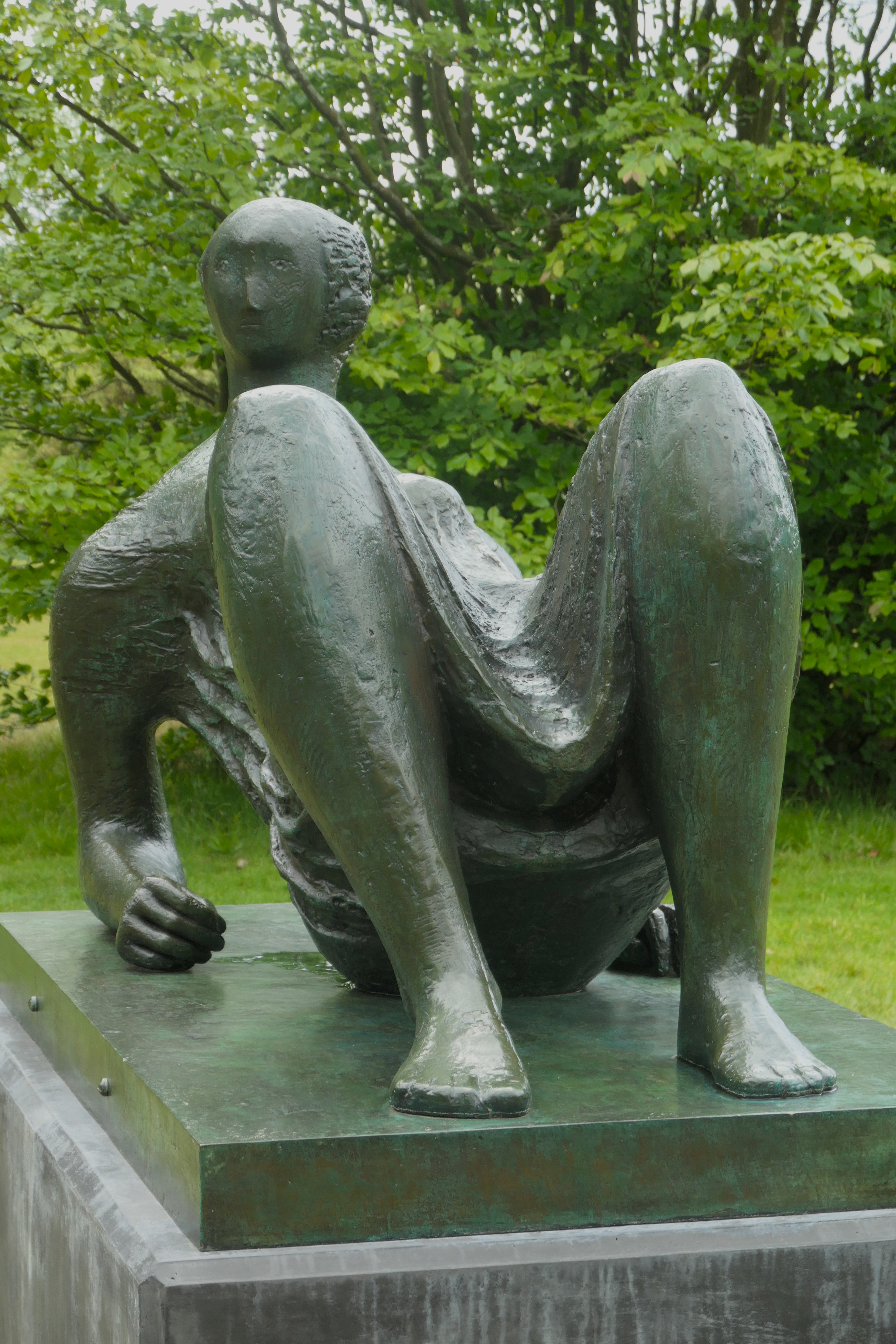
The Draped Reclining Figure of 1952 is Moore at his most eloquent. The figure rests on one elbow, the other arm reaching across the body — a pose of extraordinary tenderness. The drapery gathers in folds that read simultaneously as fabric, as musculature, and as the strata of an ancient seabed. This is Moore’s genius in a single image: three ways of seeing, all true at once, none cancelling the others.
Why Moore’s Nudes Still Matter
It would be easy to dismiss Moore as a mid-century monument — the safe modernist, the public-sculpture franchise, the man whose works adorn corporate plazas and university quadrangles worldwide. But that ubiquity is evidence of something genuine. Moore’s reclining nudes communicate across every barrier — language, culture, education — because they speak the body’s own language. You don’t need an art history degree to feel the gravitational pull of a Moore figure. Your own body recognizes it.
In an era when the nude in art is often either hyper-sexualized or nervously sanitized, Moore offers a third way. His figures aren’t erotic in any obvious sense, but they’re deeply sensuous. They acknowledge the body’s weight, its warmth, its vulnerability — everything that makes a body a body rather than a geometry problem. Moore never forgot that he was sculpting people, even when the people looked like cliffs.
The Body That Refuses to Be Finished
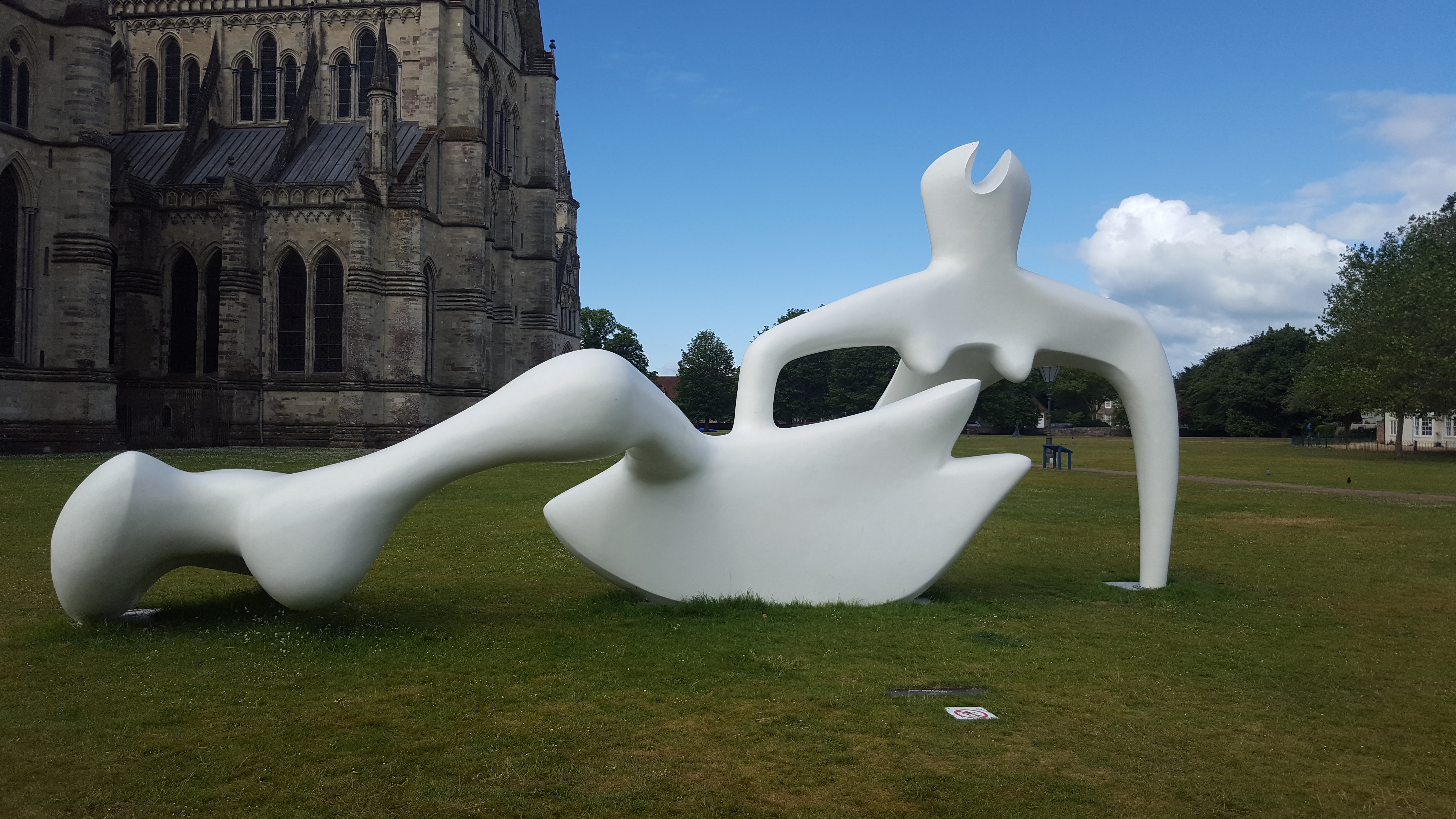
Moore worked until weeks before his death in 1986, and his late sculptures — including the massive fibreglass Large Reclining Figure of 1983 — have a roughness, an unfinished quality, that feels intentional. Moore understood that the body is never a finished proposition. It changes. It ages. It surrenders to gravity. A polished, perfected nude would have been a lie, and Moore spent his entire career refusing to tell it.
128 years after his birth, Moore’s reclining nudes still do what great art is supposed to do: they make the familiar strange and the strange familiar. Your body knows how to recline. You’ve done it ten thousand times. But you’ve never seen it the way Moore saw it — as landscape, as architecture, as an argument between mass and void, as something that can be pierced by light and still hold its wholeness. That’s the gift of a Moore sculpture. It returns you to your own body with fresh eyes.
The miner’s son from Castleford didn’t just change sculpture. He changed how we understand what it means to occupy space in a human shape. And he did it by lying down. Sometimes the most radical thing an artist can do is get comfortable with the earth.