Ingres Painted Nudes With ‘Too Many Vertebrae.’ He Was Right.
\n\n
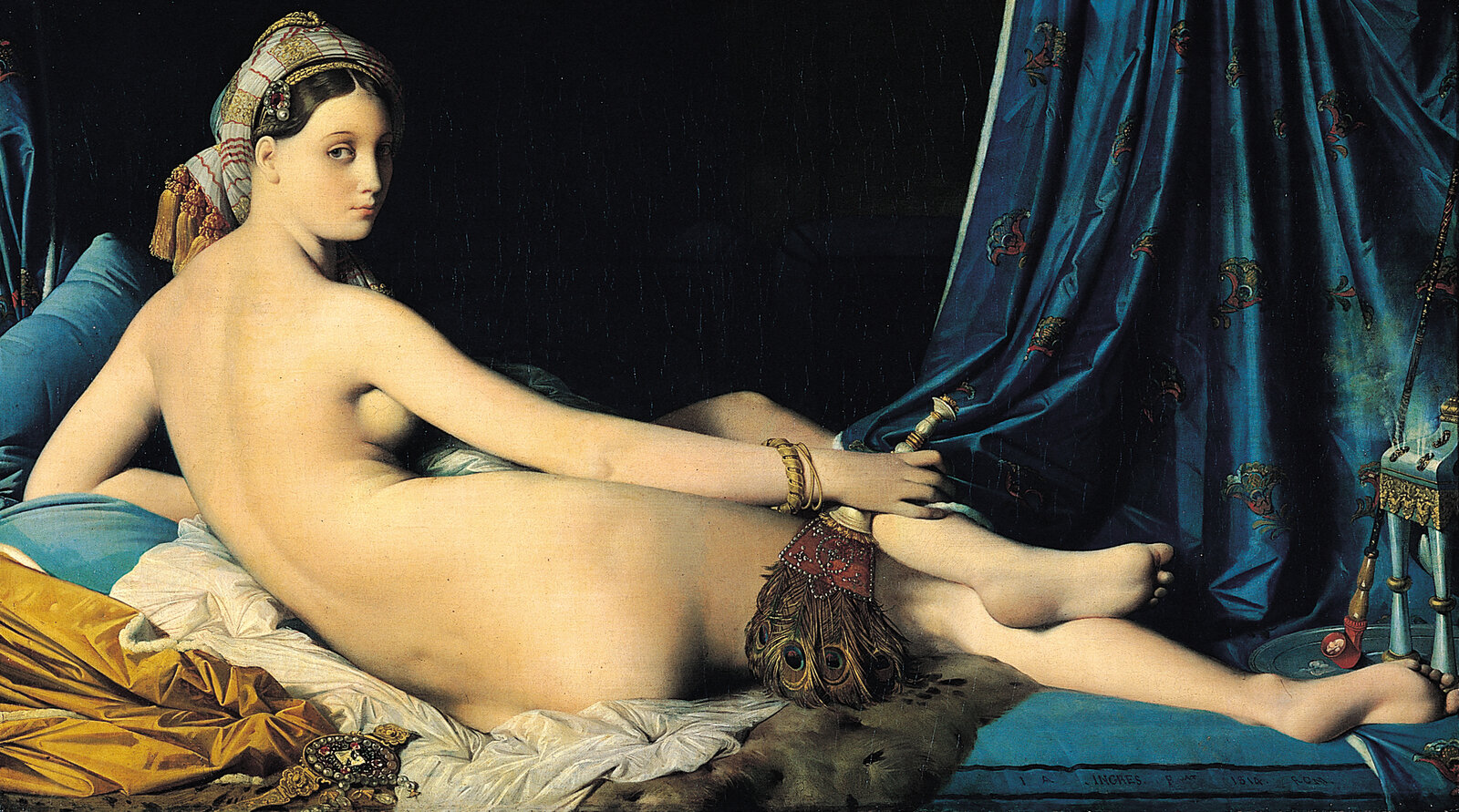
When Jean-Auguste-Dominique Ingres unveiled La Grande Odalisque at the Paris Salon of 1819, the critics didn’t just dislike it. They counted the bones.
\n\n
“He has no knowledge of anatomy,” one reviewer sniffed. “The figure has three vertebrae too many.” Another called it a “deformation of nature.” The painting \u2014 a reclining nude with her back turned to the viewer, her face glancing over her shoulder \u2014 was a scandal not because it was erotic, but because it was wrong.
\n\n
What the critics missed is that Ingres knew exactly what he was doing. The extra vertebrae weren’t a mistake. They were a manifesto.
\n\n
The Anatomy of a Rebel
\n\n
Ingres trained in the studio of Jacques-Louis David, the high priest of Neoclassical precision. He won the Prix de Rome. He could draw the human body with photographic accuracy \u2014 every tendon, every joint, every proportion exactly where the Academy said it should be.
\n\n
But somewhere between the disciplined draughtsmanship of his student years and the full flowering of his career, Ingres made a choice. He decided that fidelity to the human body was less important than fidelity to the image.
\n\n
The elongated back of the Odalisque, the impossible curve of her spine, the way her body seems to occupy a space that doesn’t quite obey the laws of perspective \u2014 these weren’t errors. They were Ingres asking a radical question: What if the purpose of painting a nude isn’t to copy a body, but to create one?
\n\n
\n\n
The Masterpiece That Broke the Rules
\n\n
La Grande Odalisque (1814) wasn’t Ingres’s first nude, but it was the one that defined his approach. Commissioned by Napoleon’s sister Caroline Murat, Queen of Naples, the painting was meant to be a gift to her brother. When Napoleon fell from power, the painting was left without a buyer \u2014 and without the protection of imperial patronage.
\n\n
At the Salon, critics attacked Ingres on every front. The anatomy was wrong. The coloring was cold. The composition felt flat. One critic wrote that the Odalisque “lacked life” \u2014 a strange criticism for a painting that would go on to become one of the most copied, parodied, and influential nudes in Western art.
\n\n
What the critics couldn’t see was that Ingres was doing something new. By elongating the spine and compressing the spatial depth, he was moving away from the window-on-the-world approach of Renaissance painting and toward something flatter, more stylized, more modern. He was, in effect, inventing the terms under which the nude could survive in the age of photography.
\n\n
La Source: Innocence Engineered
\n\n
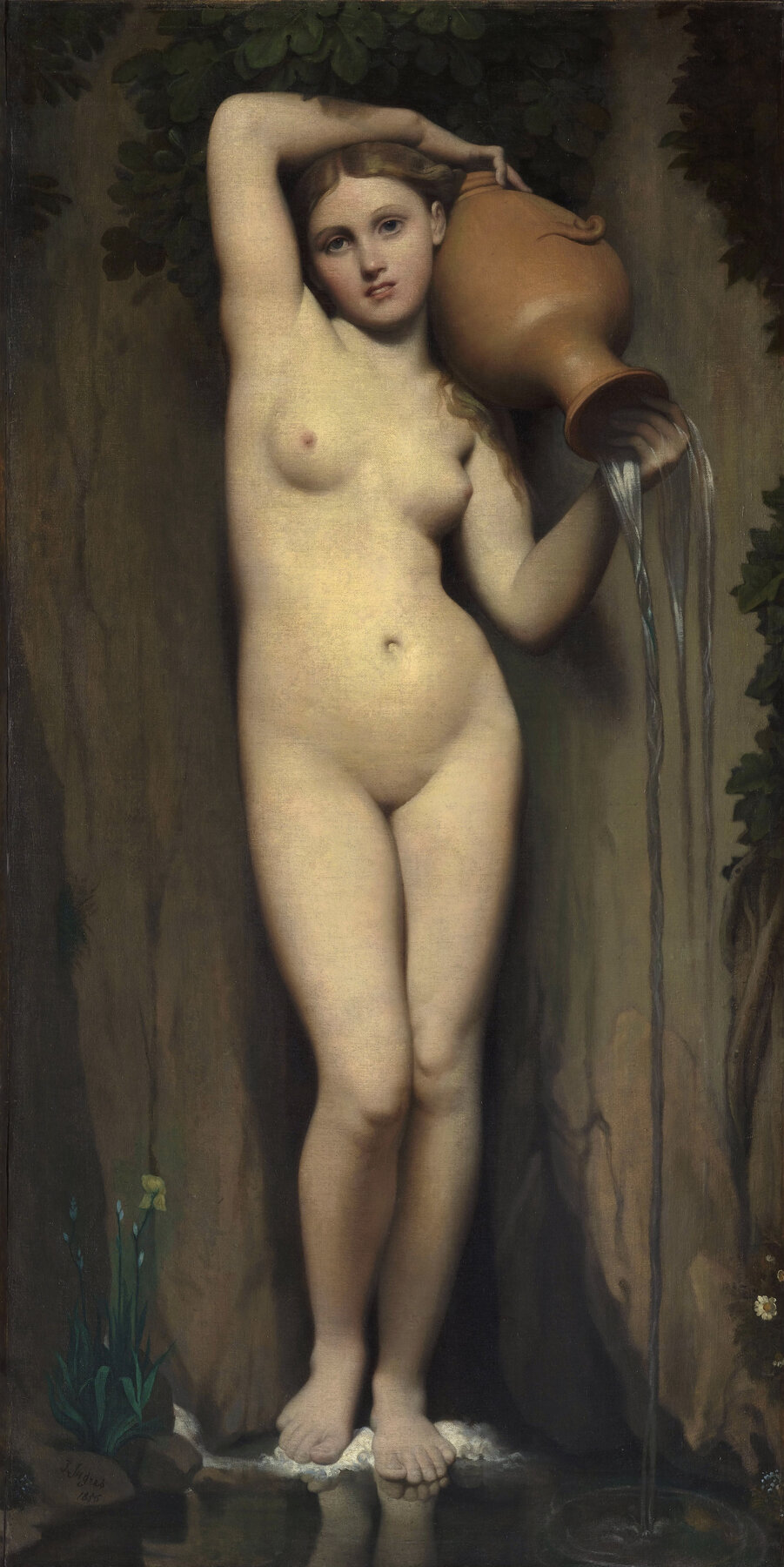
Forty-two years later, Ingres painted La Source (The Spring) \u2014 a standing nude pouring water from a pitcher, her body as perfect and unnatural as a Greek statue. Where the Odalisque was controversial, La Source was beloved. It became the most reproduced image of its age, a fixture in bourgeois parlors across Europe.
\n\n
The difference wasn’t that Ingres had learned anatomy. It was that he had refined his technique of idealization to the point where the distortions became invisible. La Source‘s proportions are as artificial as the Odalisque’s \u2014 the curve of her hip, the elongation of her torso, the way her weight balances on one foot like a figure in a frieze. But by 1856, the public had caught up with what Ingres was doing. They recognized the beauty even if they couldn’t name the geometry.
\n\n
\n\n
The Turkish Bath: The Final Gambit
\n\n
Ingres painted Le Bain Turc (The Turkish Bath) in 1862, when he was 82 years old. It’s a circular composition \u2014 a tondo \u2014 packed with more than twenty female nudes in various states of repose. The bodies overlap, intertwine, and melt into one another in a space that defies architectural logic. There’s no single focal point. The eye is meant to wander, to get lost.
\n\n
Critics were baffled. The painting had no story, no moral, no clear center of attention. It was pure spectacle \u2014 a celebration of the female nude as a visual event, stripped of narrative pretense. Ingres had spent his career defending the classical tradition, and then, in his final masterpiece, he produced something that looked forward to Matisse, to Picasso, to the abstracted bodies of the 20th century.
\n\n
When the painting was exhibited at the 1867 Exposition Universelle, the younger generation of artists understood immediately what Ingres had done. Degas copied it. Renoir studied it. Picasso would later cite it as a direct influence on Les Demoiselles d’Avignon.
\n\n
The Legacy of the Extra Vertebra
\n\n
Ingres died in 1867, but the question he raised \u2014 how much can you distort a body before it stops being a body? \u2014 never went away.
\n\n
Every artist who has pushed the boundaries of the nude since Ingres is working in territory he mapped. The elongation of Modigliani’s nudes. The compression of Matisse’s odalisques. The fragmentation of Picasso’s Demoiselles. Even the hyper-stylized bodies of contemporary fashion photography owe a debt to the man who decided that the spine could have a few extra bones if it made the image better.
\n\n
The critics who counted Ingres’s vertebrae were technically correct. The anatomy was wrong. But they missed the point entirely.
\n\n
Ingres wasn’t painting bodies. He was painting what bodies could be.
\n\n
\n\n
La Grande Odalisque (1814) and La Source (1856) by Jean-Auguste-Dominique Ingres \u2014 public domain images via Wikimedia Commons.
\n\n
Interested in exploring how artists transform the body on canvas? Discover more at NALA.