Two hundred and forty-one years ago today, on August 20, 1785, Jean-Baptiste Pigalle died in Paris at seventy-one. He was the most celebrated French sculptor of his century, the man who carved the tomb of a marshal of France and the marble busts of a king’s favorite. One work outlives all of them: a life-size statue of Voltaire, the greatest mind of the Enlightenment, carved completely naked in his old age. No god, no hero, no ideal youth. An old man’s body, every rib and wrinkle accounted for, presented as if it were a Greek athlete. The Salon of 1776 never quite recovered.
The ideal, mastered young
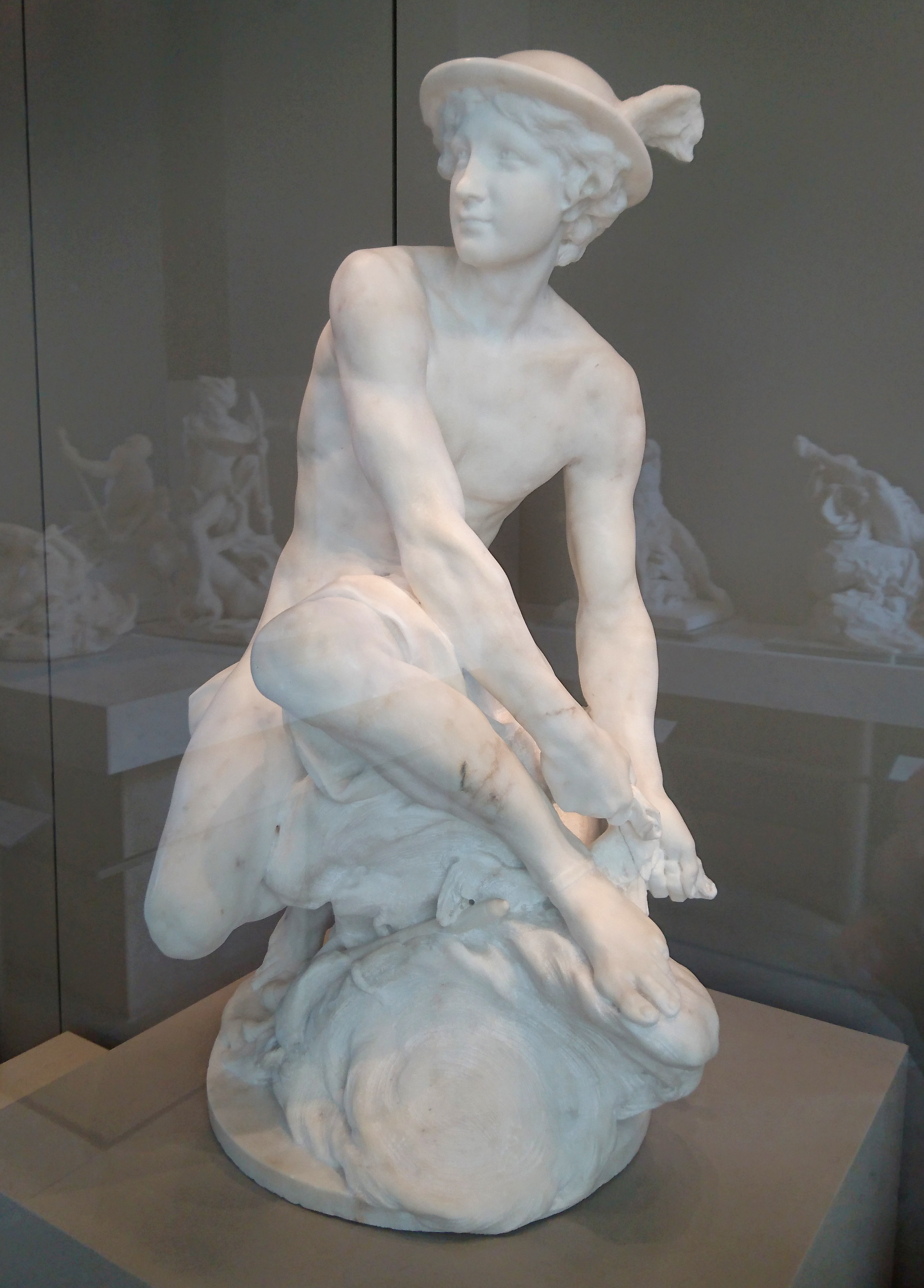
Pigalle earned his name with the body of a god. His reception piece for the Académie Royale, Mercury Attaching His Wings, completed in 1744, showed the messenger god bending low to tie a winged sandal, a study in coiled youth and perfect balance. This was the nude the French academy wanted: smooth, athletic, timeless, lifted out of any real body and into the realm of the ideal. Pigalle could deliver it as well as anyone alive, and that mastery is what made his later choice so radical. He knew the rules of the ideal nude because he had spent decades obeying them.
The commission that should never have produced a nude
In 1770 a circle of Voltaire’s admirers, the mathematician d’Alembert and the philosopher’s niece Madame Denis among them, resolved to commission a statue of the great man while he still lived. Pigalle traveled to Ferney, near the Swiss border, where Voltaire held court, and took measurements from the living philosopher, then in his mid-seventies. Then he made a decision that unsettled everyone involved: he would present Voltaire nude, in the antique manner, the pose the century reserved for gods, heroes, and the emperors of Rome.
The marble took six years. When it appeared at the Salon of 1776, the public met a seated philosopher on a rocky throne, a drape laid across his lap, a scroll in one hand. Every rib stood out. The skin sagged at the collarbone and the thigh. The chest was sunken, the shins thin as sticks. Critics compared the figure to a skeleton. Pigalle had taken the heroic nude, the highest form in the classical tradition, and used it to show a real, living, decaying body.
What the naked Voltaire argued
The scandal ran deeper than manners. The nude in Western art had always belonged to the young and the perfect: the Greek athlete, the Renaissance god, the rococo nymph. To wrap a naked body around the greatest intellect of the age, and to let that body be old, was a philosophical claim. The mind, Pigalle seemed to say, outlasts the flesh, and the flesh earns its monument even in decline. He refused to hand the Enlightenment a smooth, flattering idol. He handed it the truth: a genius is a body, and bodies age.
Contemporary accounts suggest Voltaire himself was more amused than offended by the audacity. The statue sat for years in the Institut de France before the Louvre purchased it in 1962, where an old man’s naked body now holds its ground among the ideal youths that crowd the galleries around it.
The full range of the body
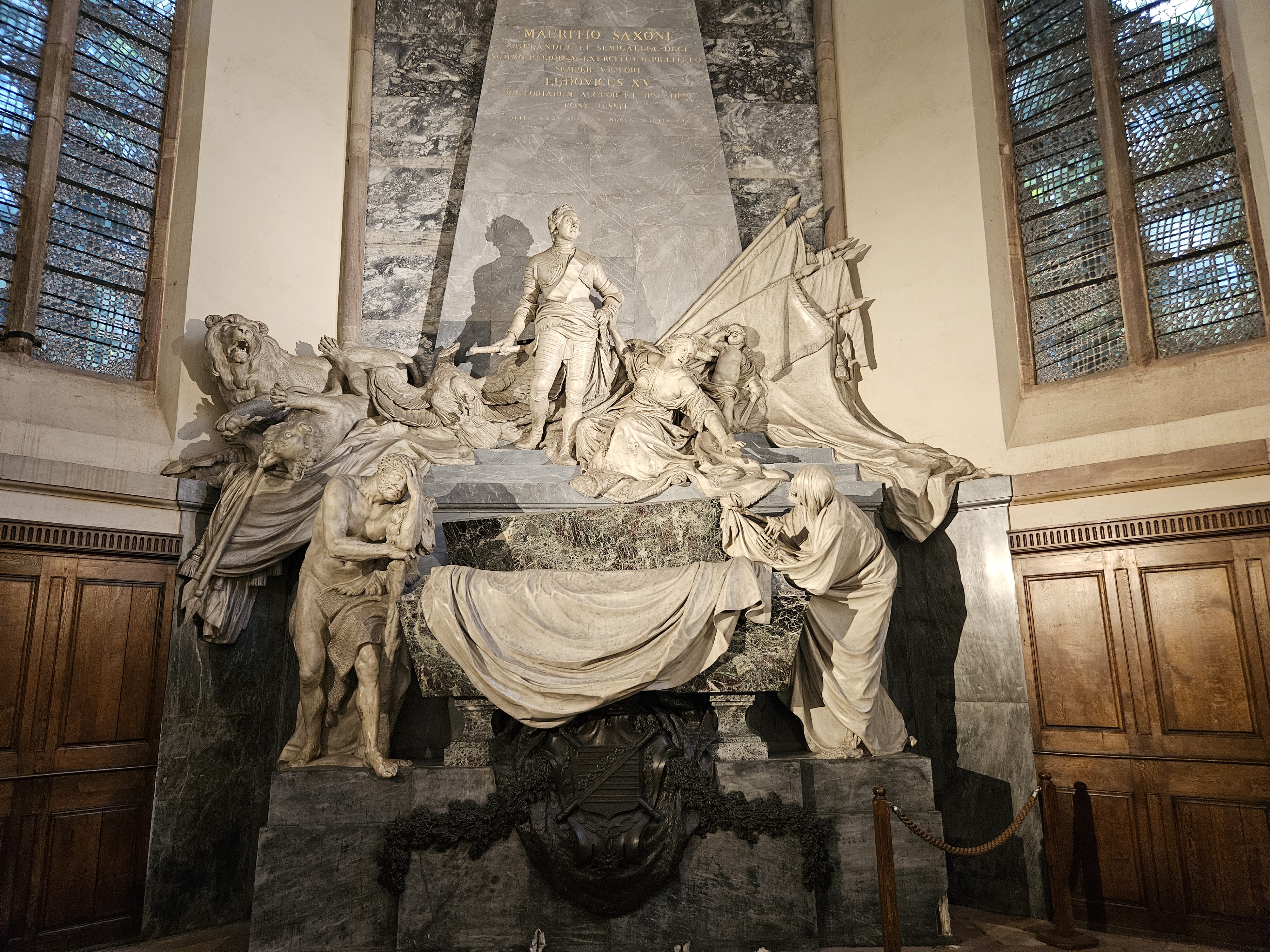
Pigalle’s engagement with the nude did not end with Voltaire. His acknowledged masterpiece, the tomb of Marshal Maurice de Saxe, finished the same year and installed in Strasbourg, is a theater of naked allegory. A grieving female nude personifying France tries to hold the dying marshal back as he descends toward an open tomb. Hercules mourns beside it. A skeletal Death waits at the coffin, its shroud slipping. On a single monument Pigalle deployed the nude in every register his century knew: the erotic, the heroic, the allegorical, and the mortal.
Why it still lands
Pigalle died just as the neoclassical ideal was tightening its grip on European sculpture, and the naked Voltaire has spent two centuries looking like a protest against it. We still argue over which bodies belong in the frame: the young, the fit, the conventionally beautiful. Pigalle answered early, and loudly, that a body’s truth matters more than its perfection. The mind that reshaped the modern world deserved a monument. The monument it received was a naked old man, unashamed, undefeated, and very much mortal.