A Forgotten Bridge Between Two Worlds
\n
If you know the name Joseph-Marie Vien at all, it’s probably as the footnote attached to a greater one: “teacher of Jacques-Louis David.” And it’s true \u2014 Vien was David’s master, the man who taught the future revolutionary painter everything he knew about composition, drawing, and the classical tradition. But reducing Vien to a footnote does him a grave injustice. Born 310 years ago today on June 18, 1716, Vien was the artist who single-handedly steered French painting away from Rococo’s sugary excess and toward the stern, noble nudity of Neoclassicism. He painted the body between two eras \u2014 and made it look effortless.
\n\n
From Rococo Pupil to Neoclassical Master
\n
Vien trained under Charles-Joseph Natoire, a Rococo painter of considerable skill. But unlike his contemporaries who chased Boucher’s rosy nudes and Fragonard’s playful eroticism, Vien looked backward \u2014 to Poussin’s noble severity, to Raphael’s clarity, to the recently excavated frescoes of Pompeii and Herculaneum. In 1743, he won the Prix de Rome and traveled to Italy, where ancient Roman sculpture and Renaissance frescoes permanently rewired his eye.
\n
What emerged was a style unlike anything else in mid-18th-century Paris: clean lines, restrained color, figures that moved with classical poise rather than Rococo flutter. Vien’s nudes didn’t tumble across the canvas in a cascade of pink flesh and billowing drapery. They stood.
\n\n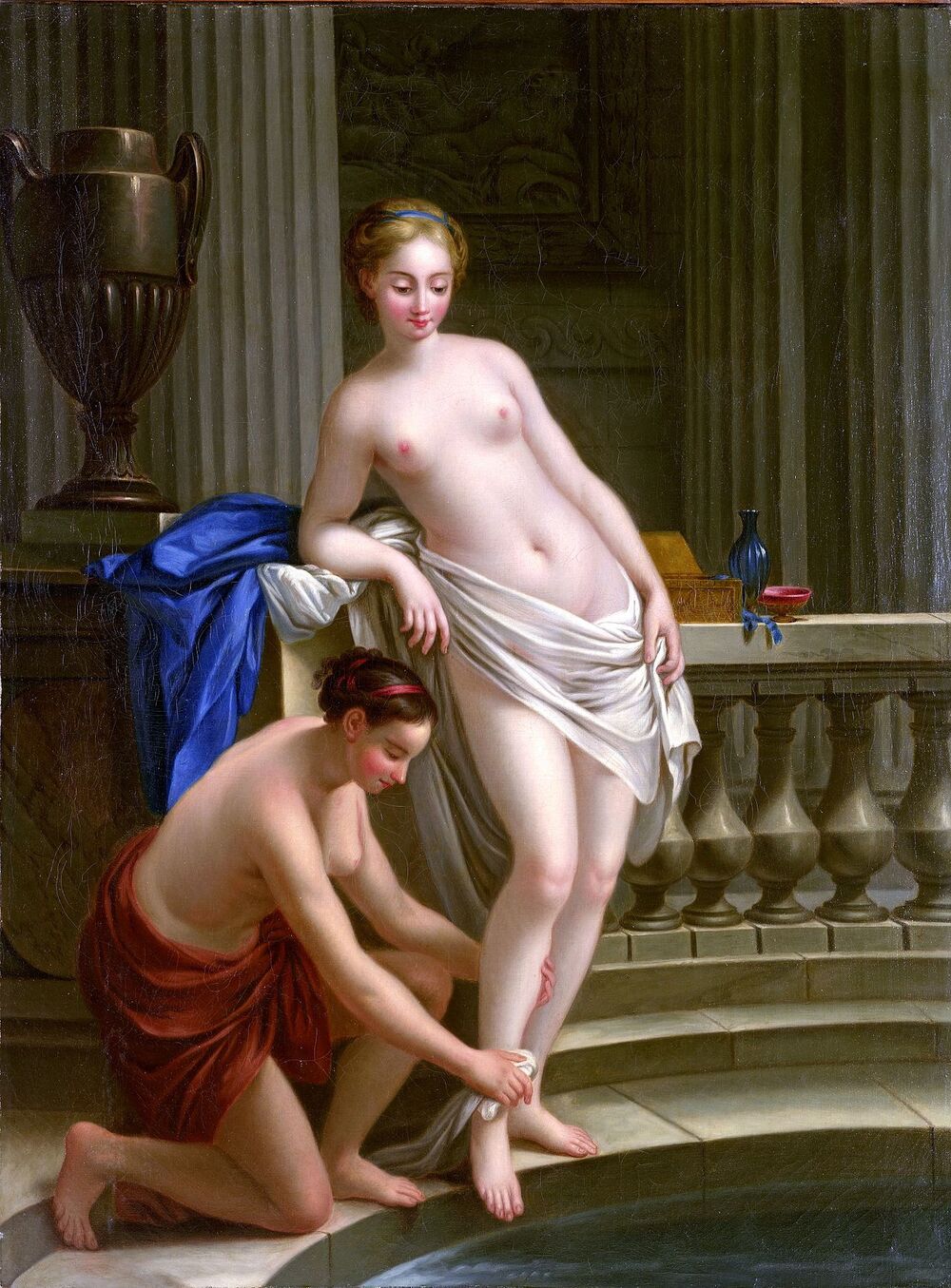 \n
\n
Joseph-Marie Vien, Greek Woman at the Bath, 1767. Oil on canvas. Wikimedia Commons. Public Domain.
\n\n
The Nude as History, Not Decoration
\n
Vien’s Greek Woman at the Bath (1767) is a perfect manifesto of his approach. The title alone announces a shift: this isn’t a mythological Venus or a biblical Susanna \u2014 it’s a mortal woman, bathing. The figure is modestly posed, torso turned, one breast exposed not for the viewer’s pleasure but as a natural part of the scene. The bath is domestic, classical, almost ethnographic in its specificity. Vien was making a deliberate argument: the nude could be historical, not merely decorative.
\n
This was a radical idea in the 1760s, when the French Academy still ranked history painting above all other genres. By dressing his nudes in Greek costume and placing them in classical interiors, Vien gave the female body the respectability of history \u2014 and in doing so, prepared the ground for David’s The Oath of the Horatii and The Death of Marat, paintings where the nude body carried moral weight.
\n\n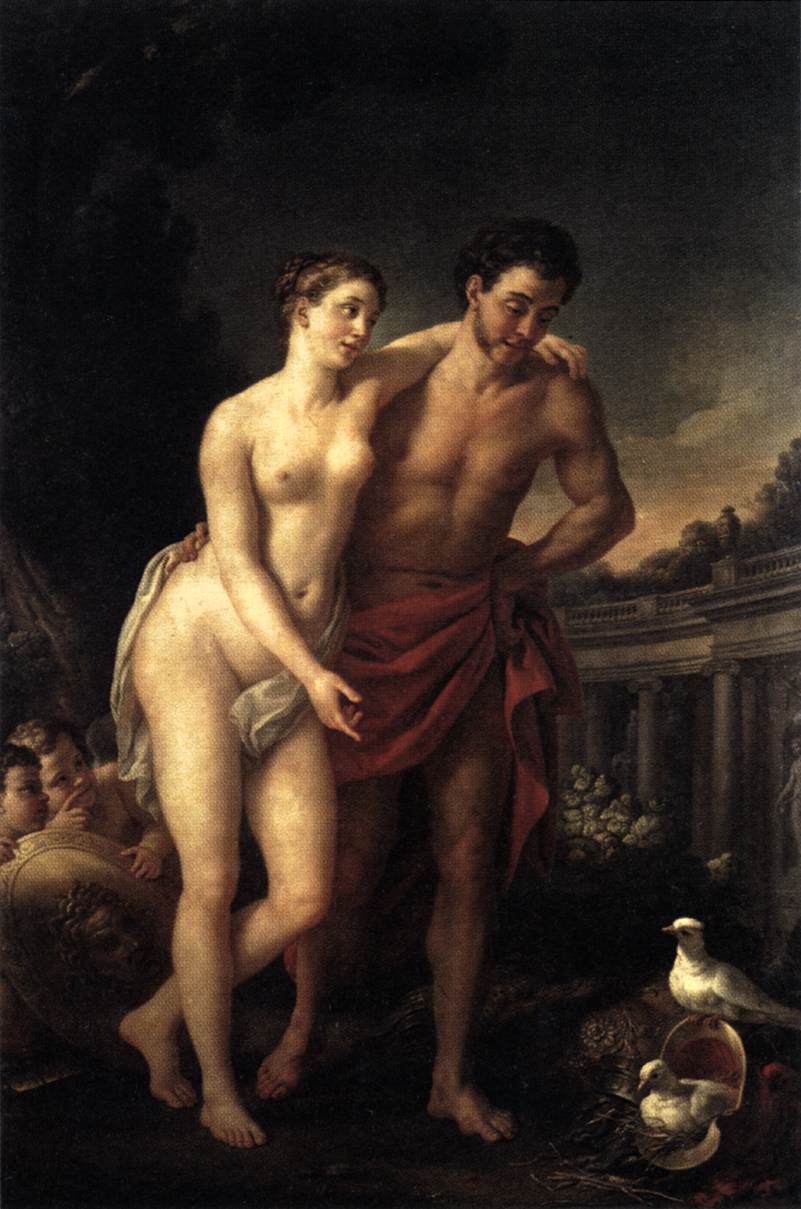 \n
\n
Joseph-Marie Vien, Venus Showing Mars her Doves Making a Nest in his Helmet, 1768. Oil on canvas. Wikimedia Commons. Public Domain.
\n\n
Love in the Time of Neoclassicism
\n
In Venus Showing Mars her Doves Making a Nest in his Helmet (1768), Vien shows us his lighter side \u2014 while still painting a Neoclassical nude. Venus, the goddess of love, points toward doves nesting in her lover’s war helmet, a domestic allegory about love taming violence. The composition is elegant and witty, but look at the bodies: Venus is modeled with classical sculptural solidity, not Rococo softness. She could be a statue from the Louvre’s antiquities collection come to life. Mars, too, has the muscular proportions of a Roman warrior god rather than a powdered courtier.
\n
Vien understood something his Rococo contemporaries missed: that the nude’s power doesn’t come from how much skin you show, but from how you frame the body within form and meaning. A Vien nude is never a pin-up. It’s always a statement.
\n\n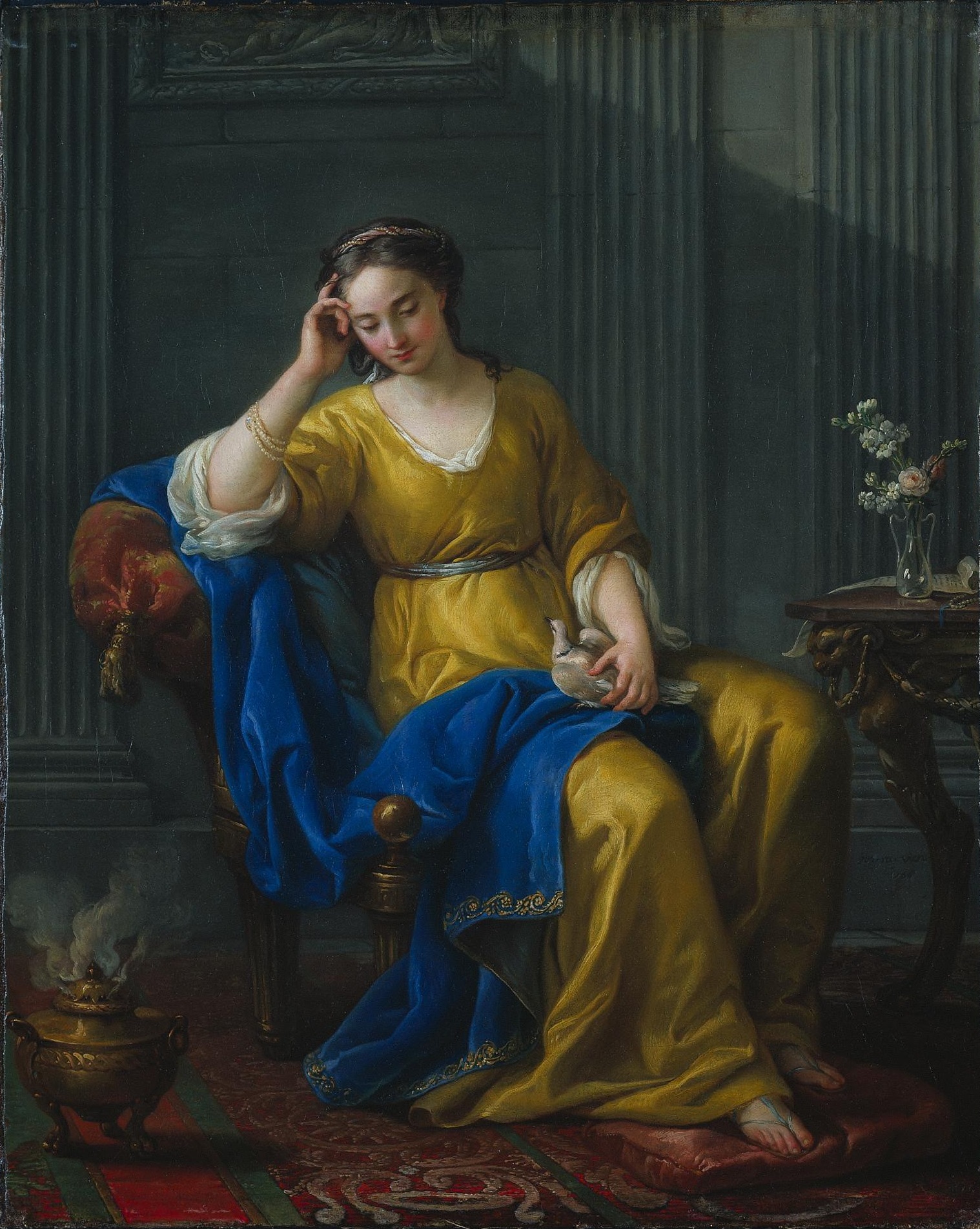 \n
\n
Joseph-Marie Vien, Sweet Melancholy, 1756. Oil on canvas. Wikimedia Commons. Public Domain.
\n\n
The Body in Thought
\n
Sweet Melancholy (1756) is perhaps Vien’s most tender nude. A young woman sits in quiet contemplation, her body half-draped, head resting on her hand in the classic pose of melancholic reflection. The painting is intimate without being invasive \u2014 we’re not voyeurs here, we’re companions to her solitude. The exposed shoulder and breast are incidental to the emotional state being depicted. Vien had mastered the art of making nudity secondary to narrative, a skill he passed directly to David and, through David, to the entire Neoclassical tradition.
\n\n
Why Vien Matters Now
\n
Art history loves its revolutions, but it often forgets the quiet revolutionaries who made them possible. Without Vien’s steady, patient work in the 1750s and 1760s \u2014 his classical subjects, his dignified nudes, his insistence that the body could carry moral and historical weight \u2014 there would have been no David, no Ingres, no Oath of the Horatii, no Grande Odalisque. The Neoclassical nude was built on Vien’s foundation.
\n
Today, as we reconsider which bodies get to be “historical” and which are merely decorative, Vien’s project feels unexpectedly current. He asked a question we’re still asking: How do we paint the body with dignity, not exploitation?
\n
Three hundred and ten years after his birth, Joseph-Marie Vien’s answer is still worth looking at.
\n