Jules Pascin Died 96 Years Ago Today. The Prince of Montparnasse Who Painted Nudes Like Confessions.
\n\n
On June 5, 1930, the body of Jules Pascin was discovered in his Montparnasse studio. He had written a farewell note in his own blood on the wall. He was 45 years old. That same day, a major exhibition of his work opened in Paris \u2014 a coincidence so cruel it feels staged.
\n\n
Pascin was the prince of Montparnasse, the gentle, haunted center of the School of Paris. Alongside Modigliani, Soutine, and Chagall, he helped define an era when Paris was the capital of modern art and the nude was its most urgent subject. But unlike the muscular certainty of a Matisse odalisque or the cool geometry of a Picasso, Pascin’s nudes feel like whispers. They are intimate, melancholic, and radically vulnerable.
\n\n
His subjects \u2014 models, prostitutes, lovers, and the women of Havana and Tunis \u2014 are never posed as goddesses or allegories. They exist in a private, unguarded space. A girl sleeping. A woman dressing. A model stretching after a long sitting. Pascin captured not the idealized nude but the unobserved nude \u2014 the body caught in a moment that was never meant to be seen.
\n\n
The Wandering Apprentice
\n\n
Born in Vidin, Bulgaria in 1885 to a Sephardic Jewish family, Pascin (born Julius Mordecai Pincas) fled his hometown’s provincial strictures as a teenager, landing in Vienna, then Munich, then Berlin. He drew constantly \u2014 in cafes, brothels, and cabarets \u2014 and his early work as a cartoonist for satirical magazines like Simplicissimus gave him a line that was quick, mercilessly observant, and graceful.
\n\n
By 1905 he had moved to Paris, the gravitational center of every ambitious young artist. He adopted the name Pascin (an anagram of Pincas) and dove headfirst into the scene at Le D\u00f4me Caf\u00e9, where Picasso, Modigliani, and Hemingway traded drinks and insults. He was small, handsome, and famously generous \u2014 financially supporting other artists even when he was broke himself. Hemingway called him “a very good painter” and “a very unhappy man.”
\n\n
The Nude as a Record of Looking
\n\n
Pascin’s nudes stand apart from the two dominant traditions of the early twentieth century. He rejected both the academic ideal (the salon nude as a polished Venus) and the Expressionist assault (the nude as a raw nerve exposed). His approach was closer to what we might call phenomenological \u2014 he painted the experience of looking at a body, not the body as an object.
\n\n
\n\n
“A Pascin nude always seems slightly sad,” wrote the critic Andr\u00e9 Salmon, “not because the model is sad, but because flesh itself, when truly seen, is a sad and beautiful thing.”
\n\n
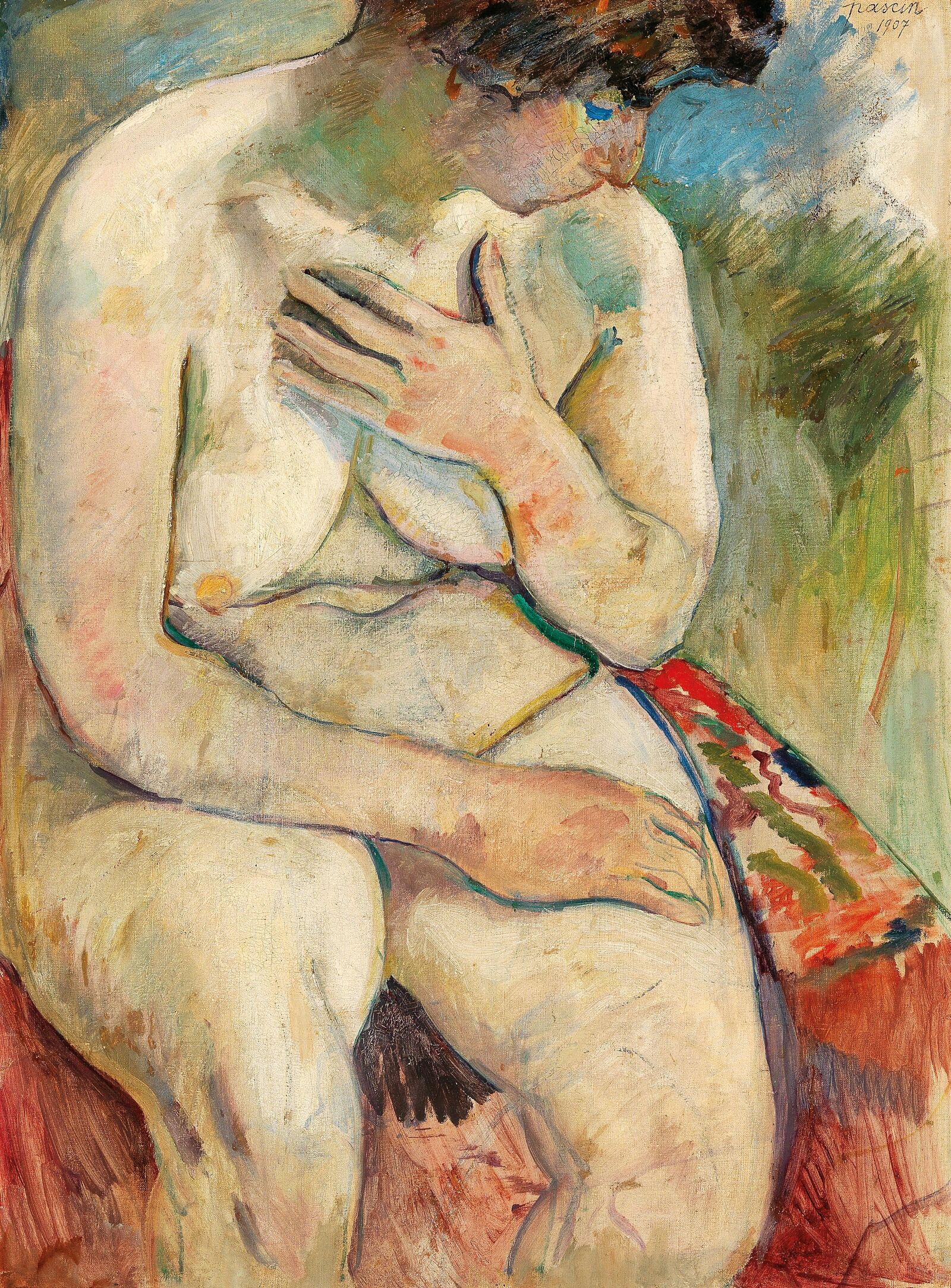
His line is everything. Look at Seated Nude \u2014 a woman rests in a chair, her weight shifted to one hip, one arm draped, her face turned away. The contours feel almost sketched, as if Pascin caught her between poses and decided that moment was the only one worth recording. The skin is luminous but not idealized \u2014 there are shadows under the breasts, a soft fold at the waist, the particular slump of a body that has stopped performing.
\n\n
His palette \u2014 pale pinks, translucent grays, lavender shadows, muted greens \u2014 gives his nudes the quality of watercolor even when he used oils. They feel fragile, as if one strong word would dissolve them.
\n\n
Cuba and the Composition of Nudes
\n\n
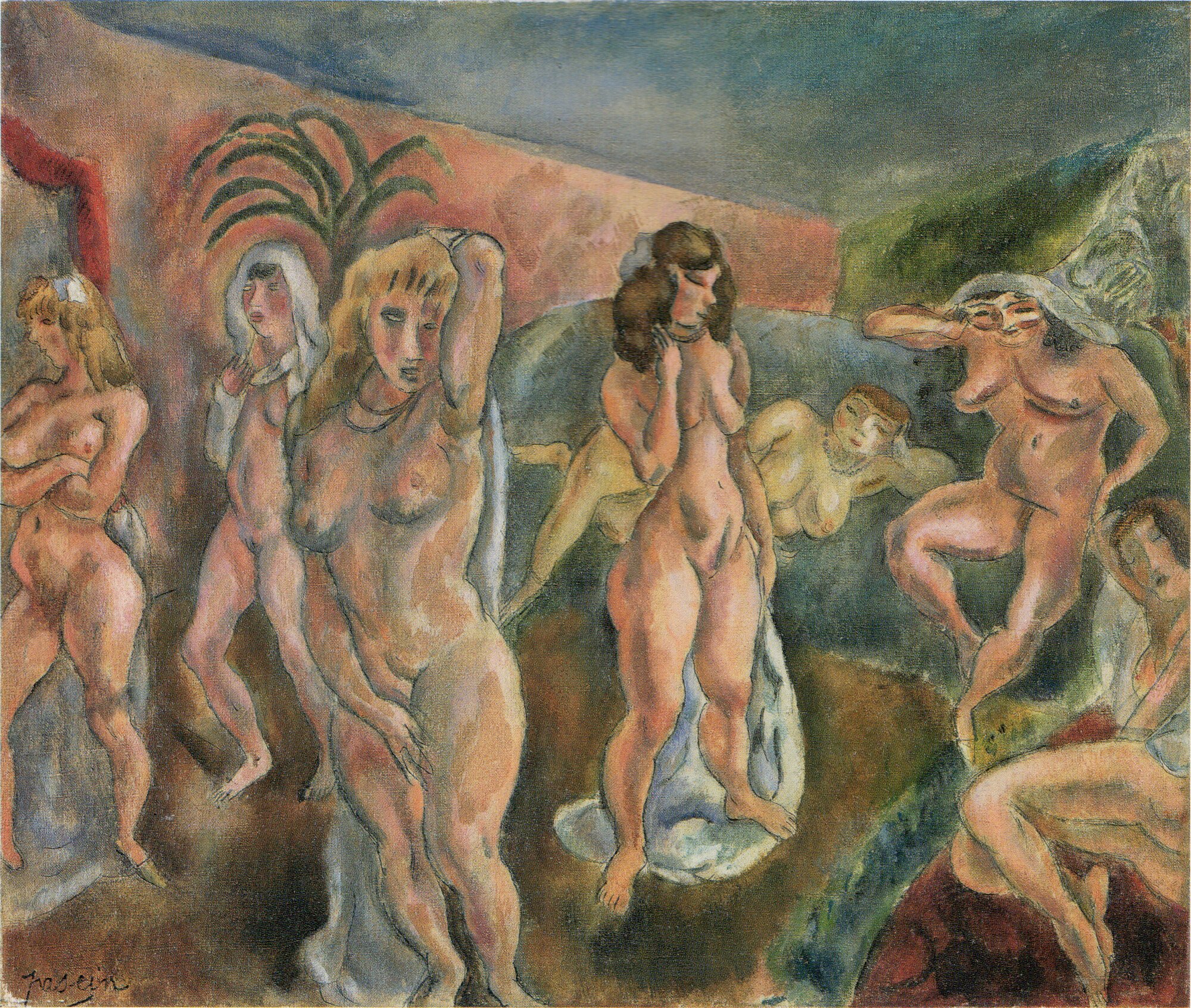
During World War I, Pascin fled to the United States and eventually to Cuba, a period that produced some of his most ambitious works. Composition of Nudes (1915) is a tangle of bodies \u2014 women resting, talking, sleeping, existing together in a humid, tropical interior. It has none of the orchestrated erotic tension of a harem scene or a classical bacchanal. Instead, it feels like a hot afternoon in a room full of people who have forgotten they are being watched.
\n\n
\n\n
The Cuban work also deepened his color. The pinks got warmer, the shadows more violet. But the sensibility remained: Pascin was not interested in possession. He wanted to document the sheer fact of other bodies sharing space, breathing together, unaware of the gaze upon them.
\n\n
The Final Year
\n\n
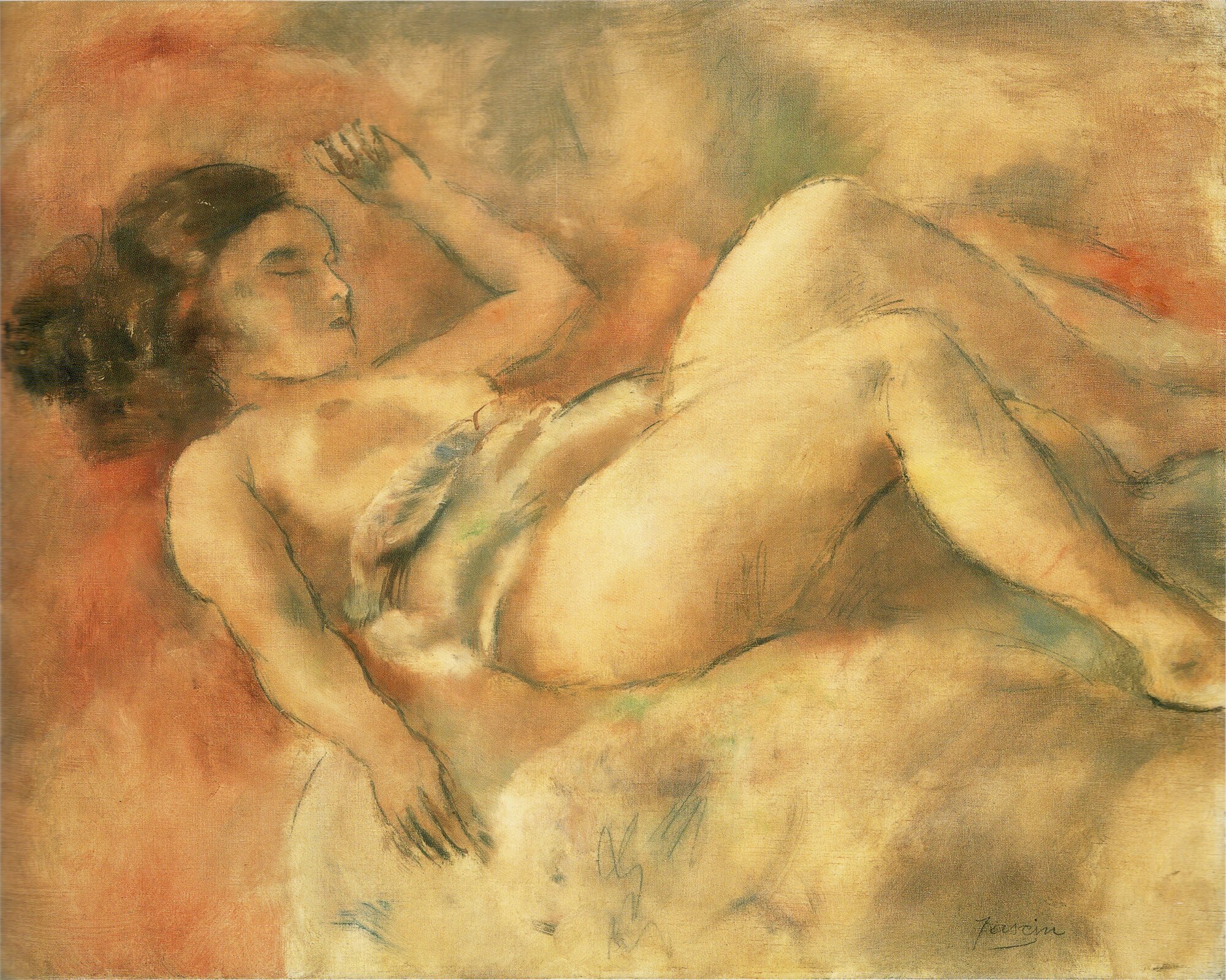
The late 1920s were cruel to Pascin. His health deteriorated. His marriage to artist Hermine David was strained. He drank heavily. The market for his work collapsed with the Depression. And yet his painting only grew more tender. Sleeping Naked Girl (1928) is one of his most devastating works \u2014 a young woman curled on her side, her face soft in sleep, her body utterly defenseless. It is not a nude. It is a portrait of trust.
\n\n
\n\n
On June 3, 1930, Pascin told a friend: “I am tired of painting the nude. I have been painting it for twenty-five years, and I have never once painted what I really see.” Two days later, he was dead. The exhibition that opened that same day became a memorial.
\n\n
Legacy: The Nude as Confession
\n\n
Pascin’s influence on the School of Paris is undeniable, but his longer legacy is harder to pin down. He doesn’t fit neatly into any movement \u2014 not quite Fauvist, not quite Expressionist, not quite anything but Pascin. His nudes don’t make a political argument, like Manet’s Olympia. They don’t perform a philosophical investigation, like C\u00e9zanne’s bathers. They simply see, with an attention that feels almost unbearable.
\n\n
What Pascin understood \u2014 and what his contemporaries often missed in their rush to master, distort, or deconstruct the nude \u2014 is that the naked body is not a subject to conquer. It is a condition to share. His paintings don’t show us nudes. They show us people who happen to be unclothed, and in doing so, they remind us that nudity is not a costume. It is the default state of being human.
\n\n
Pascin died 96 years ago this week. His work is in the public domain and held by museums worldwide including the Centre Pompidou, the Art Institute of Chicago, the Barnes Foundation, and the Mus\u00e9e de Grenoble.
\n\n
\n
Explore more about the nude in modern art, censorship in art history, and the artists who risked everything to paint the body honestly. Join NALA’s mission to keep nude art visible, discussed, and defended.
\n