Julia Margaret Cameron was 48 years old when she received her first camera. It was 1863 — a gift from her daughter, meant to give the restless matriarch something to do while her husband and sons were away in Ceylon. What happened next was nothing short of revolutionary: a woman in late middle age, with no formal training, picked up an unwieldy wooden box and proceeded to reinvent what photography could be — including what it could show of the human body.
The Most Unlikely Photographer in Victorian England
Born on June 11, 1815, in Calcutta to a British official and a French aristocrat, Julia Margaret Cameron was raised in a world of literature, art, and high society. She was the sister of Virginia Woolf’s mother (Woolf would later edit Cameron’s memoirs) and a close friend of Alfred Lord Tennyson, who lived next door on the Isle of Wight. Her social circle included the Pre-Raphaelite painters Dante Gabriel Rossetti, John Everett Millais, and Edward Burne-Jones, as well as the scientists Charles Darwin and John Herschel (who coined the word “photography”).
When she took up photography at 48, she had no technical knowledge — and she treated that as a feature, not a bug. She wanted art, not documentation. She wanted soul, not sharpness.
The Nude Body in Soft Focus
Cameron’s approach to the nude was radically different from the academic tradition. While Victorian painting still leaned on classical allegory to justify nakedness — a nymph here, a goddess there — Cameron’s photographs stripped away the pretense. She photographed her maids, her friends, and her neighbors as Venus, as Cupid, as Endymion, as angels. The mythological framing was there, but the bodies themselves were startlingly real.
Her soft-focus technique — achieved by using a lens with no diaphragm, a makeshift cardboard pinhole, and long exposures that sometimes ran five minutes — created an ethereal quality that her critics called “careless” and her admirers called “spiritual.” The resulting images were dreamlike, intimate, and deeply corporeal all at once.
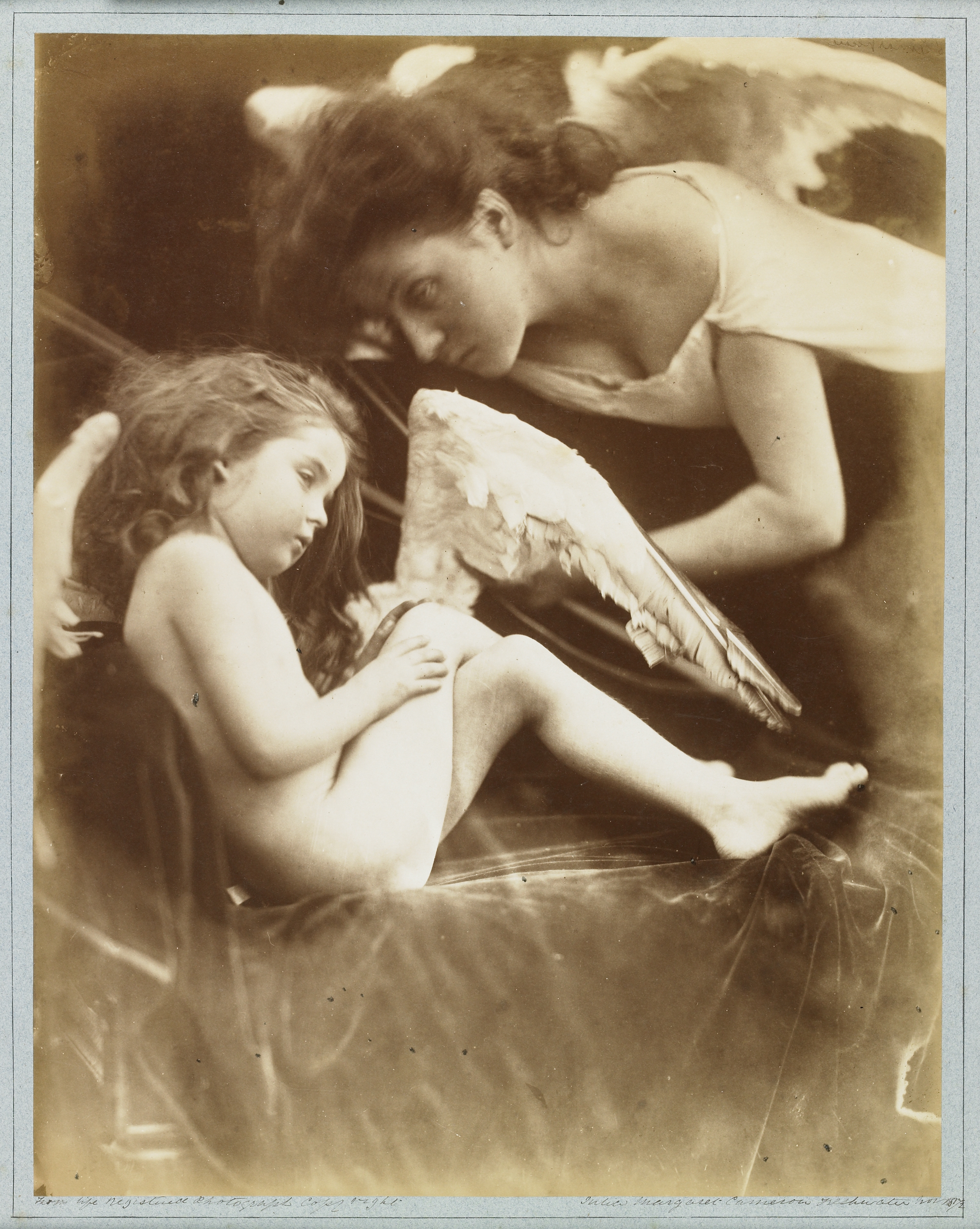
In Venus Chiding Cupid and Depriving Him of His Wings (1873), Cameron photographed a young woman in the role of the goddess of love, her bare back turned to the camera, her arm raised in gentle reprimand to a winged child. The image is at once a classical allegory and a domestic scene — the body presented not as an idealized marble figure but as a living, breathing presence.
Endymion: The Male Nude as Pure Poetry
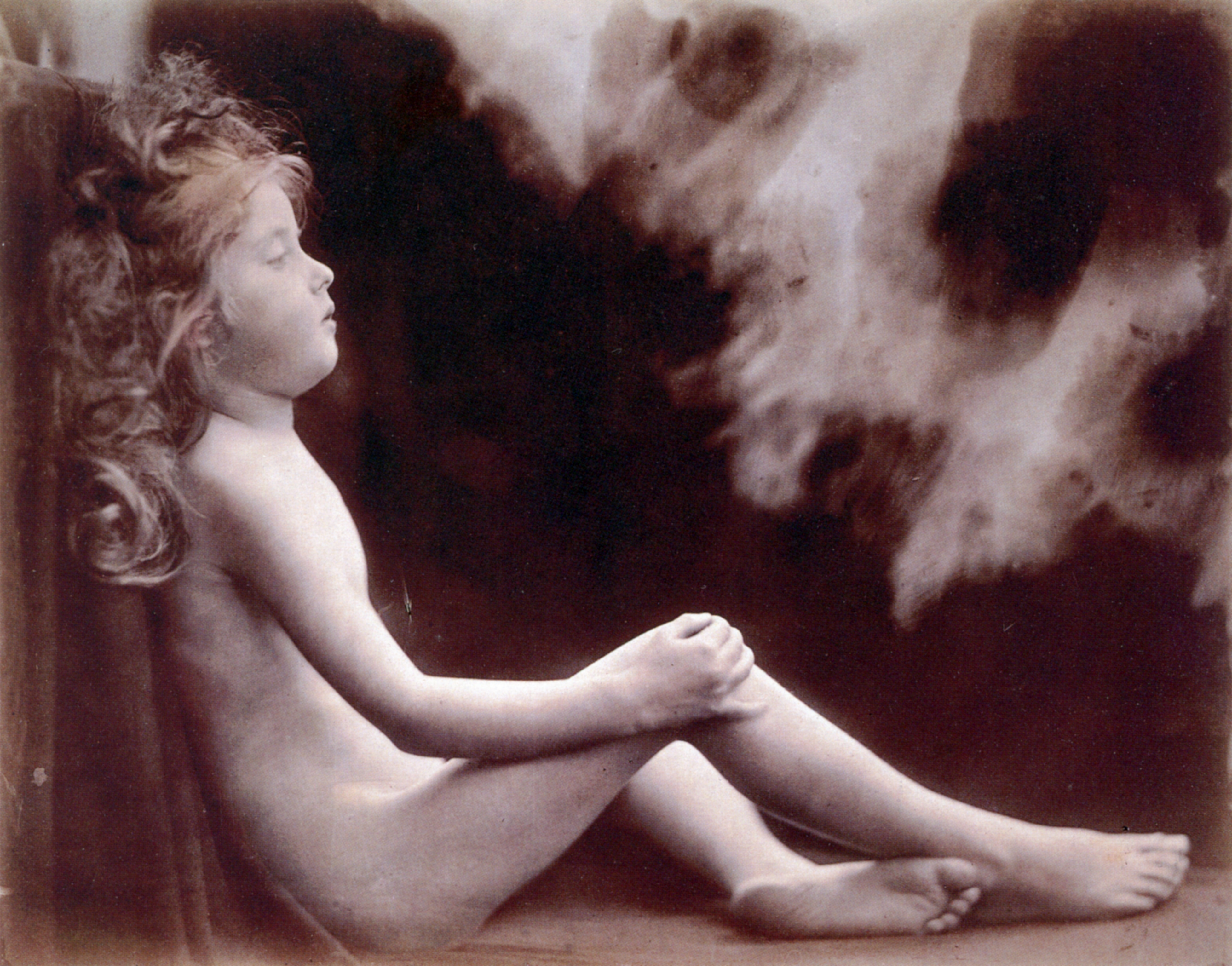
Perhaps Cameron’s most daring work was The Young Endymion (1872), depicting the mythological shepherd so beautiful that the moon goddess Selene cast him into eternal sleep so she could gaze upon him forever. Cameron’s Endymion is a young man, completely nude, sprawled across a rocky landscape in a pose of vulnerable slumber. The soft focus transforms his body into something almost painterly — flesh rendered as light, muscle as shadow.
For a Victorian audience, the male nude was far more transgressive than the female. The female body had centuries of allegorical cover — Venus, Eve, Mary. The male nude, stripped of classical distance, was simply a man, exposed. Cameron’s decision to photograph him not as a god in battle but as a sleeping youth — passive, beautiful, available to the gaze — was quietly radical.
Die Vectianische Venus: The Goddess as Woman
In her study known as “Die Vectianische Venus” (the Vectian Venus — named for the Vectis region of the Isle of Wight where she lived), Cameron photographed a woman draped in fabric but with her shoulders, neck, and collarbone bare — the composition hovering between modesty and revelation. It’s typical Cameron: the myth is the excuse, but the woman is the subject.
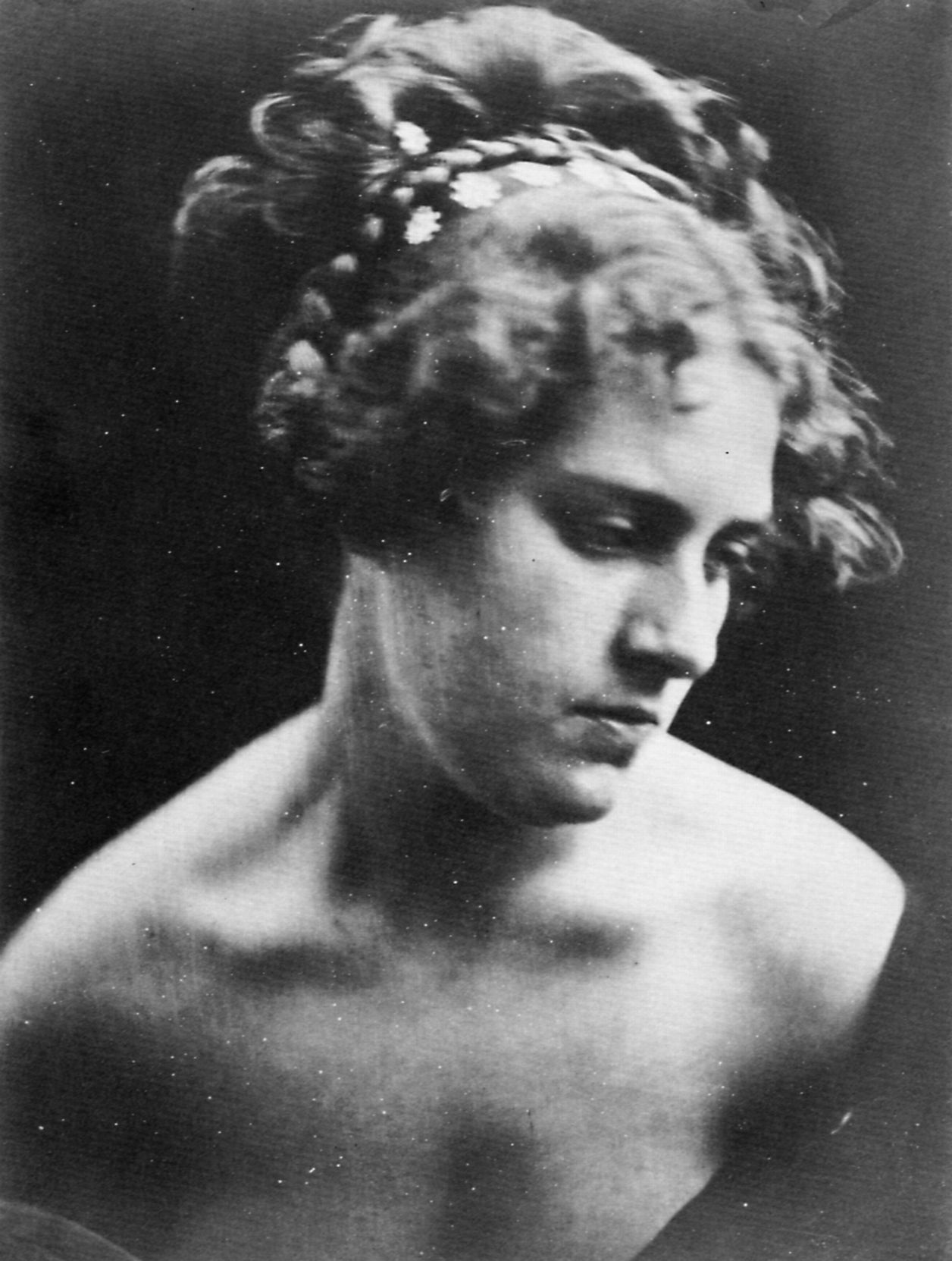
The Vectian Venus is not a classical goddess. She looks tired. She looks human. She looks like someone’s neighbor who agreed to sit for a crazy experiment with a homemade camera. And that’s precisely the point.
Controversy and Legacy
Cameron’s nudes scandalized Victorian sensibilities — not because they were explicit (by today’s standards, they are remarkably chaste), but because they were photographs. A painted nude was art. A photographed nude was a real person, and that was another matter entirely. The Victorians understood implicitly what Roland Barthes would later articulate: a photograph carries an indexical trace — the body in the image was really there, in front of the lens.
This is Cameron’s overlooked contribution to the history of the nude in art. She did not invent the photographic nude (Daguerre’s models had already posed), but she was the first to treat it as art on equal footing with painting. She insisted that the camera could produce not just records but visions — that a photograph could be as transporting, as sensual, as spiritual as a canvas by Titian or a drawing by Michelangelo.
Today, her work is held by the Metropolitan Museum of Art, the National Gallery of Art, the J. Paul Getty Museum, and the Victoria and Albert Museum. She has been the subject of major retrospectives at the Smithsonian and the Science Museum in London. And the photographs that her contemporaries dismissed as “out of focus” now look like what they always were: images seen through a different kind of clarity — one that saw the body not as an object to be documented but as a presence to be felt.
Why Cameron Matters Now
In an age of AI-generated images and hyper-filtered digital bodies, Cameron’s soft-focused, slow-exposure nudes feel more radical than ever. They remind us that the body in art is not about perfection — it’s about presence. It’s about the time it takes to sit still and be seen. It’s about the willingness to show up, in front of a lens that cannot lie, and let the light do its work.
Julia Margaret Cameron didn’t just photograph nudes. She gave the female — and the male — body a new kind of permission: to be imperfect, to be real, to be soulful. And she did it at 48, with a camera that barely worked, in a world that told her photography wasn’t art and art wasn’t for women.
She proved them wrong on all counts.
Want to see more of Cameron’s groundbreaking work? Browse our collection of art history posts here.