Kazimir Malevich Died 91 Years Ago Today. The Man Who Painted the Nude, Then Erased It — and Changed Art Forever.
May 15, 1935. On this date, Kazimir Malevich died in Leningrad at 56 — largely forgotten by the state he’d helped revolutionize, buried in a Suprematist coffin of his own design. Today, we remember the avant-garde radical who painted one of the most famous nudes nobody talks about, and then painted a black square over everything he’d learned.
Before there was a black square, there was a body. Before Malevich became the high priest of nothingness — before Suprematism, before the geometric void — he was a painter of flesh.
And not just any flesh. The nude.
The Nude That History Forgot
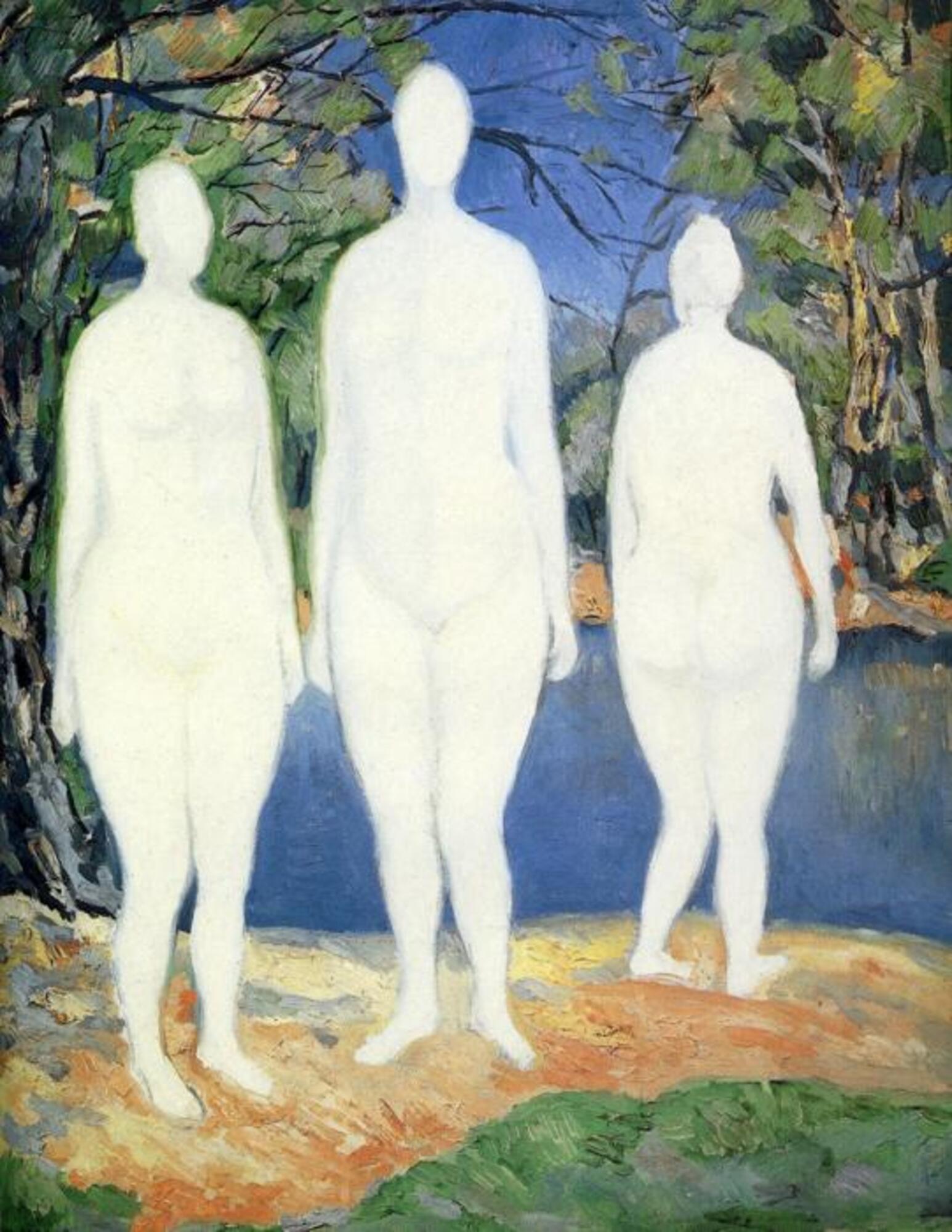
In 1908, Malevich painted Three Bathers. It’s the painter’s only known treatment of the classic bathing nude — three women at the edge of water, their bodies rendered in the decorative, symbolist style that Malevich had absorbed from Mikhail Vrubel and the Russian Art Nouveau tradition. The painting is sensual, lyrical, fully committed to the human form.
It’s also, in hindsight, a farewell.
Because Malevich was already in motion. The year after Three Bathers, he began experiments with Post-Impressionism and Fauvism. By 1911, his Floor Polishers had flattened the figure into near-geometric planes. By 1912, his Knifegrinder had shattered it entirely into glittering Cubo-Futurist fragments.
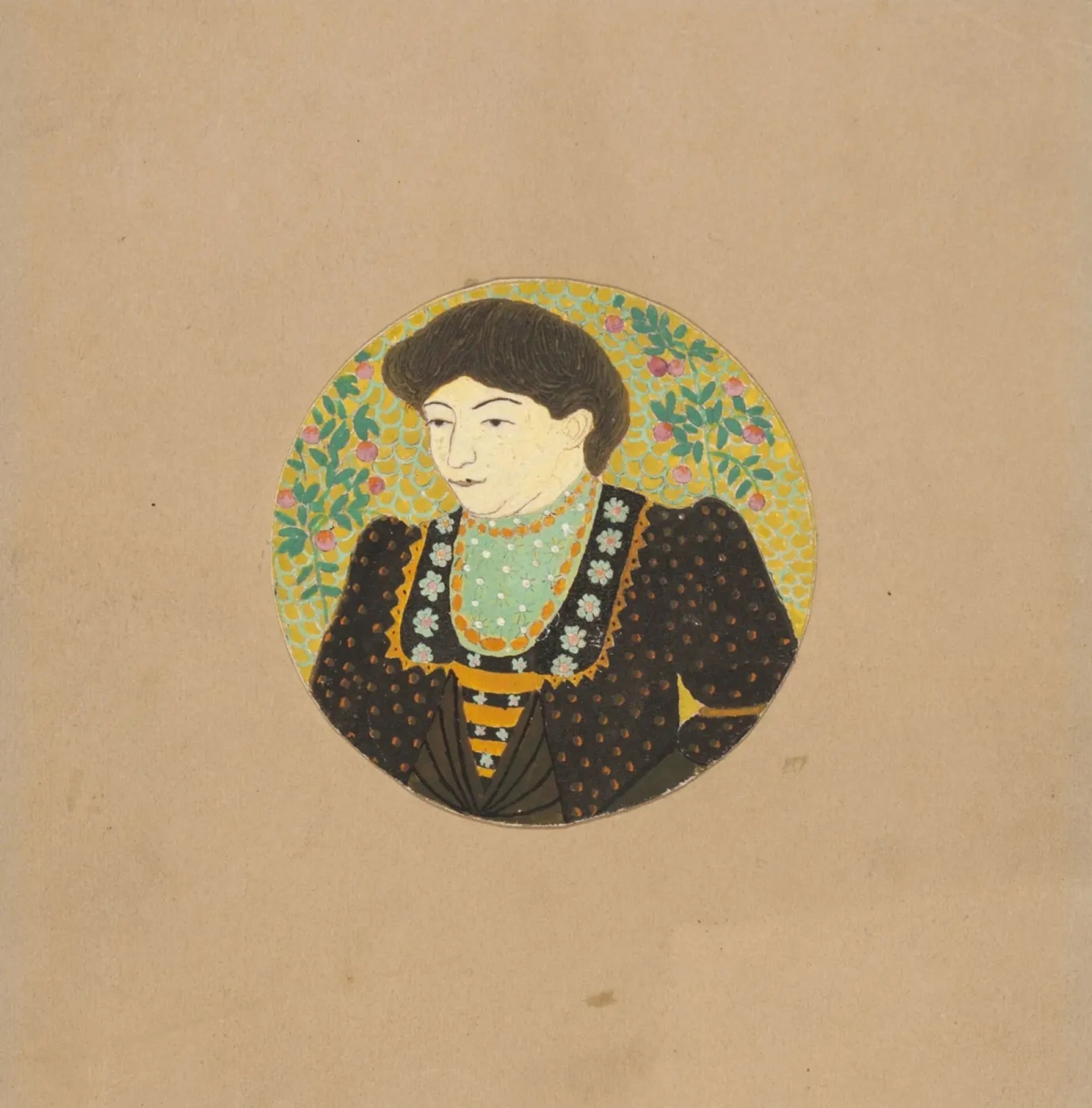
The Bust of a Woman (ca. 1908) sits at the pivot point. You can see the tug-of-war in a single canvas: the Art Nouveau curving line of the shoulder, the decorative floral background — and then the dark, almost crude simplification of the face. The figure is one foot in representation, one foot out the door.
The Great Erasure
What came next is the most radical single move in modern art. In 1915, at the 0.10 Exhibition in Petrograd, Malevich hung Black Square high in the corner — the traditional location for an Orthodox icon. He had replaced the saint with a hole. He had replaced a millennium of human figuration with a monochrome rectangle.
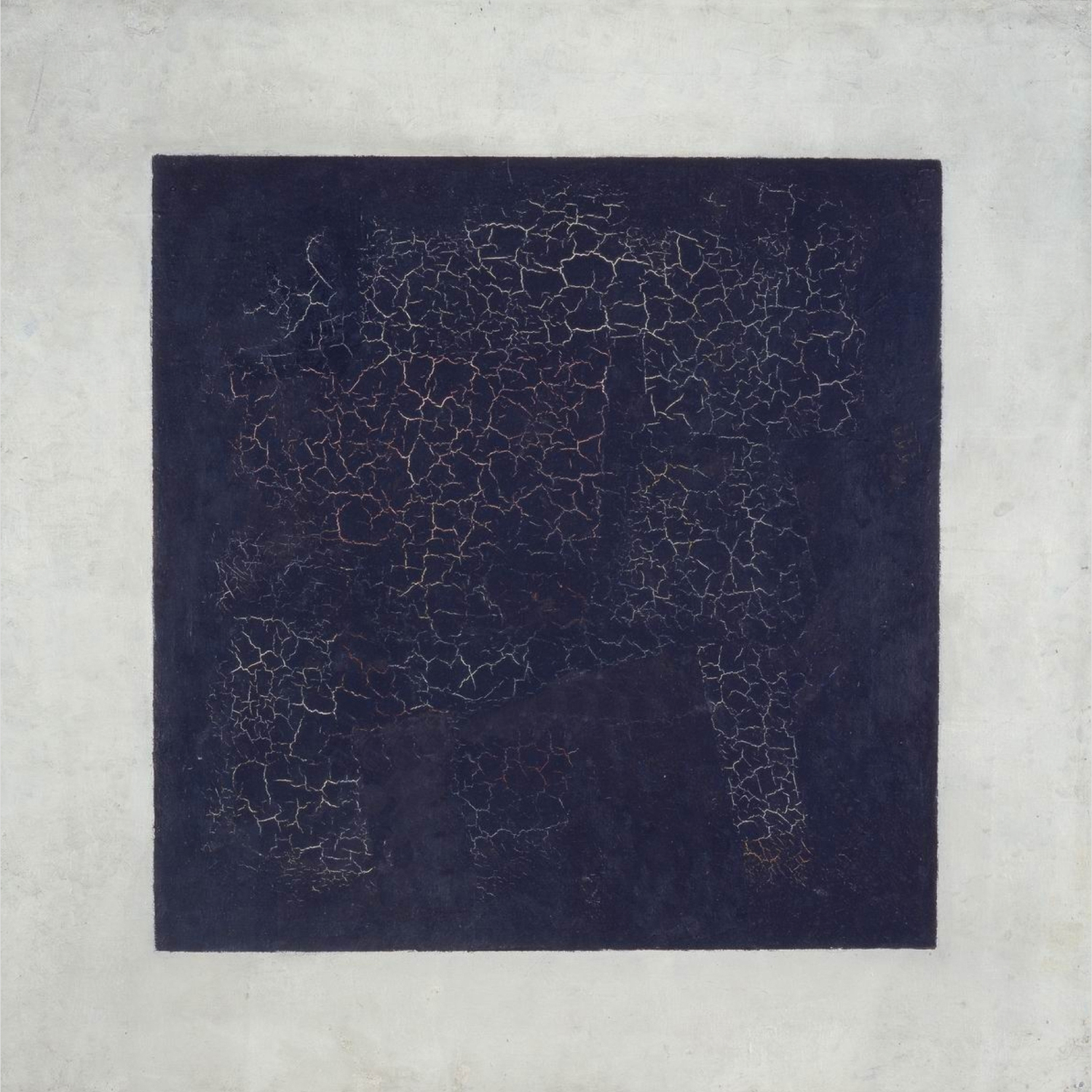
Malevich called it the zero of form — the point at which painting stops representing anything outside itself and becomes pure sensation. The nude body, the landscape, the portrait, the still life: all of it was, he believed, so much dead weight. Art had been carrying the world on its back for 500 years. Black Square was the moment it finally put the world down.
The Body Problem in the Age of Abstraction
Malevich’s trajectory poses an uncomfortable question for anyone who cares about the nude in art: Is the human body a constraint on what painting can do?
The answer, of course, is yes — and that’s the point.
What made Malevich’s move so radical wasn’t that he discovered abstraction; it’s that he understood the nude as the final anchor keeping art tethered to the visible world. For centuries, the nude had been the gold standard of artistic ambition. You weren’t a serious painter until you’d proven you could render the human form. The nude was the exam, the credential, the proof.
And Malevich said: fine. Let’s take a different exam.
This is not an argument against the nude. It’s an argument for understanding how world-shattering abstraction was — and what it took from us. When Malevich painted Black Square, he didn’t just invent a style; he abolished a subject. The body, which had been the central subject of Western art since the Greeks, was now optional.
More than a century later, that’s still the fault line running through contemporary art. Some artists return to the figure as an act of defiance. Others abandon it as an act of liberation. Malevich was the first to force the choice.
Legacy: The Nude After Zero
Malevich died in obscurity under Stalin, his work banned, his theories denounced as bourgeois formalism. It would take decades for the West to rediscover what he’d done. But by then, the damage — or the gift — was already done.
Every artist who paints the nude today does so knowing that they could paint a black square instead. The choice to paint the body is no longer the default. It’s a decision. A provocation. A posture. Malevich made it that way.
He didn’t kill the nude. He just proved it was possible to live without it.
We’re still deciding which world we prefer.
Kazimir Severinovich Malevich was born February 23, 1878, near Kyiv and died May 15, 1935, in Leningrad. He was 56. His body was cremated, and his ashes were buried near his dacha in Nemchinovka — but his black square is immortal.
Like this deep dive into art history? Follow Nude Art LA for daily explorations of the nude across centuries, movements, and cultures.