December 3, 1917. The police arrived at Berthe Weill’s tiny gallery on Rue Taitbout in Paris and ordered the show shut down. The offending works: five paintings of reclining female nudes by a 33-year-old Italian-Jewish artist named Amedeo Modigliani. The exhibition was his first \u2014 and, as it turned out, his last \u2014 solo show. Within hours of opening, the nudes that had taken him years to develop were deemed “outraging public decency” by the Parisian authorities. Modigliani never had another solo exhibition in his lifetime.
\n\n\n\n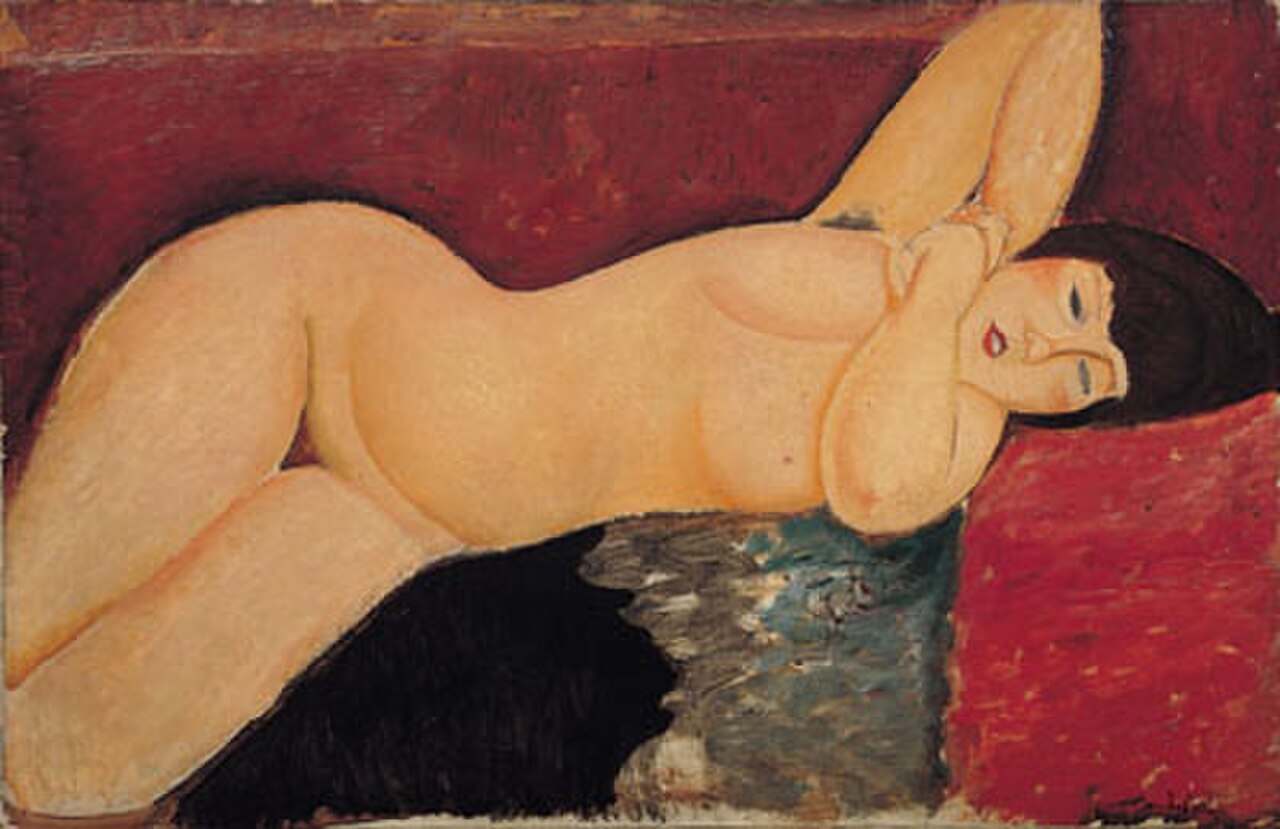
The Making of a Scandal
\n\n\n\nModigliani arrived in Paris in 1906, a handsome young man from Livorno, Italy, carrying the influence of Renaissance masters and the nervous energy of a poet. By 1917, he had absorbed everything the Parisian avant-garde had to offer \u2014 the raw power of African masks at the Mus\u00e9e d’Ethnographie du Trocad\u00e9ro, the chromatic audacity of Fauvism, the fractured planes of Cubism \u2014 and distilled them into something entirely his own.
\n\n\n\nHis nudes from this period are unmistakable. The women recline diagonally across the canvas, their bodies elongated into sinuous curves that seem to undulate beyond the boundaries of anatomy. Their faces are almond-shaped ovals with blank, slit eyes \u2014 inspired by the African and Cycladic sculpture Modigliani collected. Their limbs are impossibly long, their necks stretched, their hips broad and generous. And their pubic hair is painted frankly, without classical drapery or mythological alibi.
\n\n\n\nThat last detail mattered. In 1917, a nude woman in art was acceptable only if she had a fig leaf, a mythological name, or a virtuous storyline \u2014 Venus, Diana, Susanna, allegory. A naked woman described as a naked woman, painted on a modern canvas with visible pubic hair and an expression that acknowledged her own sexuality, crossed the line from art into obscenity.
\n\n\n\nThe Exhibition That Lasted Hours
\n\n\n\nBerthe Weill was one of the few gallerists in Paris willing to bet on unknown artists. She had championed Picasso, Matisse, and Derain when no one else would. When she agreed to give Modigliani his first solo show, it was a milestone \u2014 the moment a bohemian outsider stepped into the art world’s spotlight.
\n\n\n\nShe hung thirty-two works, including five nudes. The exhibition opened on a Monday. By Monday evening, the police had arrived. The complaint had come from neighbors \u2014 or perhaps a rival gallerist \u2014 who had seen the nudes through the gallery window. The police commissioner ordered Weill to remove five paintings from the window display. When she complied, he demanded the nudes be removed entirely. The show technically staggered on, but the damage was done. The raid generated notoriety but no sales. Modigliani’s only solo exhibition was effectively over.
\n\n\n\n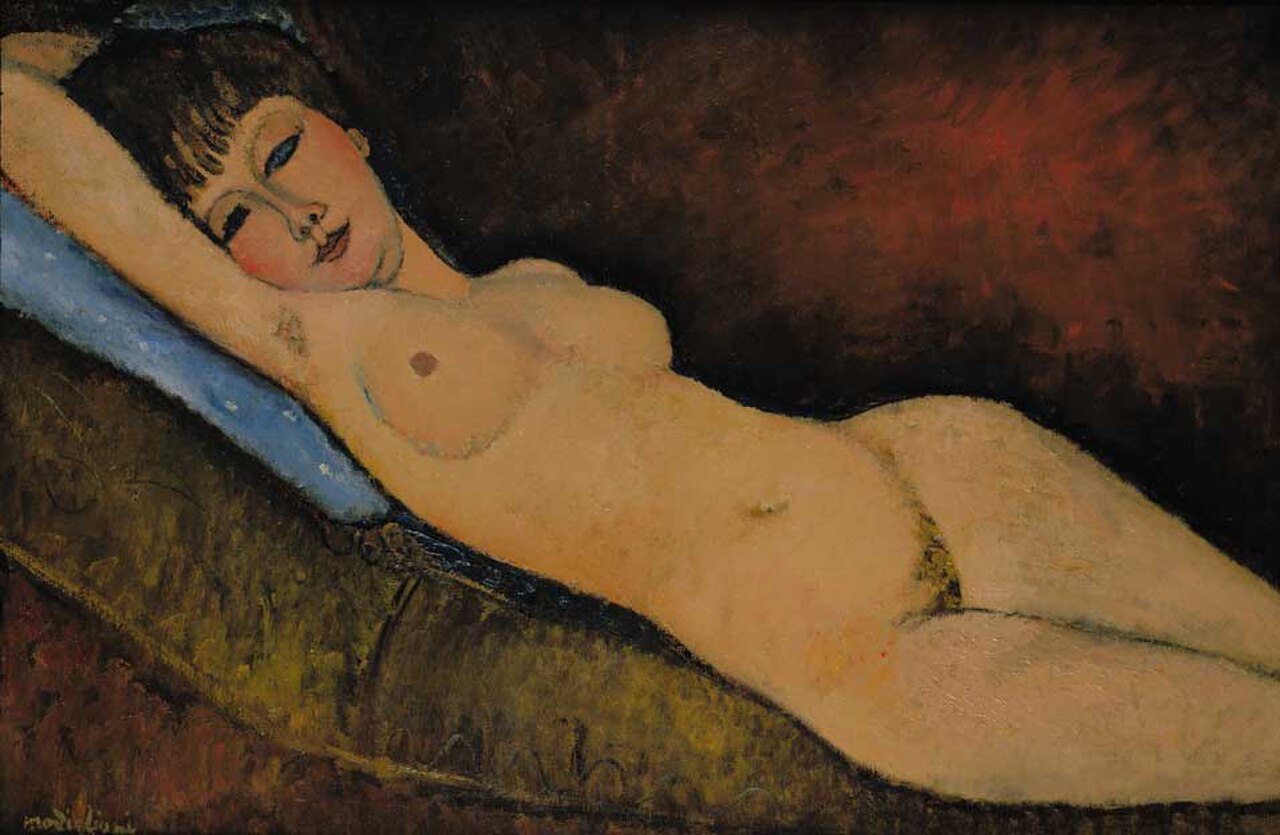
What Made the Nudes So Dangerous?
\n\n\n\nLook at a Modigliani nude \u2014 say, Nu couch\u00e9 au coussin Bleu (1916) \u2014 and the question answers itself. The woman lies on her back, arms folded behind her head, legs parted slightly at the knee. Her body fills the frame. She is not a goddess or a mythological figure. She is a woman, and she knows you are looking at her.
\n\n\n\nThis is the crux of the Modigliani scandal. The traditional Western nude \u2014 from Titian’s Venus of Urbino to Manet’s Olympia \u2014 had always maintained a certain distance: the mythological framing, the art-historical reference, the ironic gaze. Modigliani removed all the scaffolding. His nudes offered no allegorical alibi. They were simply bodies, painted with a frank sensuality that refused to apologize for itself.
\n\n\n\nThe elongated forms and blank eyes compound the effect. The faces do not engage the viewer in dialogue the way Manet’s Olympia does. They look past us, inward, absorbed in a private sensuality that we are permitted to witness but not to possess. This paradoxical combination \u2014 total exposure combined with emotional unreachability \u2014 created a tension that 1917 Paris was not prepared to handle.
\n\n\n\nThe Price of Being Ahead of One’s Time
\n\n\n\nModigliani died three years later, on January 24, 1920, at the age of 35 \u2014 victim of tubercular meningitis, exacerbated by a lifetime of poverty, alcohol, and hashish. His pregnant partner Jeanne H\u00e9buterne threw herself from a window the following day. He was buried in P\u00e8re Lachaise, largely unknown outside the Parisian avant-garde.
\n\n\n\nToday, a Modigliani nude is among the most expensive paintings in the world. In 2015, his Nu couch\u00e9 (1917-18) sold at Christie’s for 70.4 million \u2014 at the time, the second-highest price ever paid for a painting at auction. The same works that the police ordered removed from a gallery window now command prices that rival Picasso and Warhol.
\n\n\n\nThat 70.4 million canvas was one of the paintings from that 1917 exhibition \u2014 a fact that gives the story a particular sting. The works the authorities deemed unfit for public display were not destroyed or lost. They survived, traveled across the ocean, entered museum collections and private holdings, and eventually became the most valuable nudes of the 20th century.
\n\n\n\n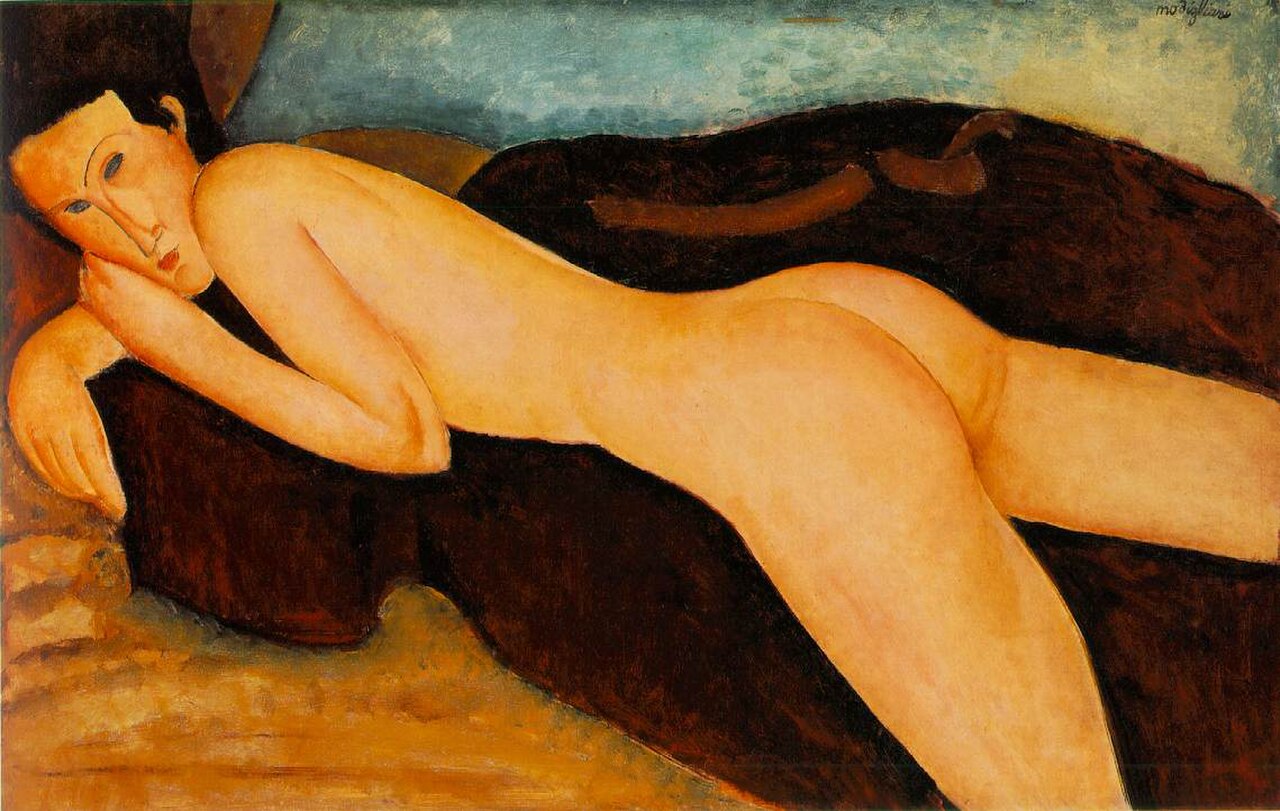
Legacy: What the Modigliani Nude Taught Modern Art
\n\n\n\nModigliani’s contribution to the nude in art is singular. He did not break with tradition in the aggressive way of the Cubists or the Dadaists. Instead, he softened it, stretched it, and pushed it toward a different register \u2014 one that fused the formal severity of African sculpture with the warm, tactile sensuality of the Italian Renaissance. His nudes are neither classical ideals nor anti-art provocations. They are simply present \u2014 bodies that occupy space with an authority that requires no mythological justification and offers no ironic escape.
\n\n\n\nThe police raid of 1917 now reads as the opening act of a larger cultural shift. The line between art and obscenity that the Parisian authorities tried to enforce that December was already dissolving. In the century since, Modigliani’s nudes have gone from scandal to canon \u2014 not because society became more permissive, but because the paintings themselves proved that the body, painted without allegory or apology, was always legitimate subject matter for art.
\n\n\n\nThe question the 1917 raid posed \u2014 what right does an artist have to show a naked body without a story to justify it? \u2014 remains unresolved. Social media platforms still remove Modigliani’s nudes when users post them. Museums still debate how to display them. The scandal was never really about art. It was about who gets to decide what we are allowed to see.
\n\n\n\nModigliani’s answer, painted in those elongated, almond-eyed, unapologetic bodies, was simple: the artist does. And the rest of us catch up eventually.
\n\n