Oskar Schlemmer, born in Stuttgart on September 4, 1888, spent his working life asking one question: what happens when the human body stops being flesh and becomes form? The answer he found still shapes how we look at the figure in modern art.
Schlemmer trained as a painter and absorbed the lessons of Cézanne and Seurat before joining the Bauhaus in 1920. At the school that rewrote design for the industrial age, he became Master of Form in the theatre workshop and the Bauhaus’s most stubborn champion of the human figure. While his colleagues pushed painting toward pure abstraction, Schlemmer kept returning to the body. He treated it as the one form that could never be exhausted.
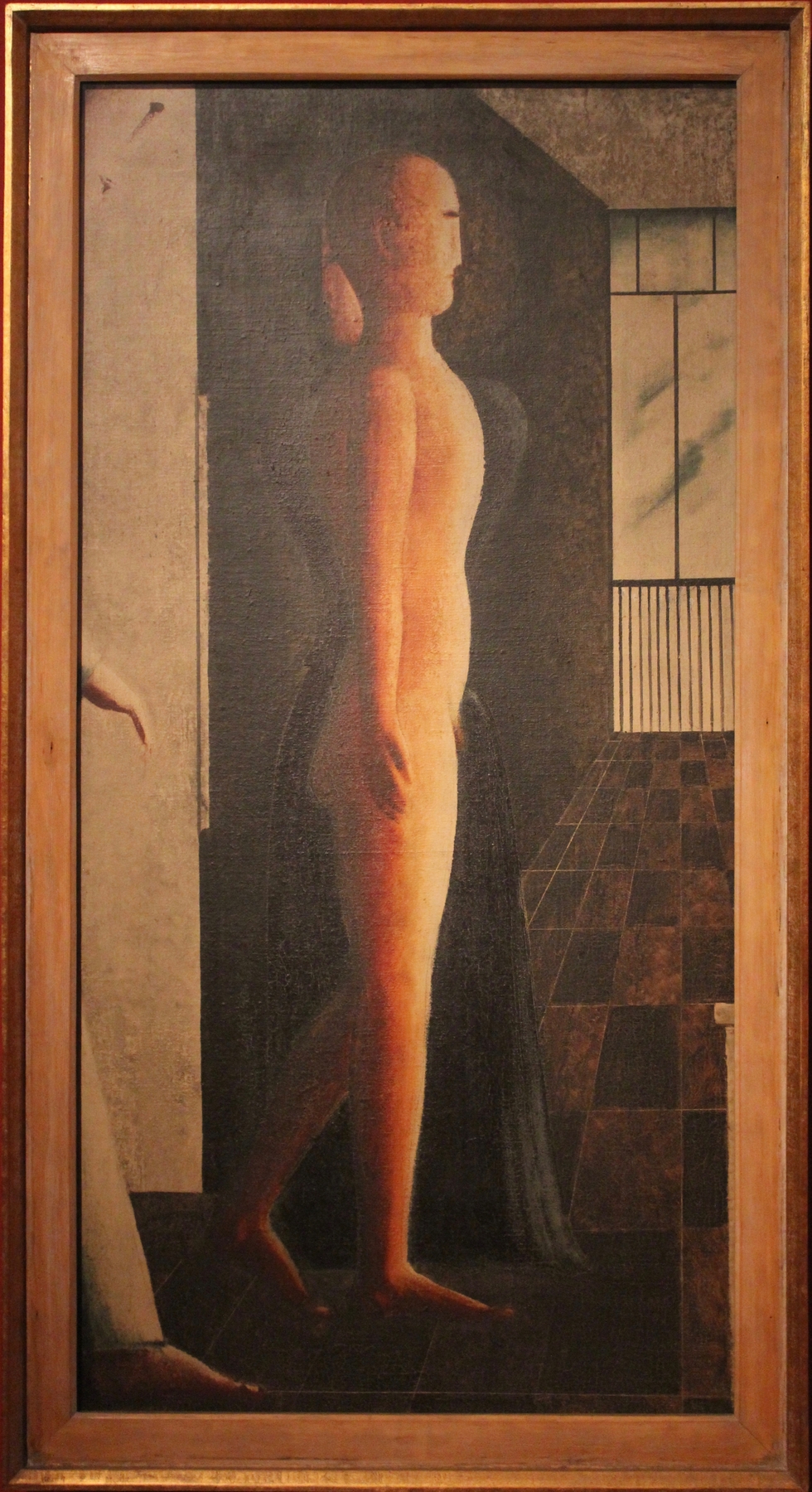
His nudes from the mid-1920s show that conviction on canvas. In Akt und Frau (Nude and Woman, 1925) and Nude, Woman, and Approaching Figure (1925), the body appears as a stack of geometric volumes. Limbs simplify into cylinders, the torso into a smoothed plane. Schlemmer did not abandon the nude; he rebuilt it. He replaced the idealized flesh of academic painting with a body constructed the way an architect raises a wall.
That instinct reached its strangest form in the Triadic Ballet, the 1922 performance piece that made his name. Dancers wore costumes that turned them into living geometry: spheres, cones, spirals, and discs. The body became puppet and monument at once. Schlemmer called the piece a party of form and colour, and it remains among the defining images of the Bauhaus.
Behind everything stood a philosophy Schlemmer borrowed from the ancient Greeks and made his own. Man, he believed, was the measure of all things. The body supplied the scale against which art, architecture, and design should be judged. In his Bauhaus notes he wrote that the stage was the place where this geometry could be lived rather than merely drawn.
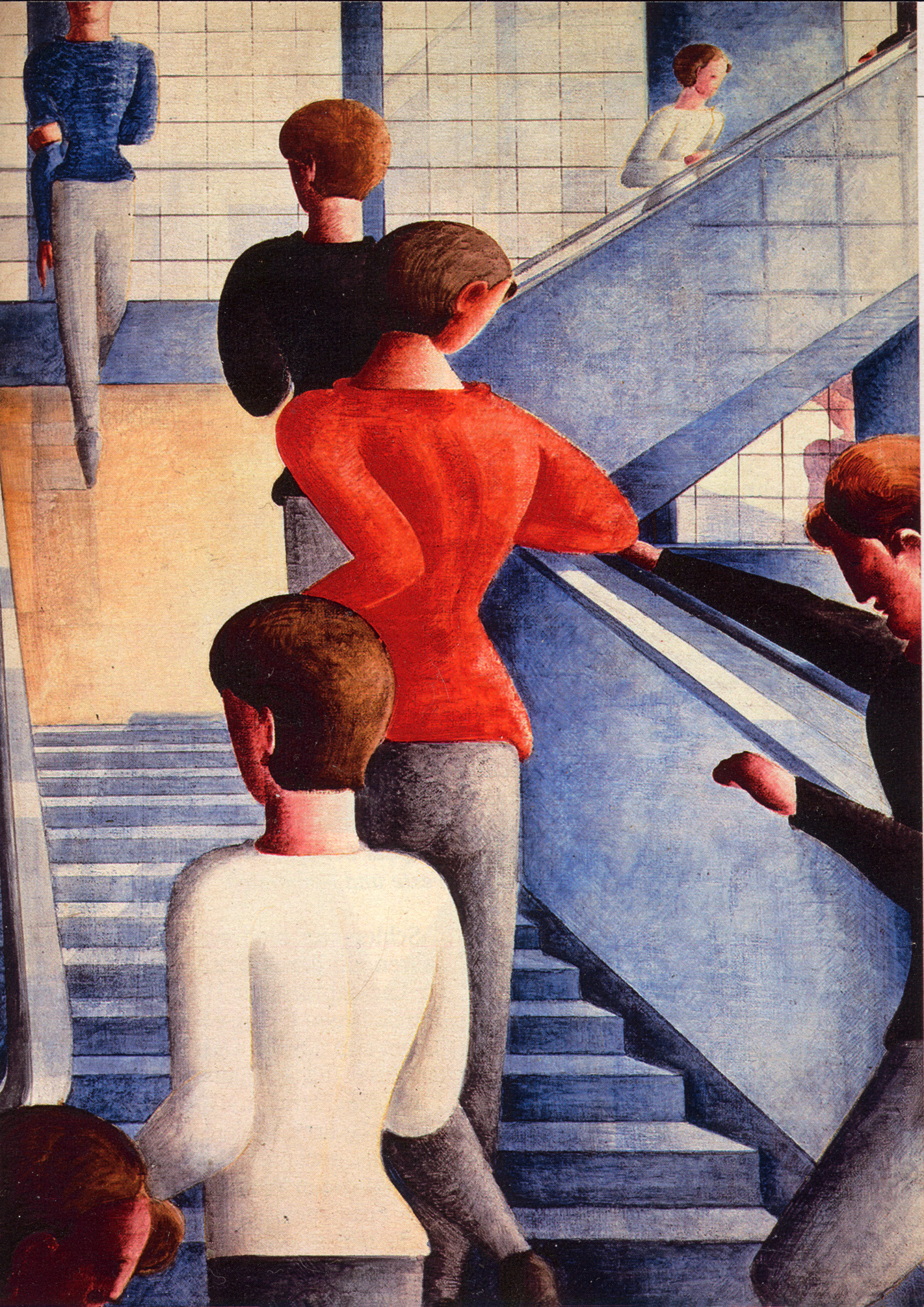
His 1932 painting Bauhaus Stairway (Bauhaustreppe) shows the idea at its most human. Figures climb the staircase of the Dessau building, reduced to rounded, nearly anonymous forms. The body stays the subject, but it has become the vocabulary of a new painting, one that keeps the figure even as it dissolves into space.
The Nazis put an end to it. In 1933 Schlemmer lost his teaching posts, and in 1937 his work appeared in the Degenerate Art exhibition in Munich, the regime’s attempt to humiliate modernism by hanging it as a crime. A painter who had spent his life insisting the body was the measure of all things watched his figures condemned as un-German. He died in Baden-Baden in 1943, pushed from public view.
His recovery after the war was slow but complete. The Triadic Ballet is restaged today, his figures hang in major museums, and his conviction that the nude could survive abstraction looks prophetic. Schlemmer proved that you can break the human body into geometry without ever losing the body.
Explore the long history of the human figure in art, from antiquity to the Bauhaus, and see how artists made the body their first language.