On May 8, 1903 — 123 years ago today — Paul Gauguin died alone in a remote hut on the Marquesas Islands, worn down by syphilis, poverty, and the weight of his own mythology. He was 54 years old. A French stockbroker who abandoned his family for the South Seas, a Post-Impressionist giant who reshaped modern art, a colonialist who exploited the people he painted — Gauguin was all of these things at once. And the nudes he produced during his Tahitian exile remain the most contested, debated, and essential body of work in the history of the nude in Western art.
The Parisian Who Fled to Paradise — and Invented One
Gauguin’s shift from Parisian stockbroker to revolutionary artist is one of modern art’s founding myths. By 1891, disillusioned with the materialism of European civilization, he sailed for Tahiti, then a French colony. He expected to find an untouched Eden. Instead, he found an island reshaped by colonialism — missionary schools, Christian dress, and a culture in ruins. So Gauguin did what all great mythmakers do: he invented his own Tahiti on canvas.
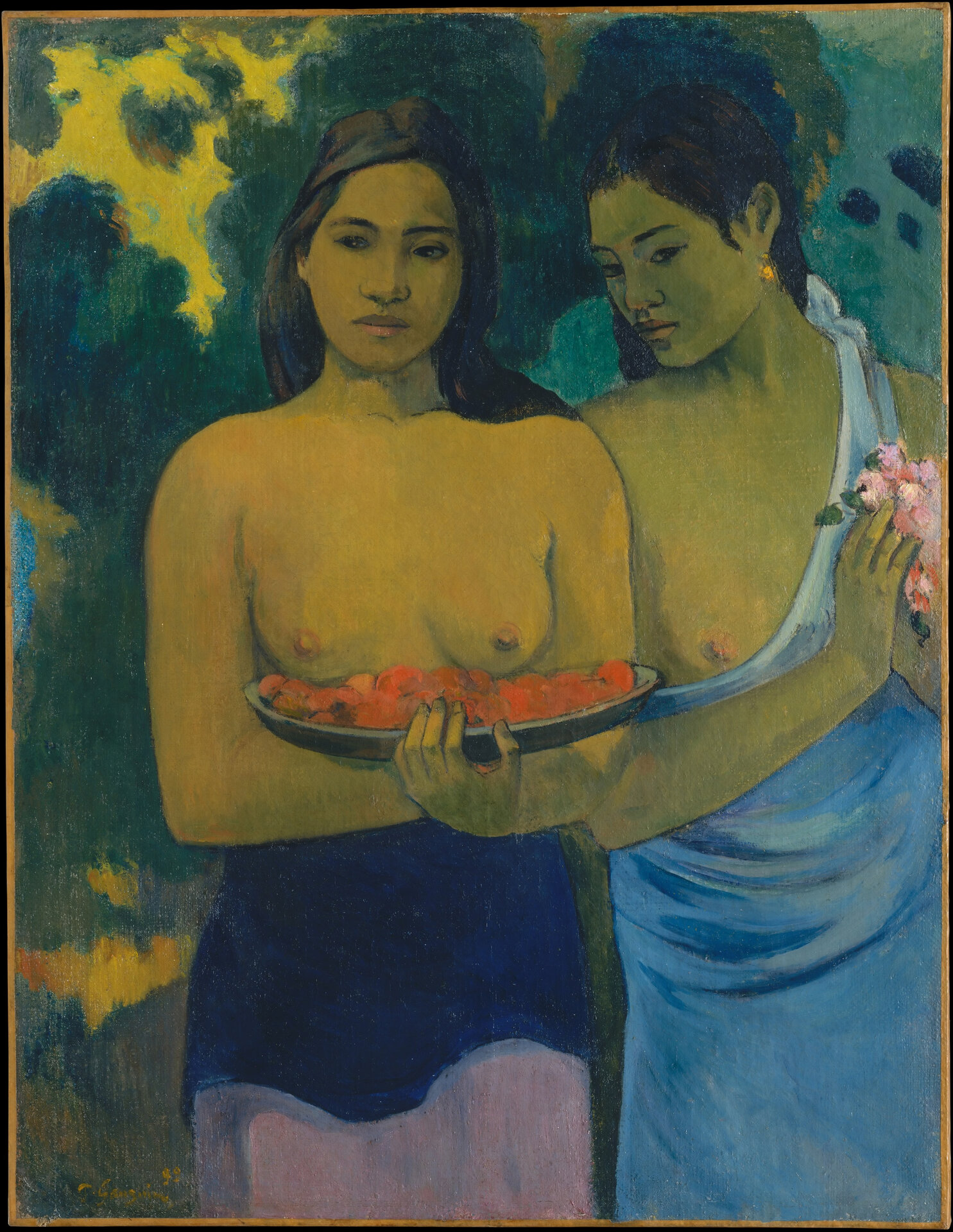
In paintings like Two Tahitian Women (1899), Gauguin created a vision of the South Pacific that never really existed. The women are topless, holding mango blossoms, their gazes unreadable. The colors are flattened, synthetic, tropical — greens and ochres that feel both real and hallucinatory. Gauguin wasn’t painting what he saw. He was painting what he wanted to believe: a world where the nude was not scandalous but natural, where the body moved without shame, where civilization’s hang-ups had no power.
The Nude as Transcendence — and Transaction
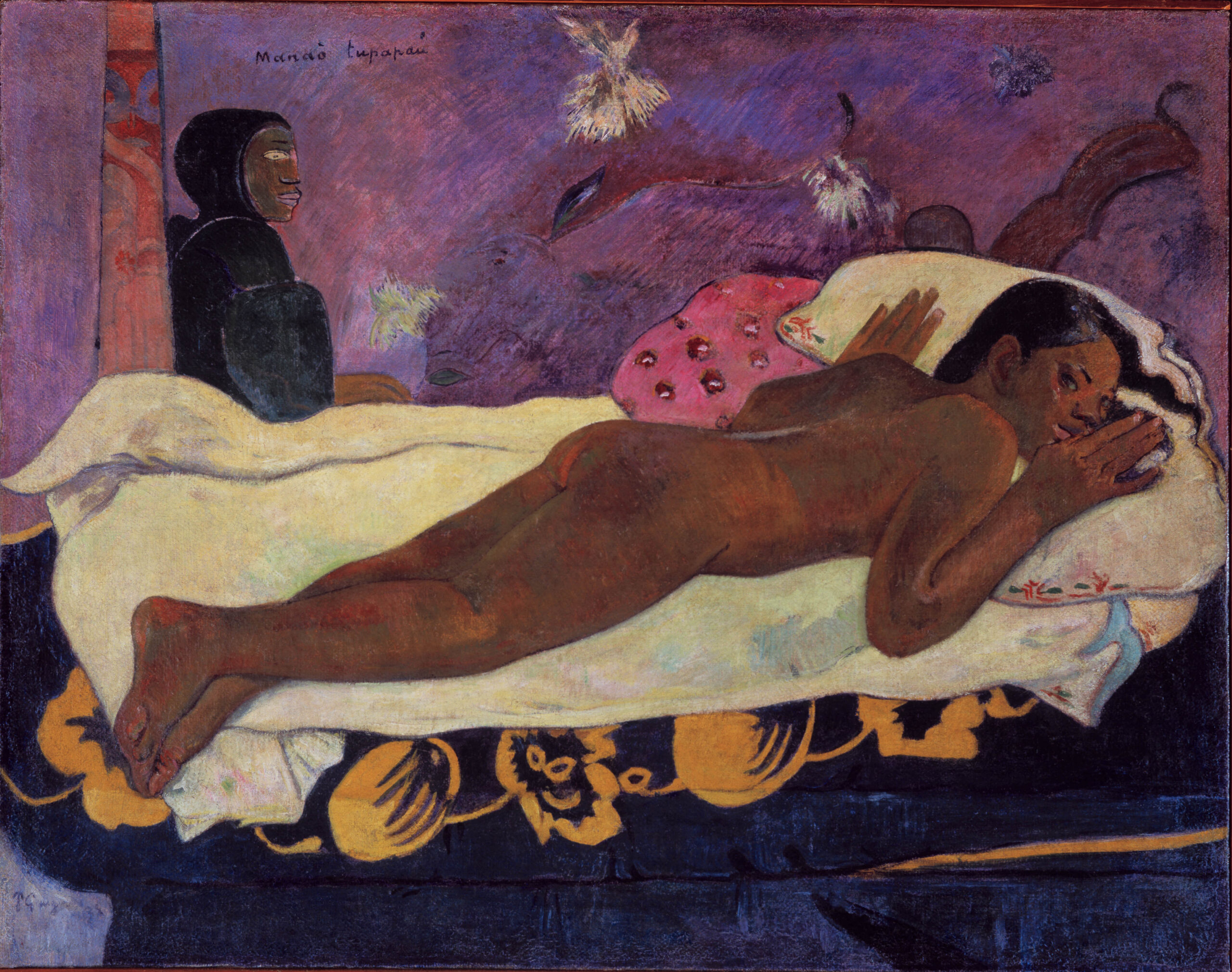
This is where Gauguin becomes impossible to separate from his controversies. His Tahitian nudes are simultaneously transcendent works of art and documents of exploitation. The model for Manao tupapau (1892) — often translated as The Spirit of the Dead Keeps Watch — was his 13-year-old “wife” Teha’amana, whom Gauguin entered into a relationship with shortly after arriving in Tahiti. The painting depicts her lying face down on a bed, naked, while a dark spirit figure lurks in the background. Gauguin described it as a portrait of fear — the girl’s terror of the dark, of ancestral spirits. But the terror in the painting belongs as much to the viewer who understands the power dynamics at play.
For decades, art historians treated these details as biographical curiosities — colorful footnotes to a great artist’s life. The MeToo era changed that calculus permanently. Museums now place wall texts next to Gauguin’s nudes that openly discuss his relationships with underage girls. The National Gallery in London controversially excluded his Tahitian nudes from a 2019 portrait exhibition, sparking a global debate about whether great art made by morally compromised artists can — or should — be displayed without full context.
What Gauguin’s Nudes Demand of Us
The question Gauguin forces us to confront is not whether we should cancel him — that’s a reductive framing that does a disservice to the complexity of art history. The real question is whether we can hold two truths at once:
- Gauguin’s Tahitian nudes are visually revolutionary. Their flattened planes, synthetic colors, and symbolic weight directly led to Fauvism, German Expressionism, and the entire trajectory of modernism. Without Gauguin, there is no Matisse. Without his radical simplification of form, there is no Picasso’s Les Demoiselles d’Avignon.
- Gauguin’s Tahitian nudes are the products of colonial violence. They were made possible by France’s imperial power structure, by the vast economic inequality between a European man and the indigenous community he entered, and by a predatory sexual relationship that would be legally actionable today.
Both of these statements are true. Neither one cancels the other. And that uncomfortable coexistence — between aesthetic achievement and ethical failure — is exactly what Gauguin’s nudes demand we reckon with.
Nevermore: The Late Nude as Elegy
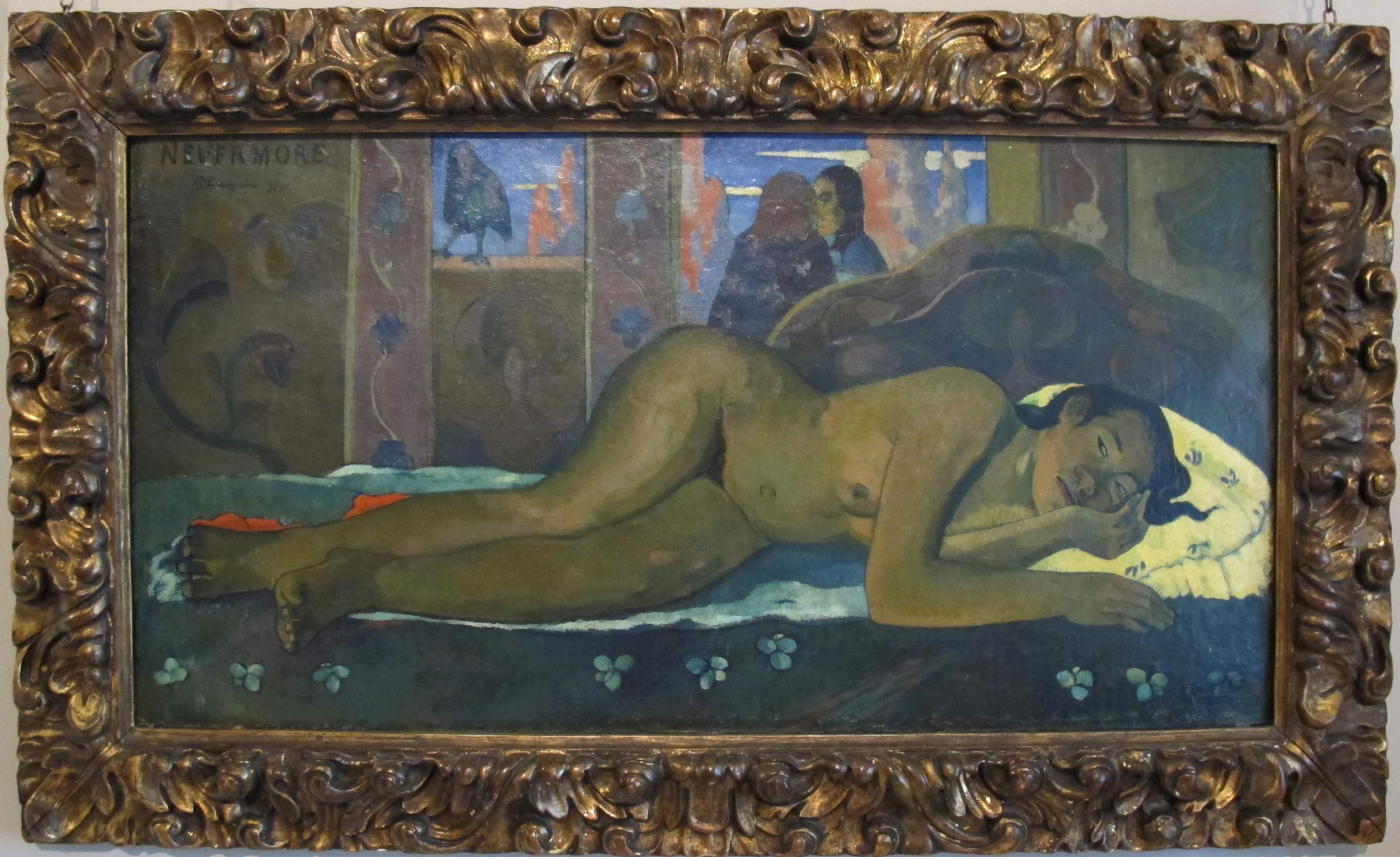
Gauguin’s final Tahitian period produced Nevermore (1897), a painting that seems to anticipate its own funeral. The model is Pahura, his 15-year-old partner, lying naked on a bed. A raven perches in the background — an unmistakable reference to Edgar Allan Poe’s poem about grief that will not end. The title is painted in the top left corner like an epitaph. Gauguin was deeply depressed when he painted it; his favorite daughter Aline had recently died of pneumonia, and his health was failing.
Nevermore is the most layered of Gauguin’s nudes because it operates on so many levels at once. It is a traditional European reclining nude in the lineage of Titian and Ingres, transplanted to the South Pacific. It is a portrait of a real teenage girl caught in circumstances she did not choose. It is a self-portrait of an artist confronting his own mortality, projecting his grief onto the body of another. And it is a document of a culture being erased — the “barbarian long-lost luxury” Gauguin said he was trying to evoke was already, by 1897, a memory.
The Nude After Gauguin
What Gauguin changed, irrevocably, was the idea that the nude could carry symbolic weight beyond the body. Before Gauguin, the nude in European painting was largely a vehicle for beauty, mythology, or allegory. After Gauguin, the nude became a field for psychological tension, cultural conflict, and personal confession. The flattened, expressive nudes of Egon Schiele, the anxious figures of Edvard Munch, the fragmented bodies of Picasso — all of them owe something to Gauguin’s Tahitian experiments.
But the most important legacy of Gauguin’s nudes may be the conversation they force us to have. In an era when museums are reckoning with colonial collections, when the power dynamics between artist and subject are under scrutiny, and when the nude in art is being reexamined from every angle, Gauguin’s work remains a pressure test for how we think about art and morality. If we can look at Nevermore and feel both its beauty and its ethical weight — without letting either cancel the other — we might actually be growing up as a culture.
The Body as Archive
Paul Gauguin died believing he had failed. His Tahitian paintings had sold poorly. He was dismissed by the French establishment. He spent his last months in the Marquesas fighting with colonial authorities over his support for the indigenous population. He died of a heart attack on May 8, 1903, with a bottle of morphine by his bed.
Today, his nudes hang in the world’s greatest museums — and they are as controversial as ever. That’s not a bug; it’s the point. The nude in art has always been a site of struggle: between beauty and politics, between the artist’s vision and the subject’s humanity, between what a culture wants to see and what it cannot look away from. Gauguin’s Tahitian nudes sit at the center of that struggle. They are not comfortable. They are not simple. But they are essential.
At Nude Art LA, we believe the nude in art deserves serious, honest conversation — not censorship, not hagiography, but thoughtful engagement with the full complexity of what it means to put the human body on canvas, in clay, or on stage. Gauguin’s work, for all its problems, is a crucial chapter in that ongoing conversation.
Want to be part of the conversation? Join NALA — whether as a model, artist, photographer, or audience member. The tradition of the nude in art is thousands of years old, and it’s still being written.