There are painters who observe the body, and then there is Peter Paul Rubens \u2014 who set it in motion. Born on this day, June 28, 1577, in Siegen, Westphalia, Rubens didn’t just paint nudes. He made the nude body the engine of Baroque storytelling: not decoration, not allegorical prop, but the very medium through which drama breathes, surges, and collides with itself on canvas.
\n\n
Four hundred forty-nine years later, his bodies are still alive in ways most painting never achieves. Every square inch of a Rubens canvas thrums with circulatory energy. Flesh folds. Skin flushes. A woman’s thigh presses into her own weight with the gravity of real physics. This wasn’t the idealized abstraction of Raphael or the marble chill of Ingres. Rubens painted bodies that existed in time \u2014 bodies that had lived.
\n\n
 \n
\n\n\n
The Body as Argument
\n\n
Rubens came of age at a peculiar moment. He spent eight years in Italy \u2014 1600 to 1608 \u2014 absorbing Titian’s color, Michelangelo’s musculature, and Caravaggio’s dramatic light. He copied everything. But where Caravaggio pulled you into shadow and moral reckoning, Rubens pushed outward into abundance. His nudes don’t whisper guilt. They announce themselves.
\n\n
Returning to Antwerp in 1608, he became the most sought-after painter in Europe. But here’s what’s remarkable: Rubens was also a diplomat who brokered peace between England and Spain. He was knighted by Charles I and Philip IV. He ran a workshop of dozens, produced thousands of works, and died wealthy in his own palace. This is the man who painted the most unapologetically carnal nudes in Western art \u2014 not as rebellion, but as celebration. There is no contradiction in Rubens between worldly success and sensual pleasure. His nudes are the logical expression of a worldview that found no shame in the material world.
\n\n
The Engine of Motion
\n\n
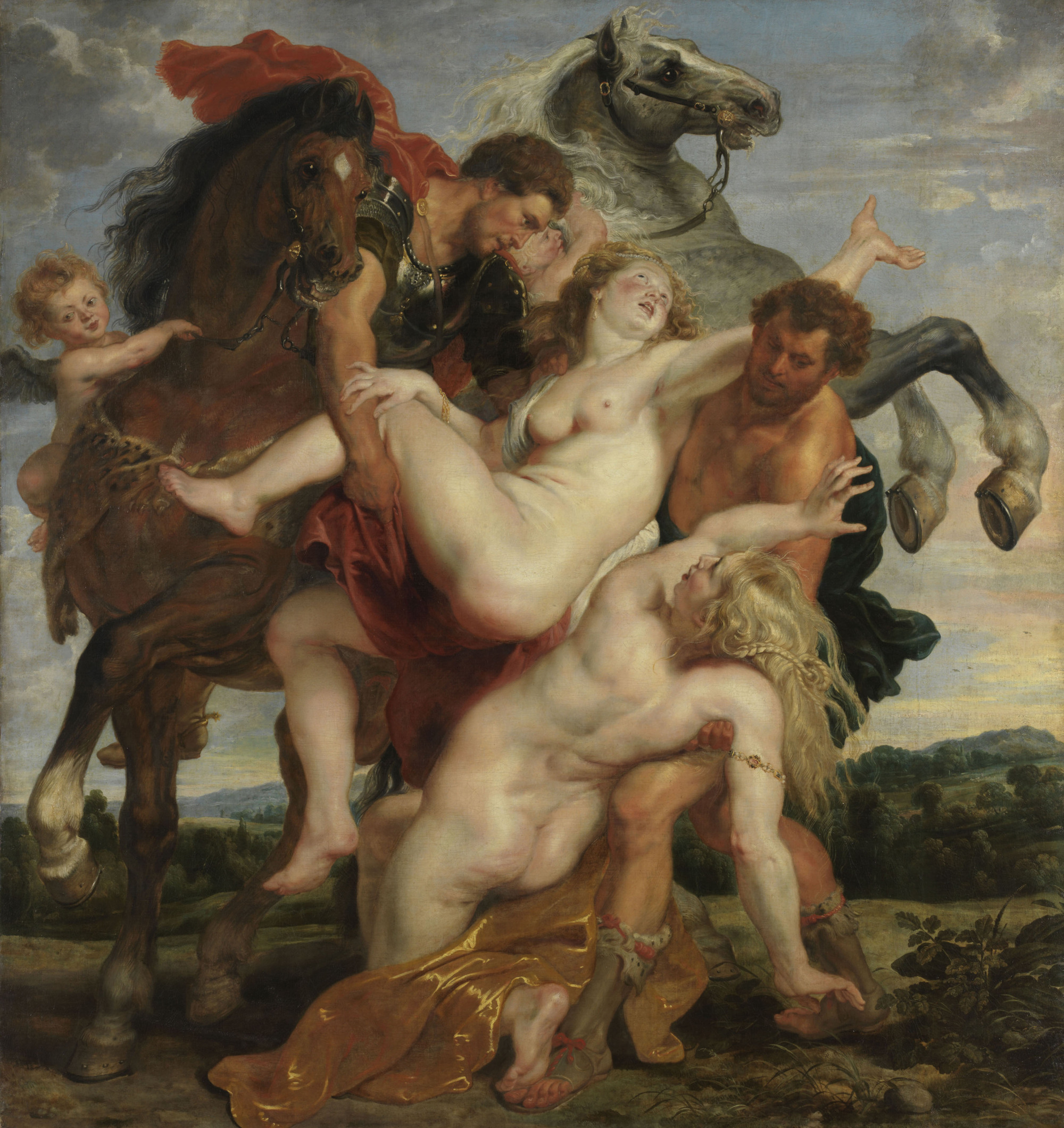
Look at The Rape of the Daughters of Leucippus (c. 1617\u201318). Castor and Pollux seize the brides of their rivals, and the entire composition becomes a spiral of limbs, straining torsos, and wind-whipped drapery. The nude here isn’t passive \u2014 it’s the carrier of action. The women’s bodies twist in three dimensions, their skin catching light from multiple sources. This is Baroque painting at its purest: the nude as kinetic sculpture, every muscle loaded with directional force.
\n\n
Rubens understood something that took modern animation centuries to rediscover: the human eye reads movement through the body’s weight shifts. A hip tilts; the opposite shoulder compensates. A head turns; the neck’s tension telegraphs through the spine. His nudes don’t pose. They move.
\n\n
 \n
\n\n\n
The Three Graces: A Private Language of Flesh
\n\n
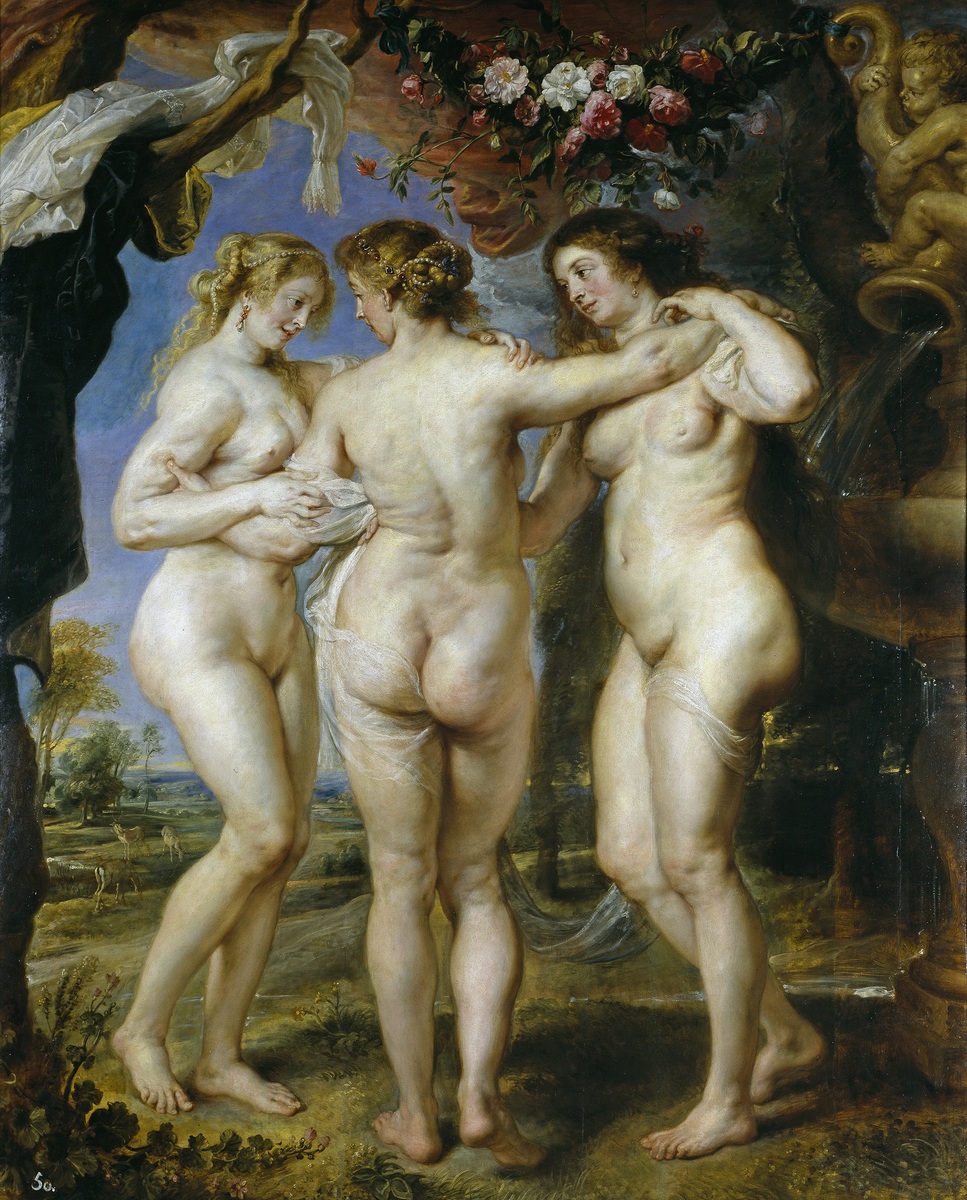
And then there is The Three Graces (c. 1630\u201335), painted when Rubens was in his late fifties, long after he’d conquered every court in Europe. He painted it for himself \u2014 it hung in his private collection until his death. Three nude women form a circle of touch and gaze: one hand rests on a shoulder, another on a hip, glances passing between them in an endless loop. There’s no myth here, exactly, beyond the classical name. There’s just bodies in relation.
\n\n
What’s radical about it \u2014 and what still unsettles viewers conditioned by airbrushed perfection \u2014 is the honesty of the flesh. The woman on the left has dimples at the base of her spine. The central figure’s stomach rounds softly. There is cellulite, visible weight, the topography of real bodies. Rubens wasn’t flattering anyone. He was looking, and what he saw was worth painting.
\n\n
The word “Rubenesque” entered the language as a polite euphemism for plumpness \u2014 but that’s a misreading. Rubens didn’t paint “plump women.” He painted the female body as it actually looks when it isn’t starved, corseted, or Photoshopped. His Graces hold space. They occupy their own volume with unapologetic presence. That’s not a body type. That’s a philosophy.
\n\n
 \n
\n\n\n
What We’re Still Learning From Him
\n\n
Rubens’ influence is so pervasive it’s almost invisible. Without him, there’s no Rococo \u2014 Watteau, Boucher, and Fragonard inherited his palette and his comfort with pleasure. Without him, Delacroix’s Romantic nudes lose their heat. Even modern painters who rejected everything Baroque \u2014 Picasso, de Kooning, Jenny Saville \u2014 are working in Rubens’ shadow. The body as force, not form: that’s his legacy.
\n\n
And yet we still judge his nudes by standards he never accepted. “Too heavy.” “Too much.” “Unrealistic” \u2014 which is funny, because what’s unrealistic is the notion that real female bodies look like the streamlined abstractions we’ve been trained to expect. Rubens painted women who had eaten, laughed, given birth, lived. The word “Rubenesque” should be a compliment. It meant, once, that a painter saw you clearly and decided you were worth immortalizing.
\n\n
Born 449 years ago today, Rubens left us something rarer than perfection: permission. Permission to paint the body as it is. Permission to find abundance beautiful. Permission to let flesh be flesh \u2014 heavy, breathing, alive \u2014 and treat it as the highest subject art can offer.
\n